The Norwegian Training Method for Runners: Science, Double Thresholds, and How to Scale It
Norway transformed world distance running using lactate-guided sub-threshold training and double-threshold days. Here is the science behind the Norwegian method and how to adapt it to your own training.
· 9 min read · Training
Norway has roughly 5.5 million people, yet Norwegian athletes have reshaped the record books in endurance sports.
From Jakob Ingebrigtsen dominating track distance events to Kristian Blummenfelt and Gustav Iden winning world titles in triathlon, the common thread is a distinct training methodology: the Norwegian Model.
At its core, the Norwegian method replaces the traditional mindset of "no pain, no gain" with precise physiological control. Instead of running hard interval sessions that leave you gasping on the track, the Norwegian approach focuses on accumulating massive amounts of work just below your lactate threshold.
Here is how the science works, why elite runners train this way, and how everyday runners can adapt the principles without needing a blood lactate meter or double-workout days.
What is the Norwegian Training Method?
The Norwegian training method is a system of endurance training centred around lactate-guided sub-threshold work and high overall aerobic volume.
!Female and male runners running on a misty Norwegian trail

Historically developed by Norwegian physician and sub-2:14 marathoner Dr. Marius Bakken in the late 1990s and 2000s, and later refined by coaches like Arild Tveiten and Olav Aleksander Bu, the method relies on one core concept:
> You gain more aerobic fitness by spending 45 minutes at a controlled, sub-threshold effort than by spending 15 minutes at a gut-busting, high-lactate effort.
In traditional training programs, runners often treat workouts as all-out tests. They push hard, accumulate high levels of muscle fatigue and blood lactate, and require 48 to 72 hours of recovery before their next hard session.
The Norwegian model flipped this approach. By keeping workouts strictly controlled at or below the second lactate threshold (LT2), athletes minimize muscular damage and central nervous system fatigue. This allows them to absorb a much higher frequency of quality workouts each week.
The Physiology: Understanding Lactate Thresholds
To understand why the Norwegian method works, you need to understand what happens in your blood as running intensity increases.
!Blood Lactate Curve and Training Thresholds for Runners Diagram
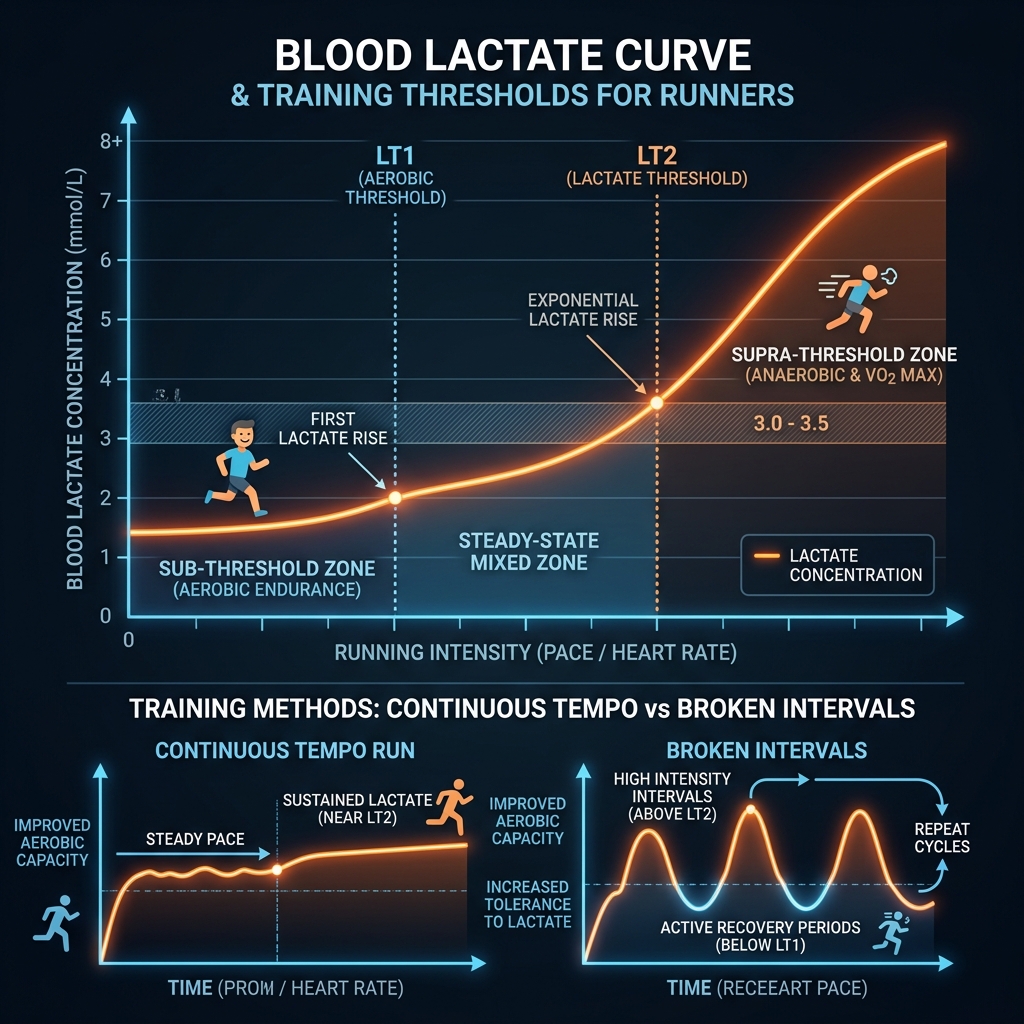
1. Aerobic Threshold (LT1) This is the intensity where blood lactate first begins to rise above baseline levels (typically around 1.5 to 2.0 mmol/L). At this pace, your aerobic system clears lactate as fast as it is produced. Easy recovery runs and steady endurance runs take place below LT1.
2. Lactate Threshold / Anaerobic Threshold (LT2) This is the upper ceiling of sustainable aerobic effort (typically between 2.5 and 3.5 mmol/L for trained runners, or ~4.0 mmol/L in traditional lab models). Above LT2, blood lactate accumulates exponentially, acidity increases in the working muscles, and exhaustion follows within 30 to 50 minutes.
Why "Sub-Threshold" Is the Secret The magic of the Norwegian model lies in training just below LT2 (around 2.5 to 3.2 mmol/L).
When you stay in this window, your body signals maximum mitochondrial biogenesis and capillary density development without triggering the severe autonomic stress or muscle fibre breakdown that comes with all-out speedwork.
| Training Approach | Typical Lactate | Volume at Target | Recovery Time | Injury & Burnout Risk | |---|---|---|---|---| | Traditional V02max Track Intervals | 6.0 – 12.0 mmol/L | 12 – 20 minutes | 48 – 72 hours | High | | Traditional Continuous Tempo | 3.5 – 4.5 mmol/L | 20 – 30 minutes | 36 – 48 hours | Moderate | | Norwegian Sub-Threshold Intervals | 2.0 – 3.2 mmol/L | 35 – 50 minutes | 24 hours | Low to Moderate |
Broken Intervals vs. Continuous Tempo Runs
One of the key technical innovations in the Norwegian method is replacing long, continuous tempo runs with broken threshold intervals separated by very short rests.
For example, instead of running a single 20-minute continuous tempo run at 4:00/km pace: - A Norwegian-style session might prescribe 5 x 6 minutes at 4:00/km pace with 60 seconds walking/jogging rest. - Or 10 x 1000m with 60 seconds rest.
Why short rests change the game During a 20-minute continuous run, blood lactate steadily climbs toward the end of the session, often crossing above LT2 into the "red zone."
By breaking the workout into 6-minute blocks with 60-second recovery breaks, your body flushes just enough lactate during the rest interval to reset the curve. This allows you to accumulate 30 to 45 minutes of total time at threshold in a single session with lower perceived exertion and far less cellular damage.
What is a "Double Threshold" Day?
If you follow elite track or triathlon news, you've likely heard of "Double T" days. This is the most famous element of the Norwegian system among professional athletes.
On a Double Threshold day, an elite athlete performs two separate sub-threshold workouts in a single day:
- Morning Session (LT1 Focus): Longer intervals at a lower lactate target (around 1.8 to 2.2 mmol/L). Example: 5 x 2000m or 4 x 10 minutes with 60s rest.
- Afternoon Session (LT2 Focus): Shorter intervals at a slightly higher lactate target (around 2.8 to 3.5 mmol/L). Example: 25 x 400m or 10 x 1000m with 45s rest.
Between the two sessions, the athlete eats, hydrates, rests, and often takes a 90-minute nap.
``` ELITE DOUBLE THRESHOLD DAY STRUCTURE
08:00 AM ── Workout 1: 5 x 2000m @ LT1 (2.0 mmol/L) 09:30 AM ── Post-workout meal & hydration 11:30 AM ── Rest & 90-minute sleep/nap 03:30 PM ── Workout 2: 25 x 400m @ LT2 (3.0 mmol/L) 05:00 PM ── Recovery meal & passive rest ```
Why double threshold works for pros By splitting the daily threshold load into morning and afternoon blocks, elites can accumulate up to 75 to 90 minutes of quality threshold work in a single day without ever crossing into anaerobic exhaustion.
Why Recreational Runners Should NOT Do Double Threshold Days
It is tempting to copy what Jakob Ingebrigtsen or Kristian Blummenfelt does on Strava. However, attempting double threshold days is one of the quickest ways for a recreational runner to get injured or burned out.
Elites can handle double threshold days because: 1. They log 140 to 180 km of total weekly volume. 2. They do not work 8-hour desk jobs or manage family schedules. 3. Their sleep, nutrition, and physical therapy are fully optimized. 4. Their musculoskeletal system has adapted to high volume over 10+ years.
If a runner doing 50 km a week tries to run two interval sessions in one day, the mechanical load on tendons, calf muscles, and shins will rapidly exceed recovery capacity, leading to issues like shin splints or tendonitis.
How to Scale the Norwegian Method for Everyday Runners
You don't need double-threshold days or a blood lactate meter to get 90% of the benefits of the Norwegian model. What matters is applying the underlying principles to a single-session schedule.
!Elite Norwegian Double Threshold vs Scaled Recreational Training Plan Infographic
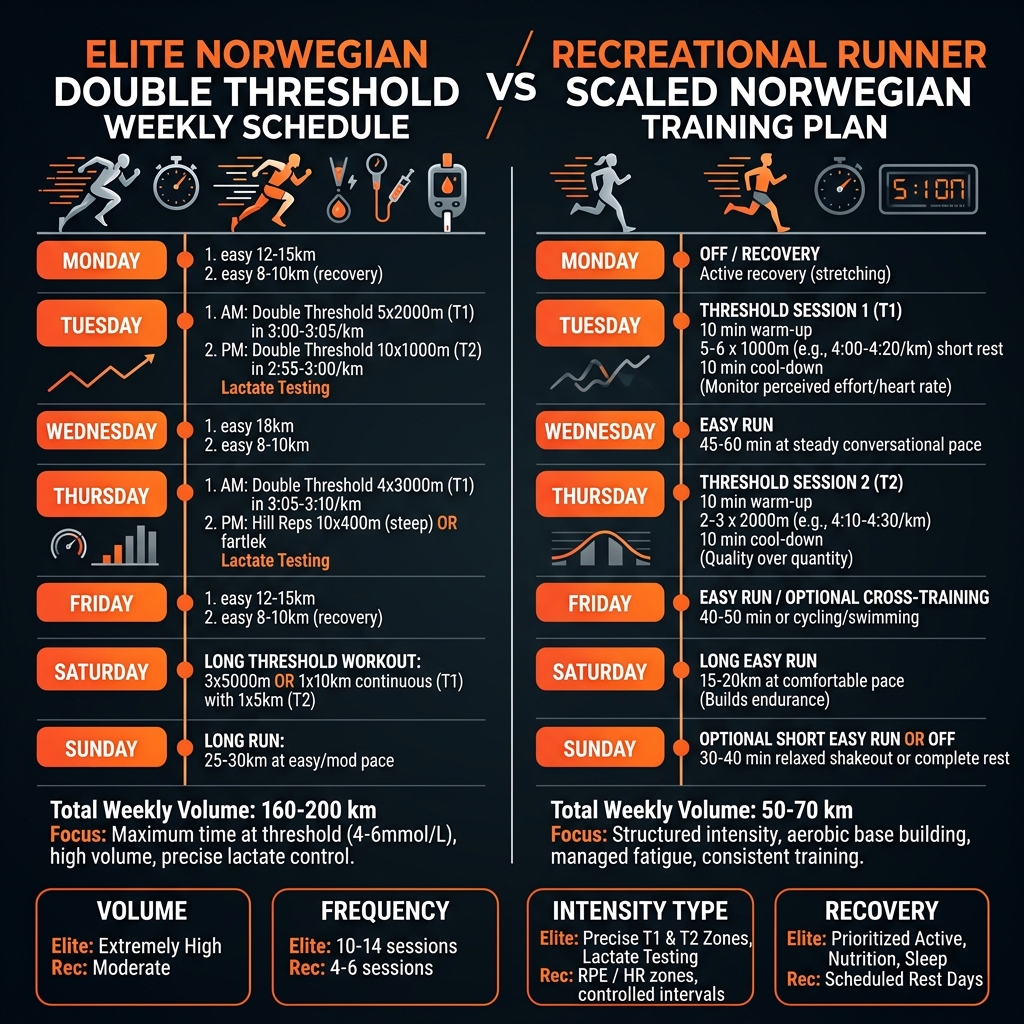
The 4 Principles of Scaled Norwegian Training
1. Increase Threshold Frequency: Instead of doing 1 brutal track workout a week, do 2 controlled sub-threshold interval sessions per week. 2. Use Short Rests: Keep recovery intervals short (30 to 60 seconds) so heart rate and respiration stay close to threshold. 3. Cap Your Effort (No Ego): Finish every workout feeling like you could easily do 2 or 3 more reps. Never sprint the final rep. 4. Keep 80% Truly Easy: Surround your threshold days with low-intensity Zone 2 running. If your easy runs are too fast, you won't recover for your threshold workouts. Check our guide on running every day benefits to learn more about balancing easy days.
Pacing Without a Lactate Meter: 3 Practical Proxies
Elite Norwegians take finger-prick blood samples during rest periods to measure lactate. As a recreational runner, you don't need a blood meter. You can use three simple proxies:
| Metric | Target for Norwegian Sub-Threshold | How to Gauge It | |---|---|---| | Heart Rate | 82% – 87% of Heart Rate Max (HRmax) | Use a chest strap monitor; stay 5–10 bpm below your 10K race HR | | Talk Test | Controlled, rhythmic breathing | You can speak short 3 to 5 word phrases, but not long paragraphs | | RPE (Perceived Exertion) | 6 to 7 out of 10 | Effort feels "comfortably hard" - steady and sustainable |
> Rule of Thumb: If you are gasping for air, clutching your knees, or muscle burn forces you to stop, you have passed threshold. Slow down by 10 to 15 seconds per kilometre.
3 Sample Norwegian-Style Workouts for Recreational Runners
Try substituting these sessions into your weekly schedule in place of traditional track workouts. Always precede workouts with a proper 8-minute dynamic warm-up and follow up with a gentle cool-down walk and stretch.
1. The 6-Minute Block (5K to Half Marathon Runners) - Warm-up: 10 minutes easy jog + dynamic mobility - Main Set: 5 x 6 minutes at 10K to 15K effort (RPE 6/10) with 60 seconds jog/walk rest - Cool-down: 5 to 10 minutes easy walk - *Total Threshold Volume:* 30 minutes
2. The Cruise K's (10K & Marathon Runners) - Warm-up: 10 minutes easy jog + dynamic mobility - Main Set: 6 to 8 x 1000m at Half Marathon to 15K pace with 60 seconds easy jog rest - Cool-down: 5 to 10 minutes easy walk - *Total Threshold Volume:* 6 to 8 km
3. The 400m Turnover Session (Speed & Economy Focus) - Warm-up: 10 minutes easy jog + dynamic mobility - Main Set: 12 to 16 x 400m at 10K effort (NOT 5K pace) with 30 seconds easy walk rest - Cool-down: 5 to 10 minutes easy walk - *Note:* Because the rest is only 30 seconds, lactate remains stable while leg turnover stays sharp.
Sample Weekly Schedule (50–60 km/week Runner)
Here is how a balanced, scaled Norwegian-inspired weekly plan looks for a runner aiming for a 10K or Half Marathon PB:
| Day | Session Type | Description | |---|---|---| | Monday | Rest Day or Active Recovery | Full rest or light 30-min cross-training (cycling/swimming) | | Tuesday | Sub-Threshold Workout 1 | 10 min warm-up + 5 x 6 min @ sub-threshold (60s rest) + 10 min cool-down | | Wednesday | Easy Zone 2 Run | 45–60 mins at conversational talk-test pace | | Thursday | Sub-Threshold Workout 2 | 10 min warm-up + 12 x 400m @ controlled 10K pace (30s rest) + 10 min cool-down | | Friday | Easy Zone 2 Run | 40 mins easy jog or rest day | | Saturday | Long Easy Run | 75–90 mins at comfortable Zone 2 pace (builds aerobic foundation) | | Sunday | Rest / Recovery Walk | Gentle walking or light stretching |
Key Takeaways
1. Sub-threshold over max effort: You don't need to suffer through extreme lactic acid burn to get faster. Spending more time at a controlled, sustainable threshold builds superior aerobic power. 2. Ditch double threshold days: Leave two-a-day interval sessions to the professionals. Recreational runners gain maximum benefit by doing 2 scaled threshold sessions per week on separate days. 3. Control your ego: The biggest mistake runners make with the Norwegian method is running reps too fast. If a rep feels like an 8 or 9 out of 10 effort, you are missing the point. 4. Consistency is king: Because sub-threshold workouts produce less fatigue, you recover faster, stay healthier, and build uninterrupted training streaks week after week.
Looking to build a science-backed training plan tailored to your fitness level, race goals, and weekly schedule? Check out our AI Run Planner or explore upcoming events on our Races Directory.