Cross-Training for Runners: What Actually Works (and What's a Waste of Time)
Not all cross-training is equally useful for runners. Here's how to pick the right activity, when to use it, and how to integrate it without it interfering with your running.
· 8 min read · Training
Most runners only start cross-training when they're injured and can't run. By then, it's reactive - damage control rather than a training tool.
The runners who actually benefit from cross-training are the ones who build it into their week proactively: as an injury buffer, as aerobic top-up on easy days, and as a way to train muscle groups that running ignores. Done this way, cross-training doesn't compete with running. It makes running more sustainable.
This guide covers which options actually transfer to running performance, how to schedule them, and what to avoid.
!Runner cross-training on a stationary bike in a gym

Why runners need cross-training at all
Running is remarkably limited in what it trains. It loads the lower body in one primary plane of movement, builds almost no upper body or core strength, and places significant repetitive stress on the same joints and tendons, session after session.
The result: running improves running fitness extremely efficiently, but it also creates specific muscle imbalances and accumulates injury risk over time. The muscles running doesn't train - hip abductors, upper body, core stabilisers - are often exactly the ones that fail and cause injuries.
Cross-training addresses this by:
- Building fitness and cardiovascular stimulus without running-specific impact
- Strengthening muscle groups that running neglects
- Allowing recovery sessions that maintain blood flow and aerobic stimulus without adding impact stress
- Providing a running-substitute during injury that preserves fitness
Ranked: the best cross-training options for runners
| Activity | Impact Level | Aerobic Transfer to Running | Key Muscle Target | Best Use Case | |----------|--------------|-----------------------------|-------------------|---------------| | Pool Running | Zero | Extremely High (90-95%) | Running-specific muscles | Injury recovery, high-volume substitution | | Cycling | Zero | High (80-85%) | Quads, glutes | Aerobic base, easy-day recovery | | Elliptical | Low | High (75-80%) | Full lower body | Low-impact stride simulation | | Swimming | Zero | Moderate (60-70%) | Upper body, core, lungs | Active recovery, upper body balance | | Rowing | Low | Moderate (60-65%) | Posterior chain, back | Full-body conditioning |
1. Cycling (road or stationary) - High value
Cycling builds the aerobic engine in a way that transfers well to running. The cardiovascular demand is similar, the leg muscles (especially quads and glutes) are heavily loaded, and there's essentially no impact. For maintaining aerobic fitness when reducing running due to injury or heavy legs, cycling is the closest substitute.
A 60-minute moderate cycling session is roughly equivalent in aerobic stimulus to a 45-minute easy run. You can replace an easy recovery run with easy cycling at a similar effort level and lose very little training stimulus.
The limitations: cycling builds quadriceps dominance more than running, which can actually increase some knee injury risks if overdone. It also doesn't load the calves, tibialis anterior, or the stabilising muscles of the ankle - all important for running. Cycling supplements running well but shouldn't fully replace it for any extended period.
For injured runners: stationary bike is ideal - low skill requirement, fully adjustable intensity, available in most gyms.
2. Pool running / deep water running - Very high value (underused)
Pool running is the most sport-specific cross-training for runners. You use a flotation belt in deep water and mimic the running motion without any ground contact. Heart rate, oxygen consumption, and movement pattern all closely match running.
!Deep Water Pool Running Technique Diagram
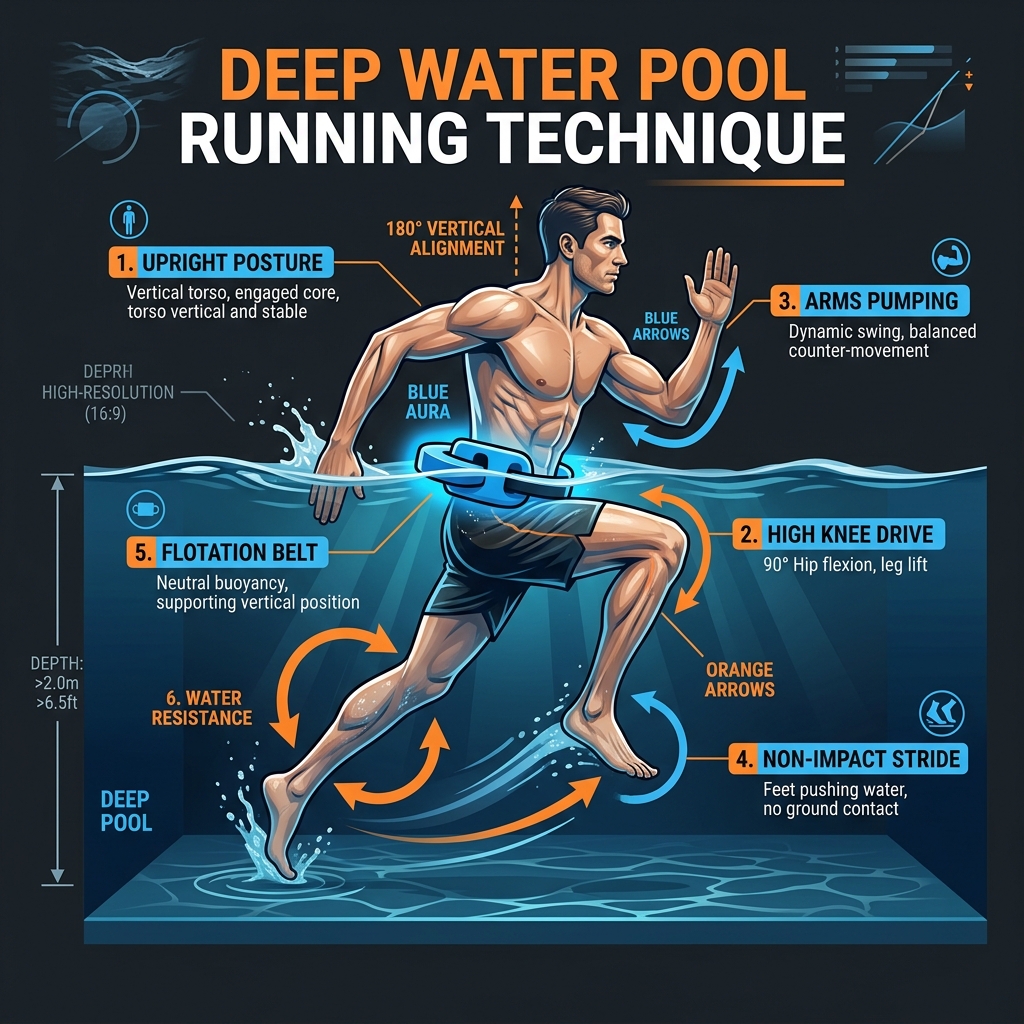
Research shows that runners can maintain aerobic fitness remarkably well on pool running alone - some studies show only modest fitness loss after 4-6 weeks of pool running replacing road running entirely. This makes it the best option for maintaining fitness during a running injury.
The downsides are real: it's tedious, requires pool access, and has a higher skill floor than cycling. But if you're facing a 6-week injury break and have pool access, deep water running is worth learning.
3. Swimming - Moderate value
Swimming provides excellent cardiovascular stimulus and is fully non-impact. It also builds upper body and core strength that running lacks, and the forced breathing patterns in swimming can improve respiratory control.
The limitation for runners: swimming is predominantly upper-body driven, and the leg kick uses different muscles (hip flexors, inner thighs) than running. The aerobic transfer is positive but lower than cycling or pool running. Swimming is better framed as a complementary cross-training tool than a running substitute.
Best use: recovery sessions, injury periods, or as a second workout on easy days for runners building aerobic volume.
4. Elliptical - Moderate value
The elliptical closely mimics the running motion without the impact, which makes it more sport-specific than swimming or rowing. Research suggests that elliptical training maintains aerobic fitness reasonably well for runners.
The main downside: it's indoor, gym-dependent, and doesn't load the bones (unlike running). The bone loading stimulus from running - which maintains bone density and reduces stress fracture risk - is largely absent on the elliptical. For runners using it as a long-term injury substitute, this is worth factoring in.
5. Rowing - Low-moderate value
Rowing provides strong cardiovascular and full-body strength training, but the movement pattern is almost entirely unlike running. There's limited sport specificity. That said, for overall fitness maintenance and building upper back and posterior chain strength (which many runners lack), rowing is a useful addition.
6. Strength training - High value, different category
Strength training is not traditional "cross-training" but deserves mention here because it's the highest-leverage non-running activity for runners. Two sessions per week of compound lower body lifting - squats, deadlifts, single-leg work - improves running economy by 2-8% and significantly reduces injury risk.
The strength training for runners guide covers the minimum effective dose and exact exercises. This is not optional cross-training - it's a core pillar of sustainable running.
When to cross-train
During normal training weeks
One to two cross-training sessions per week on easy days or the day after long/hard runs. The role here is aerobic maintenance and active recovery. Keep intensity genuinely easy - this is not the time for all-out cycling sprints. A light spin or easy swim keeps blood flowing and muscles loose without adding training stress.
Avoid scheduling intense cross-training immediately before hard running sessions. If your Tuesday is tempo intervals, Monday and Wednesday should be easy - running or otherwise.
When injured
The intensity and volume of cross-training should broadly match what you'd be doing if you were running. An injured runner who would normally be doing 50km per week of running should aim for a cross-training equivalent effort, not complete rest, unless the injury specifically requires it.
Pool running or cycling can replace individual runs on a roughly one-to-one substitution basis at similar effort levels. Cross-train your way through the injury, then gradually reintroduce running using a return-to-run protocol.
During high-volume training blocks
When weekly mileage is high - for marathon or half-marathon training - cross-training can provide aerobic stimulus on days when an extra run would be too much load. Adding a 30-minute easy cycle on a recovery day is less stressful than adding a sixth run.
The scheduling principle: cross-training should enable running, not compete with it
The governing rule is simple: if your cross-training session leaves you too fatigued for your next planned run, you're doing it wrong. Cross-training supports your running. The moment it compromises your key sessions, something is misaligned.
Specifically: - Don't do a high-intensity cross-training session 24 hours before a hard running session - On true recovery days, keep cross-training genuinely easy - If you're replacing a run with cross-training during injury, match the equivalent effort and duration
Sample cross-training week for a recreational runner
For a runner doing 4 runs per week and wanting to add cross-training:
| Day | Activity | Notes | |-----|----------|-------| | Monday | Easy run (40 min) | | | Tuesday | Strength training (45 min) | Lower body compound lifts | | Wednesday | Tempo or intervals run | Key session | | Thursday | Easy cycling or swimming (30-40 min) | Active recovery | | Friday | Rest or gentle yoga | | | Saturday | Long run | | | Sunday | Rest or pool running (if high mileage week) | |
FAQ
How much cross-training is too much?
There's no fixed limit, but the practical ceiling is when it interferes with your running quality or recovery. For most recreational runners, 1-2 sessions per week is plenty.
Can cycling replace running for fitness maintenance?
For aerobic fitness: broadly yes, with some caveats about sport specificity. Cycling is genuinely effective for maintaining VO2max and aerobic capacity during a running injury. Running-specific adaptations (bone loading, calf and tibialis strength, proprioception) will decline and need rebuilding when you return.
Is cross-training good for beginners?
Yes. Beginners who supplement running with 1-2 non-impact cardio sessions per week often progress faster than those who run only, because they maintain aerobic fitness without the risk of running overuse injuries from too-frequent impact.
Should I cross-train on rest days?
Depends on the intensity. Gentle yoga, easy swimming, or a slow walk: yes. High-intensity cycling or HIIT: probably not - true rest days serve an important recovery function that active sessions replace only partially.
Find your next race while you're building your cross-training base. Browse running events and races on Your Run Guide, and build a personalised training plan that integrates both running and the cross-training that supports it.