Cool Down After Running: The 10-Minute Routine Most Runners Skip
Stopping abruptly after a hard run is not neutral - it's actively unhelpful. Here's the simple post-run routine that speeds up recovery and reduces your injury risk.
· 7 min read · Training
Stopping dead at the end of a hard run and going straight to the car is something most runners have done. It's also one of the easiest improvements you can make.
The cool-down is the part of training that gets squeezed first when time is short. And it's understandable - after a tough session, you feel done. But what happens physiologically in the 10 minutes after your final footstrike has a meaningful effect on how you feel the next day, how quickly you recover, and over time, how much flexibility you maintain.
This guide covers why it matters, what to actually do, and which stretches make the biggest difference for runners.
!Runner performing post-run stretches on a forest trail, reaching for foot in sitting position

What happens when you stop running abruptly
During a run, your heart is pumping blood at a significantly elevated rate and your working muscles are demanding constant oxygen delivery. Your blood vessels in your legs dilate to accommodate the high blood flow.
When you stop suddenly, your heart rate drops quickly, but those dilated blood vessels in your legs don't instantly constrict. Blood pools in the lower body. The result, in some runners, is lightheadedness, dizziness, or a sudden drop in blood pressure - occasionally severe enough to cause a near-faint.
Even in runners who don't feel this, abrupt stopping means metabolic waste products (lactate, CO2, hydrogen ions) from working muscles are cleared more slowly than if you gradually reduce activity. The gradual transition helps flush these out.
The cool-down is essentially a controlled descent from effort to rest. Walk or jog slowly for 3-5 minutes before stopping. This alone handles the cardiovascular transition.
The case for post-run stretching
Here's where it gets more nuanced. The research on stretching for preventing DOMS (delayed onset muscle soreness) is genuinely mixed. A 2011 Cochrane review found that stretching before or after exercise doesn't significantly reduce post-exercise soreness. So if your goal is purely to avoid sore legs the next morning, stretching may not be the primary tool.
But the case for post-run stretching rests on different ground: flexibility maintenance over time.
Runners who never stretch tend to progressively lose range of motion in their hips, hamstrings, and hip flexors. This isn't immediately catastrophic, but tighter hip flexors alter pelvic alignment, tighter hamstrings change stride mechanics, and reduced hip mobility puts compensatory stress on the lower back and IT band.
Stretching after running - when muscles are warm and most receptive to lengthening - is the most effective time to maintain or improve range of motion. Not because warm muscles are dramatically more pliable (the research on this is also mixed), but because you're more comfortable, less likely to force a cold stretch into pain, and the habit is more likely to stick when it follows a run rather than preceding it.
The 10-minute post-run cool-down routine
Part 1: Easy walking (3-4 minutes)
Immediately after finishing your run, don't stop - walk. Maintain arm swing and upright posture. Let your breathing naturally slow. Drop your pace from running to brisk walk to gentle walk over 3-4 minutes. This is the cardiovascular transition phase. It's not glamorous but it matters.
If you've been doing intervals or a hard tempo, you might do a very slow jog for 5 minutes first, then transition to walking. The principle is gradual reduction, not abrupt halt.
Part 2: Static stretches (6 minutes)
Perform each of these for 30-45 seconds per side. Don't bounce. Breathe through each stretch.
!4 Key Post-Run Static Stretches Diagram
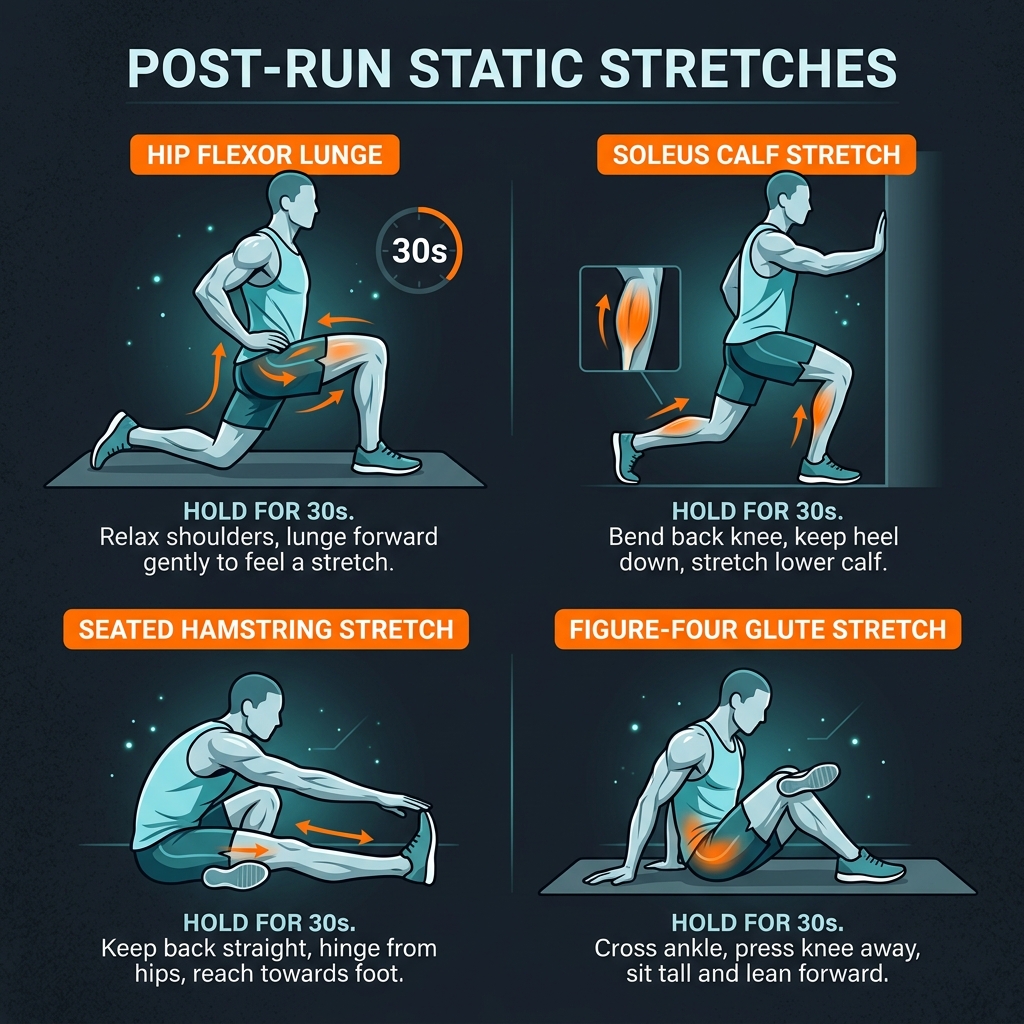
| Stretch | Priority Level | Target Area | Key Benefit for Runners | |---------|----------------|-------------|-------------------------| | Hip Flexor Lunge | High (Priority 1) | Psoas & Iliacus | Relieves pelvic tilt & lower back tightness | | Soleus & Calf Stretch | High (Priority 2) | Gastrocnemius & Soleus | Protects Achilles & prevents plantar fasciitis | | Seated Hamstring Stretch | Medium (Priority 3) | Hamstrings | Maintains stride length & hip hinge mechanics | | Figure-Four Glute Stretch | Medium (Priority 4) | Gluteus & Outer Hip | Relieves IT band tension & hip stiffness | | Standing Quad Stretch | Regular | Rectus Femoris | Reduces anterior knee compression |
Standing quad stretch Stand tall (use a wall or post for balance if needed). Bend one knee and bring your heel toward your glutes, holding your foot or ankle. Push your hips slightly forward. You should feel the stretch along the front of your thigh and hip flexor. If you're very tight here, this stretch is particularly important - tight hip flexors anteriorly tilt the pelvis and compress the lower back. 30-45 seconds each side.
Seated hamstring stretch Sit on the ground with one leg extended, the other foot tucked against your inner thigh (like a hurdle stretch). Reach forward toward your extended foot, keeping your spine as straight as possible. The goal is hip hinge, not back rounding. You should feel it in the belly of your hamstring. 30-45 seconds each side.
Standing calf stretch (gastrocnemius) Step one foot back into a lunge stance. Keep your back heel flat on the ground and push your back knee straight. Press into the ground through the heel. Feel the stretch in the upper calf. 30-45 seconds each side.
Soleus stretch Same position as the calf stretch but slightly bend your back knee. This shifts the stretch from the gastrocnemius to the deeper soleus muscle, which is important for runners and often neglected. Soleus tightness contributes to Achilles issues. 30 seconds each side.
Figure-four glute stretch Lie on your back, knees bent, feet flat. Cross your right ankle over your left thigh (just above the knee). Flex your right foot. Either hold here or pull your left thigh toward your chest - whichever produces a stretch in the right glute and outer hip. 30-45 seconds each side.
Hip flexor lunge stretch Step into a lunge. Lower your back knee to the ground. Drive your hips forward until you feel a stretch along the front of your back hip and thigh. Keep your torso upright - slouching loses the stretch. 30-45 seconds each side.
Which stretches matter most?
If you have to cut the routine short, prioritise in this order:
1. Hip flexors - Most runners are tight here from desk work plus running. Tight hip flexors directly affect stride mechanics and lower back stress. 2. Calves and soleus - The primary workhorse muscles of running. Tightness here contributes to Achilles issues, plantar fasciitis, and reduced ankle mobility. 3. Hamstrings - Important for posterior chain function and reducing lower back load. 4. Glutes - Often tight in runners, contributing to IT band issues and knee mechanics.
The quad stretch matters less for most runners than they expect - quads rarely become problematically tight from running alone - but it pairs well with the hip flexor stretch.
When to skip the cool-down
The short answer: almost never. Even on genuinely easy runs of 20-25 minutes, 5 minutes of walking and 3-4 key stretches takes less than 10 minutes total and maintains the habit.
The one legitimate exception: if you're running a race all-out to the finish line, your cool-down in the immediate aftermath is walking, hydrating, and getting warm before stretching. Don't go directly from a 5K sprint finish to a cold stretch on the ground in the wind. Walk for 5 minutes, get a drink and some warmth, then stretch.
How the cool-down pairs with your warm-up
The warm-up and cool-down are the bookends of every well-structured run. The warm-up guide covers dynamic drills before you run - the opposite of the static stretches here. Dynamic before, static after. Getting both right takes roughly 15-20 minutes total and is the single most impactful routine change for injury prevention that most recreational runners are missing.
FAQ
Does the cool-down prevent injury?
Directly, the evidence is weaker than you might expect - stretching after running doesn't show a strong preventive effect against acute injuries. But the flexibility maintenance over months and years, combined with the cardiovascular transition benefit, supports injury-free running over the long term.
How long should a cool-down be?
For easy runs: 5 minutes of walking + 4-5 key stretches = 10 minutes total. For hard sessions or long runs: 5-10 minutes of easy jog/walk + full stretch routine = up to 15 minutes.
Should I foam roll as part of my cool-down?
Foam rolling after a run is a reasonable addition if you have time and find it helpful. The evidence for foam rolling reducing soreness is modest, but it can help release muscle tension and improve local blood flow. Do it after static stretching, not instead of it.
Can I do yoga instead of stretching?
Yes - a gentle, recovery-focused yoga session after a run is an excellent cool-down substitute. Look for "post-run yoga" or "yin yoga" sequences that target hamstrings, hip flexors, and calves.
Pair a consistent cool-down with a smart training structure. Build a personalised running plan that structures your easy days, hard days, and recovery properly - and browse upcoming races to give your training a goal to work toward.