How to Warm Up Before Running: The 8-Minute Routine That Prevents Injuries
Static stretching before a run is counterproductive. Here's the science-backed dynamic warm-up routine that actually prepares your body to run - and takes less than 10 minutes.
· 8 min read · Training
Almost every runner warms up wrong.
The classic approach - stand by your front door, grab your ankle, hold for 30 seconds, repeat on the other side, run - is the wrong order. Holding static stretches before running has been shown in multiple studies to temporarily reduce muscle power output and actually increase injury risk, not decrease it. You're stretching cold tissue and reducing the spring in your muscles right before you need it.
The research consensus is clear: dynamic movement before, static stretching after. Your pre-run warm-up should gradually raise core temperature, mobilise joints through their range of motion, and activate the muscles you're about to load heavily.
Here's the routine that does that in 8 minutes.
!Runner performing warm-up exercises on a track at golden hour

Why bother at all?
A lot of runners - especially time-pressured ones - skip the warm-up and go straight into running. This works fine until it doesn't, and then it costs weeks. The case for warming up comes down to three things:
Temperature. Muscle tissue performs better and is more pliable when warm. At rest, your muscles are roughly at your body's resting temperature. The first few minutes of running are inefficient because your cardiovascular system is still ramping up oxygen delivery. A proper warm-up compresses this lag, so you feel better earlier in the run.
Joint lubrication. Synovial fluid in your joints - hips, knees, ankles - is thick when cold and thin when warm. Movement gets synovial fluid circulating, which is what gives joints that loose, well-oiled feeling mid-run rather than the first-kilometre creakiness most people tolerate.
Neuromuscular activation. Your nervous system needs to switch on specific movement patterns before you load them heavily. A cold glute that hasn't fired properly is a glute that can't absorb load - and that work gets transferred elsewhere, often to the knee or lower back. Dynamic drills specifically prime the muscles you're about to use.
Psychological preparation. A warm-up is also a transition ritual. It helps your brain shift from work or home mode into running mode, which improves focus and perceived effort during the session.
The 8-minute warm-up: exactly what to do
You don't need a track or equipment. This works on a footpath, in a park, or in your living room.
!Dynamic Warm-Up Exercises for Runners Diagram
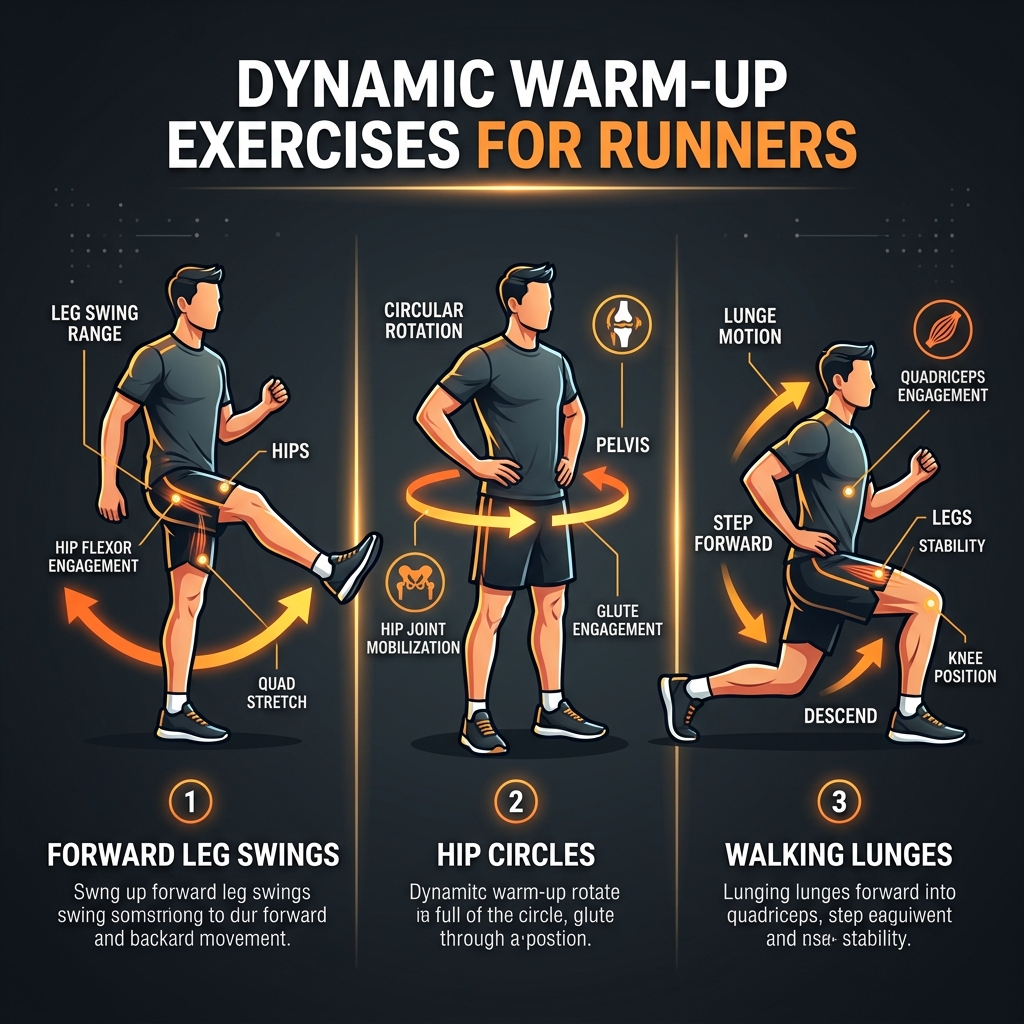
| Phase | Time | Primary Focus | Key Movements | |-------|------|---------------|---------------| | Phase 1: Easy Movement | 2 mins | Blood flow & heart rate ramp | Brisk walk / light jog, high-knee marching | | Phase 2: Joint Mobility | 3 mins | Lubricate hips, knees, ankles | Forward/lateral leg swings, hip circles, ankle rotations | | Phase 3: Dynamic Activation | 3 mins | Muscle recruitment & dynamic length | Walking lunges, lateral shuffles, toy soldiers (A-skips optional) |
Phase 1: Easy movement (2 minutes)
Start with 90 seconds of brisk walking or very light jogging - slower than your easy run pace. You're just getting blood flowing. Follow with 30 seconds of marching with high knees, lifting each knee to hip height and pumping your arms. This is not a workout. Keep it relaxed.
Phase 2: Joint mobility drills (3 minutes)
Leg swings (forward/backward) - 10 reps each leg. Find a wall or post for balance. Swing one leg forward and backward through its full range, keeping your upper body tall and relatively still. This mobilises the hip flexors and hamstrings simultaneously. Then swing the same leg side to side across your body for 10 reps. Repeat on the other side.
Hip circles - 10 reps each direction. Stand feet hip-width apart. Draw large circles with your hips, like a slow hula hoop. 10 clockwise, 10 counterclockwise. This wakes up the hip joint and the surrounding stabilisers.
Ankle rotations - 10 reps each ankle. Lift one foot slightly off the ground and rotate your ankle in a full circle, both directions. It takes 20 seconds per ankle and significantly reduces ankle stiffness at the start of a run.
Phase 3: Dynamic activation drills (3 minutes)
Walking lunges - 10 reps each leg. Step forward into a lunge, lower your back knee toward the ground (don't let it smash down), drive back up through your front heel and step forward again. Focus on feeling the glute of the front leg doing the work. Optional: add a torso rotation toward the front leg to include some thoracic mobility.
Lateral shuffles - 20 metres each direction. Get into a slight athletic squat, step to the right, bring the left foot in without crossing, repeat for 10-15 lateral steps. Then go back left. You're waking up the hip abductors - the muscles that stabilise your pelvis in single-leg running stance.
Straight-leg kicks (toy soldiers) - 10 reps each leg. Walk forward and kick each leg straight out in front, reaching the opposite hand to meet it. Keep the kicking leg straight and your back tall. This dynamically lengthens the hamstrings without holding a passive stretch.
A-skips (optional for speedwork days) - 20 metres. A-skips are a track drill that activates the hip flexors and glutes simultaneously. Drive one knee up, land on the ball of your opposite foot with a slight hop, alternate. They feel awkward at first and are worth adding if you're doing a quality session.
Short version for easy runs
If you're doing a gentle 30-minute jog and genuinely don't have 8 minutes, the minimum viable warm-up is:
1. Walk briskly for 3-5 minutes 2. Leg swings, 10 each direction, each leg (90 seconds) 3. Start running at 60% of your intended pace and gradually build over the first kilometre
That's still meaningfully better than walking out of the house and immediately running at full pace.
What to do for different types of runs
| Run type | Recommended warm-up | |----------|---------------------| | Easy recovery run | 3-5 min walk + basic leg swings | | Tempo/threshold run | Full 8-minute routine | | Interval session / track work | Full routine + A-skips + 2-3 short strides | | Long run | 5-minute routine + gradual first 2km | | Race | 10-15 minutes: jog, drills, 2-4 strides at race pace |
The higher the intensity of what you're about to do, the more thorough the warm-up needs to be. This is the opposite of how most people approach it (they warm up more on easy days because they have time, and rush straight into hard sessions because they're keen).
Common warm-up mistakes
Doing static stretches. Holding a stretch for 30+ seconds before running reduces muscle force production for up to 30 minutes. Save the deep hamstring and hip flexor stretches for after your run, when the muscle is warm and you're trying to recover and build flexibility.
Rushing through the drills. The point of leg swings is controlled, deliberate movement through a full range. If you're just flicking your leg forward and back while checking your phone, you're getting maybe 20% of the benefit.
Warming up too far in advance. A warm-up should be done 10-20 minutes before you run. If you warm up, get distracted for 45 minutes, and then run, most of the physiological benefit is gone.
Identical warm-up for every session. A 2-hour marathon long run needs a different preparation than a 20-minute easy recovery jog. Match the warm-up complexity to the session complexity.
Pairing warm-up and cool-down
A well-structured run has three phases: warm-up, the run itself, and cool-down after running. The cool-down is where static stretching earns its place - your muscles are warm, pliable, and ready to be lengthened safely. Skipping either bookend is where runners run into trouble.
If you're working on injury prevention - particularly shin splints or knee pain - check the shin splints prevention guide and strength training for runners after mastering your warm-up routine.
FAQ
Do I need to warm up for a short run?
Even for a 20-minute easy jog, a 3-5 minute brisk walk at the start is worthwhile. The first kilometre of running is always harder physiologically - a short warm-up makes it easier.
Can I warm up on a treadmill?
Yes. Walk at 5-6 km/h for 3-4 minutes, then do your drills beside the treadmill (leg swings, lunges) before getting back on at easy running pace.
My calves are always tight at the start of runs. What helps?
Ankle circles and walking calf raises as part of your warm-up help. Longer-term, calf raise strength work and consistent cool-down stretching reduces morning-of tightness. If calf tightness is accompanied by shin pain, read the shin splints guide.
Build consistency into your training with a personalised running plan that includes structured easy days and hard days - so you always know exactly what kind of warm-up you need before you step out the door.