How to Prevent Shin Splints: A Runner's Guide to Protecting Your Shins
Shin splints are the most common running injury for good reason - most runners are doing the exact things that cause them. Here's how to protect your shins before they break down.
· 9 min read · Injury Prevention
Shin splints do not happen randomly. They happen because of specific, predictable mistakes - and most of them are preventable.
The medical name is medial tibial stress syndrome (MTSS). It shows up as a dull, aching pain along the inner edge of your shinbone, usually worse at the start of a run and sometimes easing as the tissue warms up, then returning after you stop. It's not a dramatic injury. It's a gradual accumulation of load that your bone and surrounding tissue cannot absorb fast enough to repair.
Understanding that mechanism is key: shin splints are essentially an overuse failure, not a random misfortune. Which means they're largely preventable if you train intelligently.
This guide covers prevention first, because that's where most runners need help. If you're already injured, also read the return-to-running after shin splints guide we've covered separately.
!Runner's lower legs and shins during a night run on wet roads

A medical note first
"Shin splints" is an umbrella term. Not all shin pain is MTSS. If your pain is: - Pinpoint in one small spot rather than diffuse along the inner shin - Present at rest, at night, or during normal walking - Accompanied by swelling or a visible lump - Getting worse rather than better with reduced training
...see a physiotherapist or sports medicine doctor before continuing. These signs can indicate a stress fracture, which is a different injury with different management. Do not run through suspected stress fracture pain.
Why shin splints happen
Your tibial bone and the muscle-tendon attachments around it need time to adapt to the mechanical load of running. Each footstrike sends force through your lower leg - your shins absorb this impact thousands of times per hour.
When training load increases faster than the tissue can remodel, the bone surface becomes inflamed and the muscles pulling on it get irritated. This is MTSS.
The three biggest risk factors:
1. Doing too much too soon. This is the dominant cause. Whether it's a beginner jumping from no running to 5 days a week, or an experienced runner dramatically increasing mileage after a break, the common factor is a spike in load that the body wasn't ready for.
2. Running form problems. Specifically, heavy heel striking with a long, overstriding gait sends higher-than-necessary impact forces up the lower leg. The research linking overstriding to shin splints risk is reasonably consistent. See the overstriding guide for how to address this.
3. Poor lower leg and hip strength. The tibialis anterior (the muscle that runs alongside your shinbone) and calf complex absorb impact during running. When they're weak relative to the load being placed on them, the bone itself takes more stress. Weak hip stabilisers compound this by allowing excessive inward knee drop and foot pronation.
Running surface and shoe choice also matter, but they're secondary to load management and form.
The 10% rule and why most runners ignore it
The traditional guidance is to increase your weekly running volume by no more than 10% per week. A lot of experienced runners dismiss this as overly conservative. They're not entirely wrong - trained athletes with good form and strong musculature can tolerate higher progression rates.
But for runners in their first year, or returning from any meaningful break, the 10% rule is often the right call. The bone remodelling that allows your shins to handle progressively higher load takes 6-8 weeks to show up. Your cardiovascular system adapts in 2-3 weeks. This gap - where your lungs feel fine but your bones aren't ready - is where shin splints live.
A more nuanced approach: track your mileage in 3-week blocks. Two weeks of modest increase, one week of reduced volume (a "down week" at 70% of peak). This gives the bone remodelling process time to keep pace with your fitness gains.
Prevention: what to actually do
1. Load management (non-negotiable)
Build your weekly mileage slowly. If you're a beginner, start with 3-4 days of running per week and don't increase total time or distance by more than 10-15% week over week. If you're returning after a break, treat the first 4 weeks as an introductory block regardless of your previous fitness level.
Use a structured plan rather than running by feel. When training feels easy, that's often when runners over-extend and set up injuries 3-4 weeks later. A personalised training plan accounts for your current fitness and progression rate.
2. Strengthen the right muscles
The following exercises target the specific muscles that protect your shins. Do them 2-3 times per week, ideally as part of a post-run routine.
!Tibialis Anterior Strengthening and Shin Splint Prevention Diagram
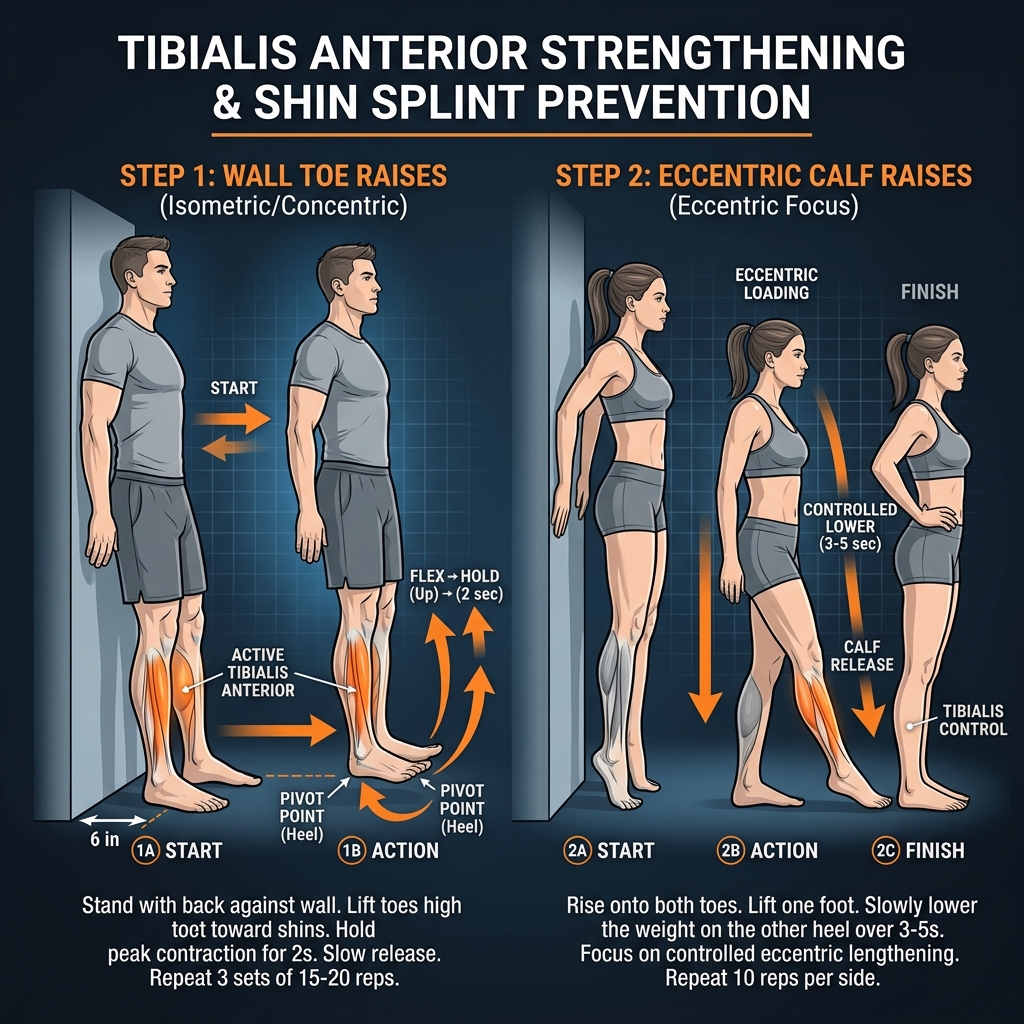
| Exercise | Target Structure | Volume & Frequency | Key Form Cue | |----------|------------------|--------------------|--------------| | Wall Toe Raises | Tibialis anterior (front shin) | 3 sets x 15 reps | Lift toes high, hold top 2 seconds, lower slowly | | Eccentric Calf Raises | Gastrocnemius & Achilles | 3 sets x 15 reps | Rise on two legs, lower down on one leg over 3 seconds | | Bent-Knee Soleus Raises | Deep soleus muscle | 3 sets x 15 reps | Maintain a 30° knee bend throughout the calf rise | | Single-Leg Glute Bridges | Pelvic stability & glute medius | 3 sets x 12 reps/side | Squeeze working glute, keep hips square to ceiling |
Tibialis anterior raises (wall toe raises) Stand with your back against a wall, heels about 15cm out, feet flat. Lift your toes and the front of your feet off the ground as high as possible, hold for 2 seconds. Lower slowly. 3 sets of 15.
This directly strengthens the tibialis anterior - the muscle that runs alongside your shinbone and takes the primary brunt of the MTSS load.
Calf raises Stand on the edge of a step, heels hanging off. Rise onto your toes, lower slowly past neutral. Eccentric calf loading (the lowering phase) is particularly important for tendon and bone health in the lower leg. 3 sets of 15, both legs together initially, progressing to single-leg.
Soleus calf raises The soleus is the deeper calf muscle, often undertrained. Do calf raises with a slight knee bend (about 30 degrees) - this shifts the load from the gastrocnemius to the soleus. 3 sets of 15.
Glute bridges Lie on your back, knees bent, feet flat. Drive your hips to the ceiling, squeeze your glutes at the top, lower with control. 3 sets of 12-15. Progressing to single-leg bridges addresses the hip stability that reduces tibial rotation during the stance phase of running.
3. Fix your footstrike
Running with a very heavy heel strike and overstriding pattern puts disproportionate braking force through your lower legs on each stride. Increasing your cadence by 5-10% (taking slightly shorter, quicker steps) and focusing on landing under your hips rather than in front of you reduces the loading rate on your shins.
This doesn't mean you need to become a forefoot striker - there's no strong evidence forefoot striking prevents shin splints outright. The key change is reducing overstriding, not necessarily changing where your foot contacts the ground. Read the overstriding guide for the practical cues.
4. Vary your surfaces
Concrete is harder than asphalt, which is harder than packed trail, which is harder than grass. All running on concrete puts maximum load on your shins for every kilometre. If you can route some easy runs onto grass or packed trail, your shin bones get a reduced-impact option. This is most relevant when building volume - your long runs and hard sessions can be wherever makes sense logistically.
5. Check your shoes
Running shoes don't last forever. The foam midsole that absorbs impact deteriorates long before the outsole shows visible wear. A general guide: replace road running shoes every 600-800km. If you're not tracking shoe mileage, most modern GPS watches and Garmin/COROS apps let you assign distance to specific pairs.
More importantly: wear a shoe appropriate for your foot type. Excessive overpronation (inward rolling) under load is associated with increased tibial torsion and shin splint risk. A gait assessment at a specialist running shop is worth doing if you haven't had one. You don't necessarily need a "motion control" shoe, but knowing your foot's natural mechanics helps you make better choices.
When shin splints are starting to develop
If you're feeling the early warning signs - a shin ache that's present at the start of a run but fades, or post-run shin soreness that's more than normal muscle tiredness - act early:
- Cut volume by 20-30% for 1-2 weeks
- Do the strengthening exercises above, focusing on tibialis anterior raises
- Ice after runs if there's any heat or swelling (15-20 minutes)
- Avoid back-to-back hard days; give the shin tissue 48 hours between impact sessions
- Cross-train (swimming, cycling, elliptical) to maintain fitness without loading the shins
If the pain doesn't improve within 2-3 weeks of reduced load and strengthening, see a physiotherapist. Don't just wait and hope - MTSS that escalates can become a stress fracture, which means weeks of no running, not days.
Shin splints vs other shin pain
| Symptom | Likely cause | Action | |---------|-------------|--------| | Diffuse ache along inner shin during/after runs | MTSS (shin splints) | Reduce load, strengthen, monitor | | Pinpoint pain at one spot on the bone | Possible stress fracture | See a doctor before running | | Pain at the front of the shin, worsens during runs | Anterior compartment syndrome | Physio assessment | | Pain at rest or overnight | Stress fracture, other | Medical assessment urgently |
FAQ
Can I run through shin splints?
Early, mild MTSS can sometimes be managed with reduced volume and modified training. But "running through" significant shin pain risks turning a 2-week interruption into a 2-month one. Pain during a run that gets worse as you go is a signal to stop and rest, not push through.
How long does shin splint prevention training take to work?
Tibialis anterior strengthening shows measurable effects in 4-6 weeks of consistent training. Load management benefits are more immediate - reducing your weekly mileage spike removes the primary stressor within days.
Do shin sleeves or compression socks help?
The evidence for shin sleeves is modest - some runners report pain relief during running, possibly from improved proprioception. They don't treat or prevent MTSS but may reduce discomfort in mild cases. Compression socks have slightly better evidence for recovery use post-run.
If you've already developed shin splints and are wondering how to get back to running, the shin splints return-to-run plan gives you a structured, pain-led progression. For building your lower body resilience more broadly, the strength training for runners guide complements the specific shin work above.