Benefits of Running Every Day (and When You Shouldn't)
Running every day works for some runners and breaks others. Here's the honest case for daily running, the real warning signs of overtraining, and how to know which camp you're in.
· 8 min read · Running Culture
Some runners have been on a streak for 10 years. Some lasted 10 weeks before blowing up their knee. The difference isn't discipline - it's understanding what daily running actually requires.
The running streak is a real subculture. Runners Alley Millennial Streak Club has members with over 20,000 consecutive days logged. Ron Hill ran every day for over 52 years. For a certain type of runner, the idea of never missing a day is deeply compelling.
For others, running every day was the thing that got them seriously injured for the first time.
This guide is about being honest with yourself about which category you're in.
!Runner happily running through city streets at golden hour during her daily running streak

The genuine benefits of running every day
Let's start with what's real, because there are legitimate advantages to daily running when it's done right.
Habit formation. The biggest thing daily runners report is that running becomes automatic. You don't debate whether to run today. You run. This eliminates the decision fatigue that causes intermittent runners to skip sessions when life gets busy. Research on habit formation consistently shows that consistency matters more than session quality - daily easy runs beat sporadic hard efforts for long-term fitness maintenance.
Aerobic base development. Running every day - even very easy, very short runs - accumulates aerobic stimulus. Over weeks and months, this volume builds a broader aerobic foundation. The caveat is that the quality of those daily runs matters enormously. Daily easy runs build base. Daily hard runs break people.
Lower injury risk than you'd expect (for experienced runners). Counterintuitively, some research suggests that experienced runners on streaks have lower injury rates than their start-stop counterparts. The proposed mechanism: consistent running keeps tendons, bones, and connective tissue in a state of ongoing adaptation, rather than the repeated load-off, load-on cycle that can cause stress injuries. This benefit is specific to experienced runners running at appropriate volume and intensity.
Mental health and routine. This is one of the most consistent findings in running research. Regular physical activity - particularly daily - has significant, well-documented effects on mood, anxiety, and stress regulation. For many streak runners, the run is as much about mental health as physical fitness. Missing a day genuinely makes them feel worse.
When running every day goes wrong
Most injury statistics for recreational runners centre on the same problem: doing too much before the body has adapted. Daily running amplifies this risk if you get the intensity or volume wrong.
The overtraining trap. Overtraining syndrome (OTS) is not just feeling tired - it's a systemic condition where the body's repair capacity can't keep pace with its training load. Unlike normal accumulated fatigue, OTS doesn't resolve with a few easy days. It can sideline you for months.
!Healthy Adaptation vs Overtraining Syndrome Diagram
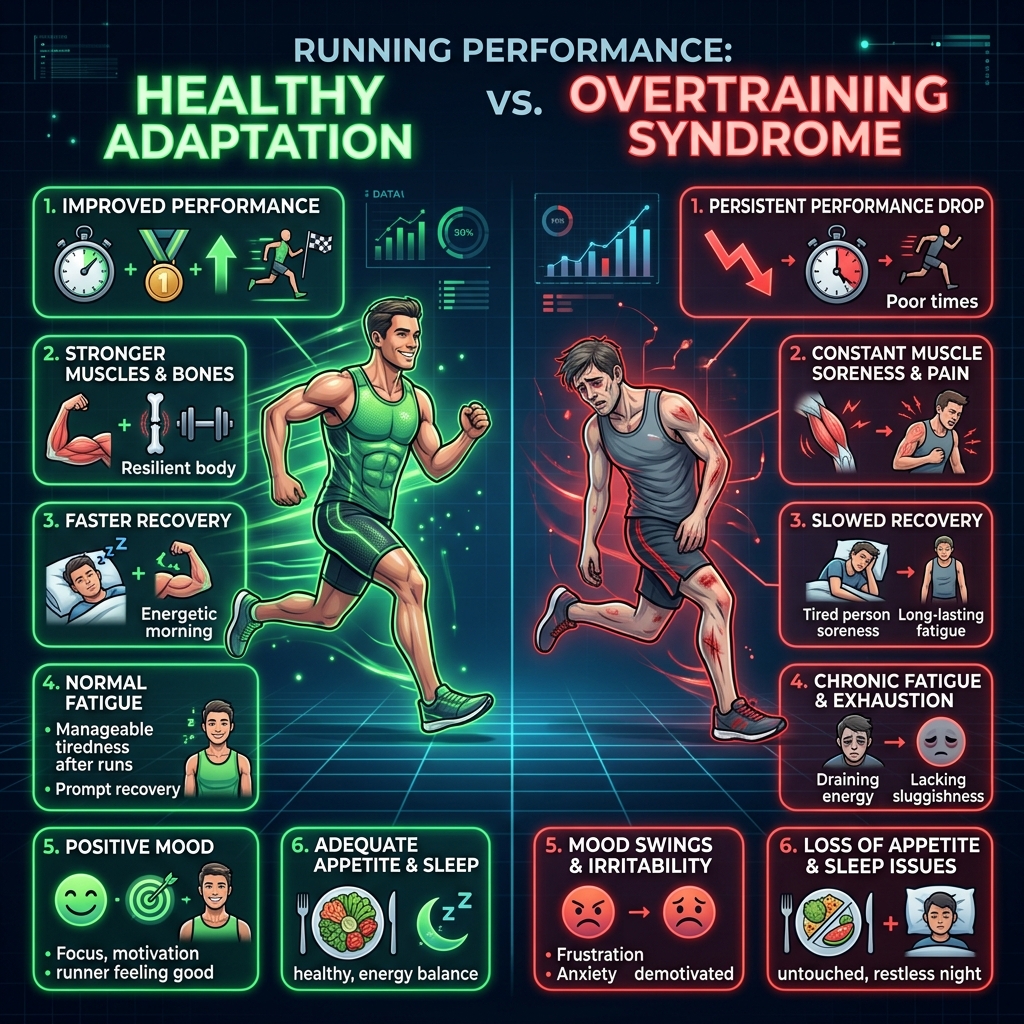
Warning signs of overtraining: - Persistent soreness that doesn't improve after 48-72 hours of easy effort - Resting heart rate elevated 5-10+ bpm above your normal baseline (your GPS watch or smartwatch can track this) - Sleep quality deteriorating despite normal habits - Mood changes - irritability, anxiety, or unusual flatness about running - Performance declining in sessions where you'd expect to maintain or improve - Getting sick more frequently than usual
If you're experiencing three or more of these, reduced training and rest are not optional. They are the treatment.
Cumulative stress without recovery. Rest days aren't just rest from running - they're when your body actually gets stronger. Exercise breaks down tissue; rest is when it rebuilds. Removing all rest days removes the rebuilding phase. If you're running every day and not getting stronger, this is likely why.
The "never miss a day" psychology. Some runners develop an unhealthy relationship with the streak. Running through warning signs, running while sick, or running on a stress fracture to preserve a number is not commitment - it's compulsion. A streak that injures you is not worth keeping.
How to run every day without destroying yourself
If you want to experiment with daily running, the key variables are volume and intensity distribution.
Keep 80-85% of your daily runs genuinely easy. Not "feels comfortable but I'm pushing a bit." Easy. This is pace where you can hold a full conversation, your breathing is relaxed, and effort feels like a 3 or 4 out of 10. The 80/20 rule holds even more strictly for daily runners who have no rest-day buffer.
Use short recovery runs. On days after a hard session or long run, 20-30 minutes at very easy pace is genuinely beneficial for recovery - it promotes blood flow without adding meaningful stress. These recovery runs should feel almost embarrassingly slow.
Watch your weekly total, not just your daily effort. 7 runs of 30 minutes easy is very different from 5 runs of 1 hour including 2 hard sessions. The total stress load matters more than the daily count.
Build in very easy "token" days. Many experienced streak runners maintain their streak on their rest day equivalent with a 1-2km very easy jog - enough to keep the streak alive but not enough to accumulate meaningful fatigue. This is a reasonable compromise that preserves the psychological benefits of the streak while allowing genuine recovery.
Who should and shouldn't run every day
Good candidates for daily running: - Runners with 2+ years of consistent training - Those who can genuinely distinguish easy effort from moderate effort (many can't) - Runners whose current weekly mileage is modest relative to their history - People who find the streak psychologically helpful and don't obsess over it
Poor candidates for daily running: - Beginners in their first year of running - Anyone recovering from injury - Runners who consistently run hard every session and struggle to dial back - People who notice their body needs 48-72 hours to recover from most sessions
If you're in the second group and want to build toward daily running, start by making alternate days deliberately easy - not just "easier than hard days," but genuinely recovery-pace efforts. Build 3-4 months of consistent 5-6 day per week training before considering seven.
The alternative: structured rest days
Most evidence-based training programs for recreational runners include 1-2 rest days per week. This is not the conservative option - it's the option that produces the most improvement for most runners.
The reason rest days work: the physiological adaptations from training (increased mitochondrial density, improved stroke volume, better fat oxidation) happen during recovery, not during exercise. Running provides the stimulus; rest provides the adaptation.
Active recovery on rest days - walking, easy swimming, yoga - maintains movement and circulation without adding significant training stress. Cross-training on rest days is another way to maintain fitness while giving running-specific muscles and joints a break. See the cross training for runners guide for which options translate best to running performance.
FAQ
How long does it take to build a running habit?
Research on habit formation generally puts reliable automaticity at around 66 days - not the often-cited 21. For running specifically, most coaches suggest that a consistent 3-month block of running 4-5 days per week is enough to make it feel like a default behaviour rather than a decision.
Can running every day cause overuse injuries?
Yes, particularly in beginners or anyone increasing volume quickly. Stress fractures, plantar fasciitis, shin splints, and IT band syndrome are all more common in runners who don't allow adequate recovery. The shin splints prevention guide and knee injury prevention guide cover the specific warning signs.
Does running every day speed up weight loss?
Running every day burns more calories than running 4-5 days per week, all else being equal. But "all else" is rarely equal - daily runners often unconsciously eat more, and overtraining can suppress fat oxidation. Daily easy running combined with a moderate caloric deficit is more effective for weight management than daily hard running.
What's the minimum run to maintain a streak?
There's no formal rule. The Road Runners Club of America streak rules require at least one mile (1.6km) per day to count. Many streakers set their own standard. What matters is that the run is sufficient to maintain the habit without being so minimal that it's merely performative.
Build your running habit on a foundation that works. A personalised running plan on Your Run Guide accounts for recovery, intensity distribution, and your specific goals - whether that's a streak, a race, or just feeling better every week.