Side Stitch When Running: Why It Happens and How to Fix It Fast
That stabbing pain under your ribs mid-run is a side stitch. Here's what actually causes it, how to stop it during a run, and how to prevent it from ruining your next race.
· 7 min read · Technique
A side stitch has ended more promising race performances than bad weather, wrong shoes, or poor training combined.
You're mid-race, feeling strong, and suddenly there's a sharp, stabbing pain just under your ribs - usually on the right side. Your breathing gets choppy. Your pace drops. You instinctively grab your side and start running with one arm stuck to your hip like you're holding yourself together.
The stitch is frustrating, but it's not dangerous. And unlike a lot of running problems, it responds pretty quickly to the right technique.
!Runner clutching side in pain with a side stitch during a race

What actually causes a side stitch?
The medical name is exercise-related transient abdominal pain (ETAP), which is a mouthful for something that happens to roughly 70% of runners at some point.
!Anatomy of ETAP Side Stitch Diaphragm and Ligaments Diagram
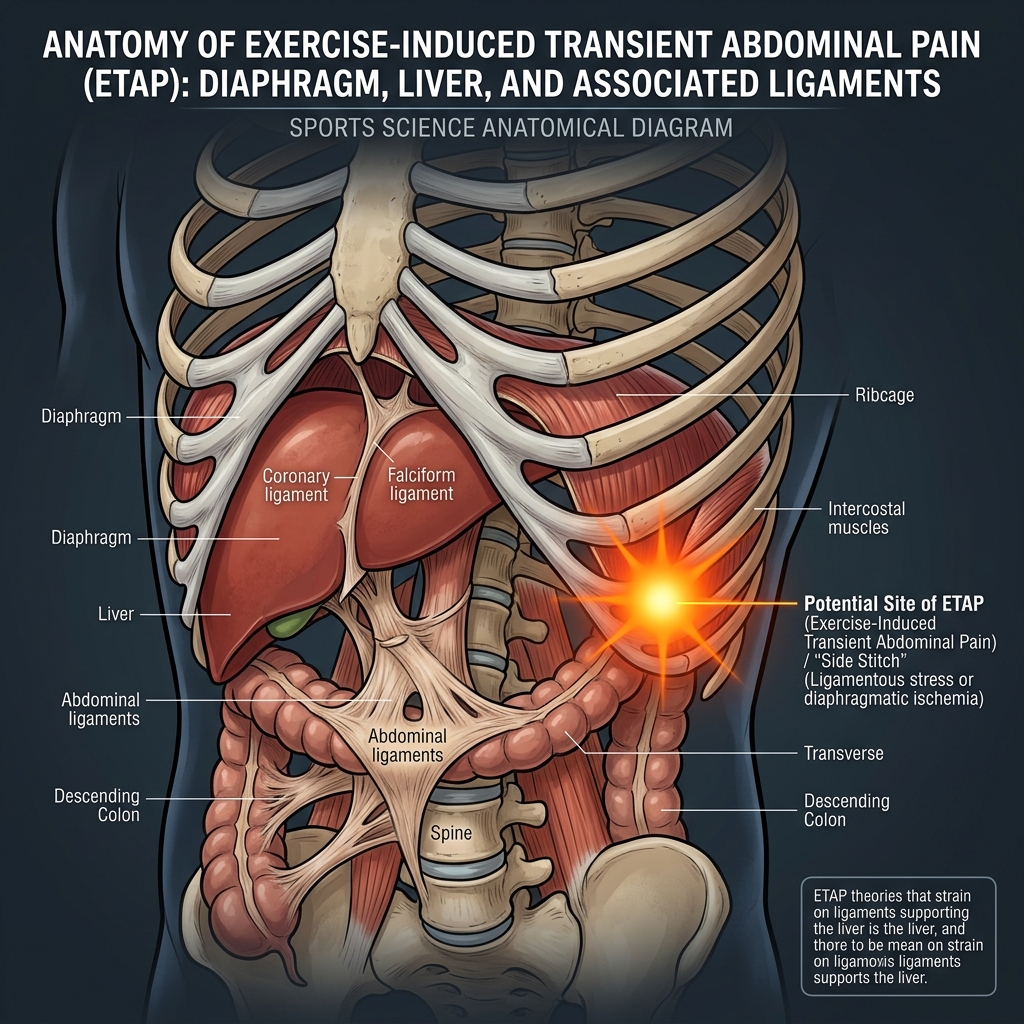
The exact mechanism is still debated, and that tells you something - this is harder to pin down than you'd think. The main theories:
The diaphragm spasm theory is the most commonly cited. The diaphragm (the dome-shaped breathing muscle beneath your lungs) gets fatigued or cramped from the combined demands of breathing hard and absorbing the jostling impact of running. The pain refers to the side because of the diaphragm's shape and attachment points.
The ligament stress theory is gaining traction in sports science. The organs in your abdomen are connected to the diaphragm by a series of ligaments. When your stomach or intestines are full, they're heavier. The pounding of running pulls on these ligaments with each stride, irritating the diaphragm from below. This explains why eating too close to running - especially high-fat or high-fibre foods - significantly increases stitch risk.
The breathing pattern theory suggests that stitches are more likely when you're breathing shallowly and your exhalation doesn't fully clear the diaphragm before the next stride's impact. There's some evidence that certain foot-breath patterns aggravate the right side in particular.
The practical upshot: stitches are more likely when you're running hard, haven't warmed up, have eaten recently, and are breathing inefficiently. Fix those things and you'll get far fewer.
How to stop a side stitch mid-run
If you feel one coming on or it's already hit, try these in order:
1. Slow down, don't stop. Dropping to a jog or fast walk lets your diaphragm recover without you losing all momentum. Stopping completely can sometimes make the spasm tighten.
2. Change your breathing pattern. Take a slow, deep belly breath and exhale forcefully. You're trying to break the cramped breathing cycle. Some runners find exhaling specifically when the opposite foot strikes (so if the stitch is on the right, exhale on left footstrike) provides fast relief.
3. Stretch the affected side. Reach the arm on the stitched side straight overhead and lean away from the pain. You're lengthening the space between your bottom rib and hip, which decompresses whatever's irritated. Hold for 10-15 seconds while walking.
4. Press and release. Some runners get relief by pressing their fingers firmly into the stitch and exhaling hard on the pressure. The theory is that you're manually helping the diaphragm release tension. It works for some people, does nothing for others - worth trying.
5. Slow your breathing and tighten your core. Bracing your core lightly while taking longer, slower breaths can help stabilise the trunk and reduce the jostling motion that's aggravating the diaphragm.
Most stitches resolve within 2-3 minutes if you implement these. If yours lasts longer than 10 minutes or is getting worse rather than better, stop running and reassess.
What causes stitches on the left side vs right side?
Right-side stitches are more common, and the most cited reason is that the liver - the heaviest organ in the abdomen - sits on the right. More weight means more ligament tension on the right diaphragm during the pounding of running. If you tend to exhale when your right foot strikes, you're also lowering your diaphragm at peak ligament tension, compounding the problem.
Left-side stitches often involve the stomach and spleen, which sit on the left. A left stitch shortly after eating is frequently just a full stomach pulling on the left diaphragm attachment.
How to prevent side stitches
Most prevention comes down to three things: what you eat before you run, how you warm up, and how you breathe.
Timing your food. The research is fairly consistent that eating in the 2 hours before a run significantly raises stitch risk. High-fat meals are the worst offender, followed by high-fibre foods, and then large volumes of any food. Simple carbs in a small quantity (e.g., a banana or a piece of toast with jam) tend to digest quickly and cause fewer problems.
For race day, treat what you eat the night before with equal seriousness. A heavy meal the evening before a 5K or 10K can still be in your system race morning. See the 5K nutrition guide for specific timing.
Warming up properly. A proper warm-up - 5-10 minutes of easy running or brisk walking before your main session - gets blood flowing to your diaphragm and reduces the shock of jumping straight into hard effort. Cold starts are a common trigger, especially for race-day stitches when nerves make people sprint off the start line. Pair this with the warm-up routine we cover separately.
Breathing habits. Learning belly (diaphragmatic) breathing - expanding your belly rather than just your chest on each inhale - reduces diaphragm fatigue over a run. The better your breathing technique at easy efforts, the less likely you are to fall into shallow, choppy breathing when pace increases. The full breathing guide covers this in detail.
Build fitness gradually. Stitches are far more common in people who are pushing above their current fitness level. If you're regularly getting stitches on most runs, the honest answer might be that your pace is slightly too high for your current aerobic base. Slowing down by 30-45 seconds per kilometre often eliminates the problem within a few weeks.
Core strength. A weak core means more trunk rotation and bounce with each stride, which increases the jostling of your abdominal organs. This doesn't mean you need to spend hours doing crunches, but strength work for runners that includes basic trunk stability helps reduce stitch frequency over time.
When should you be worried?
Almost all stitches are harmless and resolve within minutes. But a few warning signs suggest something other than ETAP:
- Pain under the ribs that doesn't improve with slowing down or stopping
- Pain that spreads to your shoulder tip (particularly the left shoulder tip)
- Chest pressure alongside the side pain
- Pain that recurs in exactly the same place every run with no obvious trigger
- Stitch-like pain that persists hours after finishing
If any of these apply, see a doctor. Don't assume it's a stitch and push through.
FAQ
Can you run through a side stitch?
For mild stitches, yes - slowing down slightly and using the breathing and stretching fixes above often clears it within a few minutes. For a severe, sharp stitch that worsens with continued running, slow to a walk until it passes.
Do experienced runners still get stitches?
Yes, though less often. Better fitness, better breathing habits, and knowing exactly what and when to eat before a run reduces frequency significantly. But most runners have a race where something goes wrong nutritionally and they pay for it mid-race.
Does drinking during a run cause stitches?
Gulping large amounts of fluid at once can. Taking smaller, more frequent sips - 100-150ml at a time - causes less gastric disturbance than drinking a full cup in one go.
Ready to find your next 5K or parkrun? Browse upcoming running events on Your Run Guide and use the pre-race nutrition guide to get your food timing right.