Benefits of Morning Running: What Science Says About Running Before Breakfast
Morning runs aren't for everyone - but the research case for them is stronger than you might think. Here's what actually happens physiologically when you run at sunrise.
· 7 min read · Running Culture
Ask most morning runners why they run at 6am and they'll tell you it's the only time they have. Ask them again six months in and the answer changes: it's their favourite part of the day.
There's a real phenomenon here. Morning running has a distinct quality to it that few other training windows can match - the quiet roads, the absence of obligations, the way it reframes everything that comes after it. But beyond the lifestyle reasons, the physiological and psychological case for morning running is surprisingly strong.
This guide looks at what the science actually says, not just the motivational posts.
!Runner silhouette at sunrise in misty park with orange morning light

The honest starting point: the best time to run is the time you'll do it consistently
Before anything else: research consistently shows that the cardiovascular adaptations from running are essentially identical whether you run at 6am or 6pm. Your VO2max improves at the same rate. Your body gets fitter. The aerobic system doesn't care about the clock.
Where time of day starts to matter is in secondary outcomes - fat oxidation, circadian rhythm effects, cognitive benefits, and practical adherence. These are real and worth understanding.
What actually happens when you run in the morning
Your body temperature is lower, which means your warm-up matters more
Core body temperature is at its daily low point in the early morning, reaching its natural peak in the late afternoon. Peak physical performance - maximum strength, sprint speed, reaction time - tends to follow temperature, so you're physiologically somewhat weaker in the early morning.
The practical implication: morning runners need to take their warm-up more seriously than afternoon runners. Joints are stiffer, connective tissue is less pliable, and the neuromuscular system takes longer to come online. A 10-minute dynamic warm-up before a morning quality session is not optional.
For easy runs, the temperature disadvantage matters less. Your body doesn't need to be at peak capacity to run at conversational pace.
Your circadian rhythm gets a strong cue
Light exposure in the early morning is one of the most powerful signals your circadian clock receives. Running outside at sunrise - even on cloudy days - delivers much more light than indoor environments. This morning light cue helps synchronise your internal clock, which has downstream effects on sleep quality, hormone rhythm, and energy levels throughout the day.
!Morning Sunlight, Circadian Rhythm, and Sleep Quality Diagram
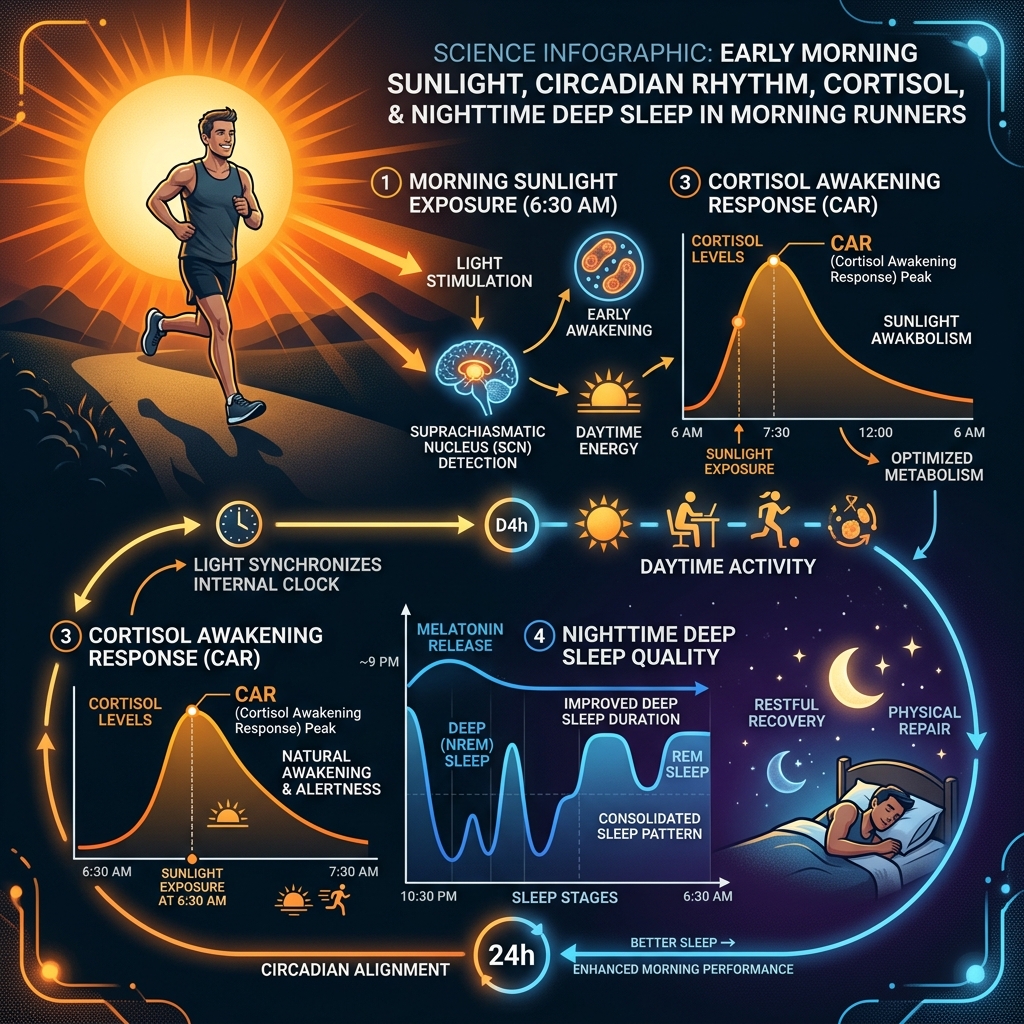
Research published in the British Journal of Sports Medicine found that morning exercisers reported better sleep quality and more time in deep sleep compared to evening exercisers. The mechanism is likely this light-mediated circadian synchronisation, plus the cortisol response to morning exercise (which helps the body stay alert and then properly wind down by evening).
Fat oxidation may be higher
A 2020 study from the Karolinska Institute found that morning exercise activates gene programs in muscle tissue that enhance the metabolism of sugars and fats - a different molecular signature than evening exercise. The effect was more pronounced in morning exercise, suggesting timing-specific metabolic adaptations.
For runners who want to improve fat utilisation - relevant for marathon and half-marathon training where fat becomes the primary fuel at lower intensities - fasted morning easy runs (running before breakfast) are a tool some coaches use. The research on this is mixed, and you need enough base fitness and enough carbohydrate the night before for it to be safe, but there's a real physiological basis for the approach.
Cognitive benefits carry into the work day
Several studies have found that morning exercise improves executive function, working memory, and reaction time throughout the day. A 2021 study in the British Journal of Sports Medicine found that 30-minute morning runs improved verbal memory, cognitive flexibility, and visual attention in participants compared to days they didn't exercise.
The mechanism involves increased cerebral blood flow and elevated BDNF (brain-derived neurotrophic factor) - a protein that supports neuron function and is often called "fertiliser for the brain." If you've ever noticed that your thinking feels clearer on days you run before work, this is the likely reason.
The adherence argument (and why it matters more than any of the above)
The strongest practical argument for morning running is simply this: life doesn't cancel your 6am run.
Evening runs get displaced by late meetings, social commitments, a hard day that leaves you mentally depleted, family commitments, weather that turned, or a dozen other legitimate reasons. Morning runs exist in a protected window before the demands of the day arrive.
Research on exercise adherence consistently shows that people who run in the morning maintain their training schedules more consistently over 6-12 month periods than evening runners with equivalent motivation. Consistency, accumulated over months and years, is the primary driver of fitness improvement. A slightly suboptimal session done reliably beats the optimal session done irregularly.
The downsides of morning running (and how to handle them)
Stiffness and injury risk. The lower temperature and reduced joint lubrication of early morning mean you need to respect your body's slower transition to full capacity. This is solved by a proper warm-up and starting easy runs at 60-70% of your intended pace for the first 10-15 minutes.
Sleep sacrifice. There's limited benefit to a morning run if you're achieving it by sleeping 5 hours instead of 7. Sleep is the primary recovery mechanism for runners - not nutrition, not ice baths, not compression boots. Sleep. If morning running costs you more than 30-45 minutes of sleep, reconsider the tradeoff or adjust your evening schedule.
Fasted running considerations. For runs under 60 minutes at easy effort, most runners can run fasted without performance impact. For longer runs or any quality session above Zone 2, have something to eat - a banana and a coffee is sufficient. Running a long run or hard session fasted when you're not fat-adapted can result in significantly worse quality training.
Safety in the dark. Reflective gear, a head torch, and running familiar routes are basic precautions for pre-dawn running. High-visibility vests for road running are not optional when drivers can't see you.
Morning running for race preparation
One often-overlooked benefit: most running races, from 5Ks to marathons, start in the morning. Training at race time means your body is conditioned to perform at that time of day. If you do all your quality training in the evenings but race at 8am, you're racing in a time window where your body hasn't been trained to perform.
This isn't a trivial effect - experienced marathoners sometimes deliberately train in conditions that mimic their target race environment, including time of day. If your goal race starts at 7am, at least some of your long runs and quality sessions should happen in that window.
Browse upcoming races on Your Run Guide to see start times and pick your next target event.
Practical guide to starting morning runs
Week 1-2: Don't change your alarm aggressively. Move it 15 minutes earlier each week rather than jumping to 5:30am immediately. Your body's circadian rhythm adjusts gradually.
Sleep schedule: Go to bed 15-20 minutes earlier each week in parallel. Morning runs that don't compromise sleep are sustainable. Morning runs that do are not.
Prep the night before: Lay out your clothes, fill your water bottle, set your GPS watch to charge. Removing friction from the morning routine is the difference between a snooze button moment and a run that happens.
Start easy: Your first morning run does not need to be a PR attempt. Easy, short, and consistent for the first 2-3 weeks. Let your body adapt to performing in the morning window.
Coffee: If you're a coffee drinker, having it before your morning run is both practical and evidence-backed. Caffeine is a well-evidenced performance enhancer - and it helps get out of bed.
FAQ
Is morning running better for weight loss?
The evidence is mixed but leans slightly positive for fasted morning easy running enhancing fat oxidation in people who are already reasonably fit. For most runners, the adherence benefit - consistently running more days per week - matters more for weight management than the metabolic timing effect.
Is it okay to run first thing in the morning without eating?
For easy runs under 45-60 minutes: generally yes, assuming you ate adequately the day before. For longer runs or hard sessions: have a small amount of simple carbs first (banana, toast).
Why do I feel slow on morning runs?
Primarily because your body temperature is lower and your neuromuscular system isn't fully activated. This is normal. The first 10-15 minutes of a morning run typically feel harder than an equivalent afternoon effort. It passes once you're warmed up.
How long before I adapt to morning running?
Most runners find morning runs feel "normal" (no more grinding out of bed) after 3-4 weeks of consistent practice. Circadian adaptations take a similar timeline.
Need a plan that works around your schedule? Build a personalised running plan on Your Run Guide that fits your training time, whether that's 6am or 6pm - and see your fitness improve consistently.