Is 180 Steps Per Minute Really the Gold Standard for Running Cadence?
Your Garmin nudges you toward 180 SPM. Every running forum repeats it. But sports scientists have a different story - and it comes down to a single observation at the 1984 Olympics.
· 7 min read · Technique
Your GPS watch has a cadence field. Most running apps have one too. And somewhere along the line, you probably picked up the idea that 180 steps per minute is the magic number - the mark of an efficient, injury-free runner.
Here's what actually happened. At the 1984 Olympics in Los Angeles, exercise physiologist and coach Jack Daniels sat in the stands and counted footsteps. He noticed that most elite distance runners competing in events from the 800m to the marathon were turning over at or above 180 SPM during their races. He wrote it down. He shared it.
Decades later, that single observation of world-class athletes at full race intensity became a universal rule for all runners at all paces.
That is not how it was meant to work.
!Running cadence data overlay showing 162 SPM vs 180 SPM
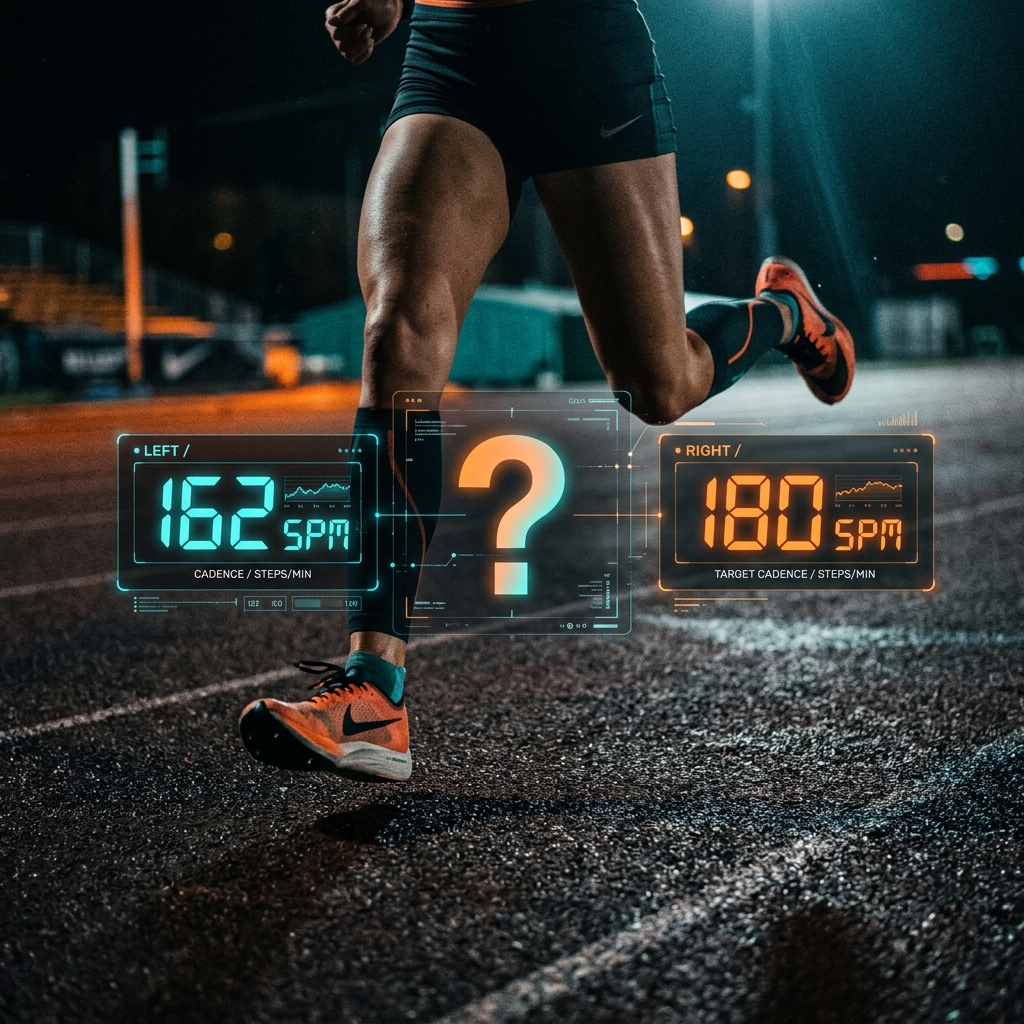
What Jack Daniels actually said
Daniels himself has clarified in interviews that 180 was never intended to be a prescriptive target for every runner. His goal was simply to help recreational runners understand that very low cadences - the shuffling, heavy-heeled gait of someone overstriding badly - were inefficient and risky. He was pointing at a floor, not a ceiling.
The observation also came with a huge asterisk: these were elite athletes running at near-maximum effort. Their cadence was 180 SPM or higher because they were moving fast. Cadence naturally rises with pace. A runner hitting a 3:30 marathon pace moves very differently than the same runner jogging an easy 6:30 km.
What the research actually shows
Current sports science is clear on a few things.
First, optimal cadence is highly individual. It depends on your height, leg length, running speed, experience level, and natural biomechanics. Studies of competitive distance runners have shown cadence ranges from well below 160 to above 200 SPM, with no consistent link between a specific number and better performance.
Second, cadence changes with pace - it always has. Researchers at the University of Michigan and elsewhere have shown that as runners speed up, their cadence increases naturally. Expecting someone to run at 180 SPM on a slow recovery jog is like telling a driver to keep engine revs at highway levels while crawling through a car park.
Third, the evidence does support one specific use case for cadence monitoring: modest increases can reduce injury risk in runners who are genuinely overstriding. A 2011 study by Heiderscheit et al. published in Medicine and Science in Sports and Exercise found that increasing cadence by 5 to 10% reduced the mechanical energy absorbed at the knee by up to 34% - a meaningful number if you're dealing with patellofemoral pain or shin stress injuries. A separate study (Willy et al.) found comparable reductions in vertical loading rates. The mechanism is the same: shorter steps mean less braking force, which means less stress on the joint per stride.
That's the real takeaway. Not 180 for everyone. A small increase from your own baseline, for runners with identified problems.
How to find your actual cadence
Before you try to change anything, you need to know where you are starting.
On your next easy run, count how many times your right foot hits the ground over 30 seconds. Double it, then double it again. That's your SPM. Most modern GPS watches (Garmin, COROS, Apple Watch with the right app) do this automatically - but check your average across several easy runs, not a race effort where cadence will be naturally higher.
Most recreational runners who haven't thought about cadence sit between 155 and 175 SPM on easy paces. That same runner might hit 182 SPM on a hard 5K effort and 163 SPM on their Sunday long run - both are completely fine. The number moves with pace.
If you're consistently below 155 SPM on easy runs, that's worth paying attention to. It often correlates with overstriding, where your foot lands too far in front of your center of mass. Use the running pace calculator alongside cadence data to understand how your form changes across different intensities.
How to improve cadence: practical steps that work
If your cadence is genuinely low and you want to change it, here's what actually works.
Start by targeting a 5% increase from your current baseline - not 180. If you're running at 162 SPM, aim for 170. If you're at 168, aim for 176. That is the research-supported increment for meaningful joint load reduction without forcing an unnatural gait. Chasing a specific number is the wrong goal; chasing your own modest improvement is the right one.
The most effective tool is a metronome app. Download a free one, set it to 5 beats per minute faster than your current cadence, and during easy runs, spend two to three minutes matching your footsteps to the beat, then run normally for five minutes, then repeat. Your legs need to learn the rhythm, not just execute it on command. If a clinical beep feels unbearable, search "170 BPM running playlist" on Spotify - there are dozens of purpose-built options.
Three drills are worth adding to your warm-up:
- Fast feet: run in place with quick, light steps for 20 to 30 seconds. The goal is minimal ground contact time, not height.
- Strides: after an easy run, do 4 to 6 accelerations of 20 to 25 seconds at a controlled fast pace. This trains the neuromuscular pattern without hammering your legs.
- Uphill intervals: it is physically difficult to overstride on a hill. Running up a 5 to 8% incline forces your foot to land under your hips naturally, without you having to think about it.
There is also a mental cue that helps: think about a slight forward lean from the ankles, not the waist. This shifts your centre of mass forward and naturally stops your foot from reaching ahead. Many runners who try to quicken cadence just end up stamping their feet faster, which misses the point entirely.
Give this process six to eight weeks. New movement patterns take time to embed. A new cadence that feels forced in week two usually feels natural by week six.
When cadence doesn't matter at all
If you're not injured, not dealing with any overuse pain, and running feels efficient - your cadence is probably fine. Obsessing over a number on your watch when nothing is broken is a fast route to tinkering yourself into a problem.
The best use of cadence data is as a diagnostic tool: if you keep getting the same knee or shin injury, if your running feels heavy and jarring, or if your training load analysis shows high ground impact forces, then cadence is worth examining.
Don't chase 180. Chase your own improvement, at your own pace. Use a personalised running plan to build your training progressively, find a parkrun or local 5K to test your fitness, and save the cadence watch obsession for when it actually serves a purpose.
The number Jack Daniels wrote down in 1984 was never meant to live in your GPS profile. Now you know why.