Yomif Kejelcha Broke the 2-Hour Barrier in His Marathon Debut and Still Lost
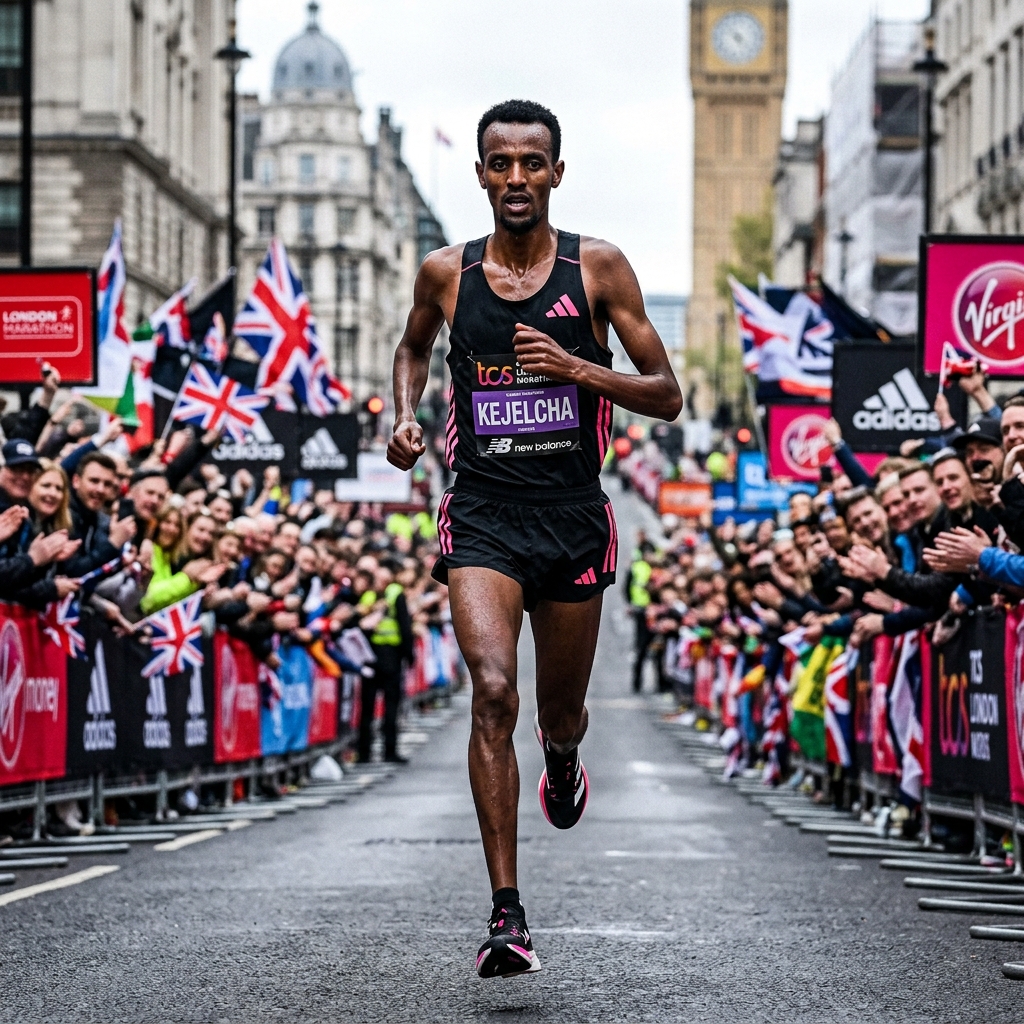
Imagine running a 1:59:41 in your first ever 26.2-mile race and crossing the finish line in second place. That is exactly what happened to Yomif Kejelcha at the London Marathon.
· 5 min read · Athletics News
The marathon distance is notorious for humbling athletes who step up from the track. We have seen countless 10,000-meter specialists confidently toe the line for their debut 26.2, only to blow up spectacularly around mile 20.
Yomif Kejelcha did not blow up. Instead, he did something that completely broke our understanding of human limits. He ran his first ever marathon in 1:59:41 at the 2026 London Marathon. He officially became one of only two men in history to run a sub-two-hour marathon in a legal race.
And he finished in second place.
!Yomif Kejelcha running the 2026 London Marathon
A Debut That Defies Logic
Before this race, breaking two hours was considered the absolute ceiling of human performance. It was a feat so difficult that Eliud Kipchoge needed a highly controlled, laser-paced, unsanctioned environment in Vienna just to prove it was theoretically possible.
Kejelcha went out and did it on the streets of London in his first attempt at the distance. He hung onto the punishing pace set by Sabastian Sawe, hitting the halfway mark in an absurd 59:45. When the pacers dropped off, Kejelcha stayed right on Sawe's heels, looking remarkably relaxed for a guy who had never raced past 13.1 miles.
It wasn't until the final grueling stretch down The Mall that Sawe finally created a gap, crossing the line in 1:59:30. Kejelcha followed just 11 seconds later. If you run a 1:59:41 and someone beats you, you just have to shake their hand and acknowledge you were part of the greatest race ever run.
Track Speed Translating to the Roads
Kejelcha has always been a monster on the track. He holds the indoor mile world record and has world championship medals in the 10,000 meters. But raw speed does not automatically translate to marathon endurance.
What makes his debut so shocking is his biomechanics. He is incredibly tall and thin for an elite runner, standing at 6-foot-1. Historically, shorter athletes with lower centers of gravity have dominated the marathon. Kejelcha's long, bounding stride looked like it might be a liability over 26 miles, but combined with the massive energy return of modern super shoes, his stride proved to be a lethal weapon.
Why This Matters for Everyday Runners
You might not be running a sub-two-hour marathon anytime soon, but Kejelcha's debut holds a massive lesson for anyone stepping up to a new race distance.
He didn't respect the distance by running scared. He trusted his fitness. When you transition from a 5K to a 10K, or a half to a full marathon, there is a tendency to run extremely conservatively because you are afraid of the unknown. Kejelcha threw caution out the window and stuck to the aggressive pacing plan he had trained for.
If you are stepping up to a new distance, use our run planner to build a solid block of long runs. Once the fitness is there, trust it. You can also use our pace calculator to find a challenging but realistic race pace.
Do not let the fear of a new distance hold you back from finding out how fast you actually are.
*Are you inspired to tackle a new distance after watching the London Marathon? Check out our race directory to find an event near you and start putting in the miles.*