Why the Chicago Marathon is the World Record Factory: Course Analysis and History
From Khalid Khannouchi in 1999 to Kelvin Kiptum's 2:00:35 and Emily Sisson's American record, explore why Chicago consistently produces the fastest marathon times on earth.
· 7 min read · Race Spotlights
When distance runners talk about flat and fast marathon courses, Berlin often dominates the conversation. Yet over the last three decades, Chicago has laid claim to more dramatic world records and era-defining breakthroughs than almost any road race in history.
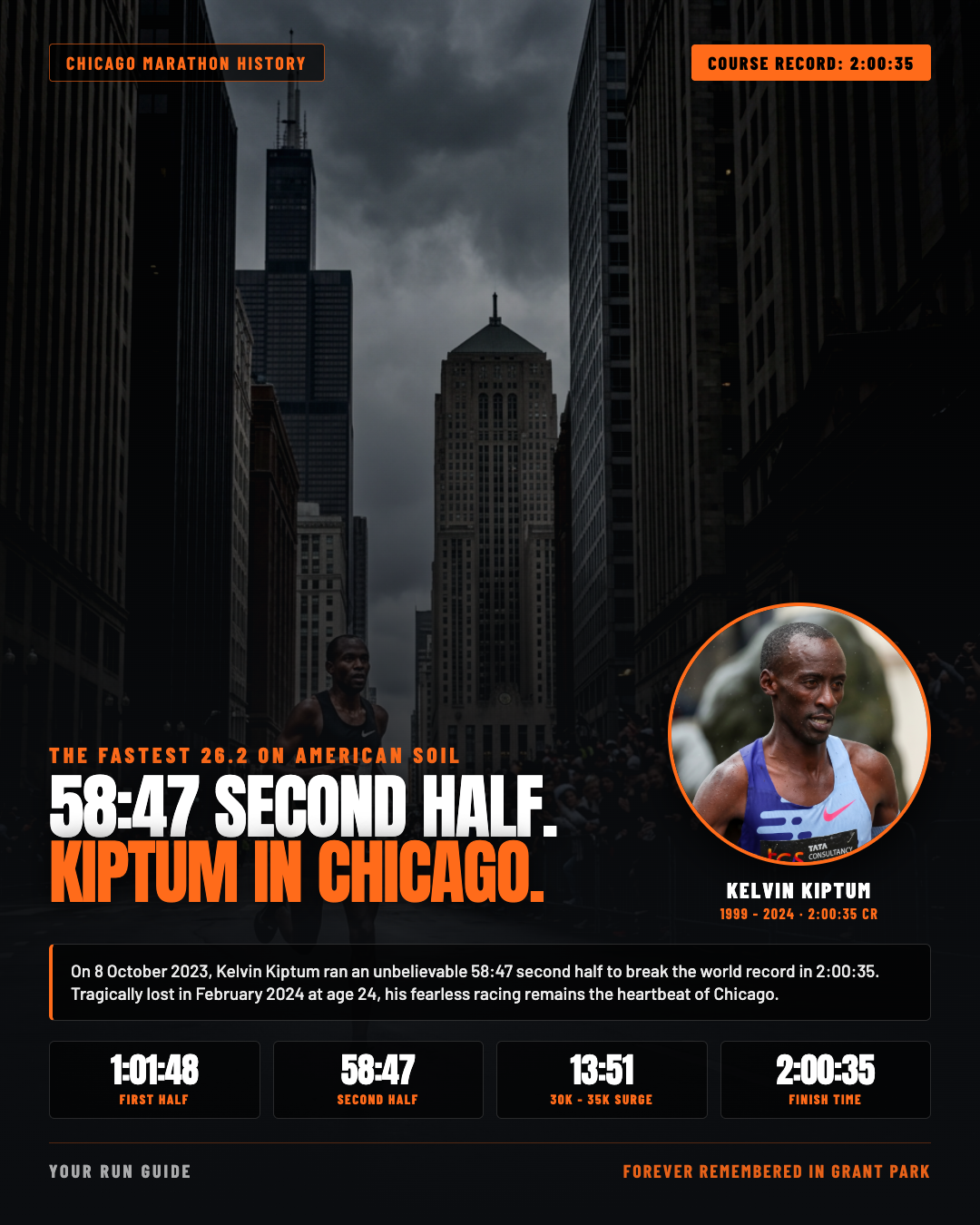
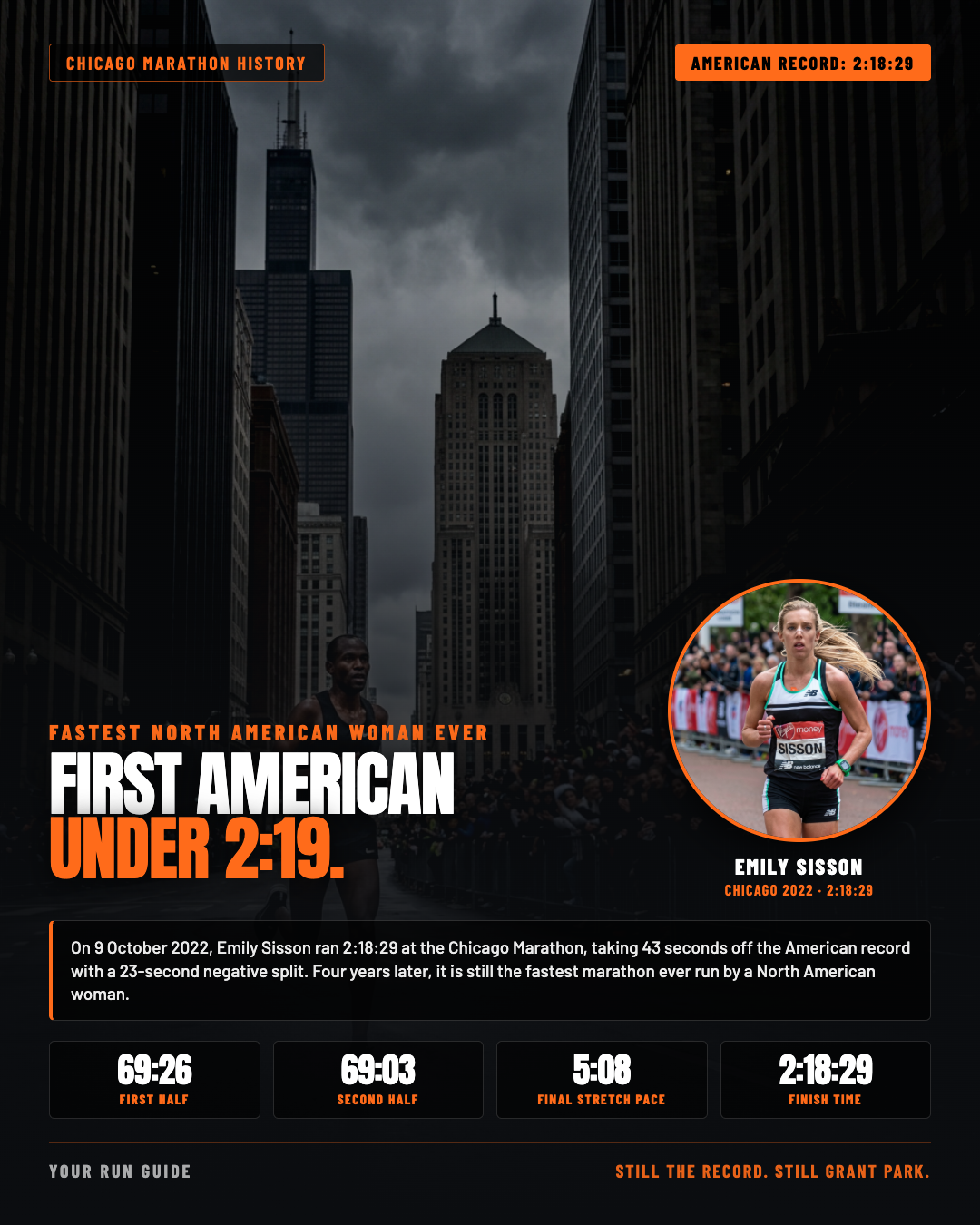
It was on the streets of the Windy City in 1999 that Khalid Khannouchi became the first person to break 2:06 in an official marathon, clocking 2:05:42 before he even acquired American citizenship. Twenty-four years later, Kelvin Kiptum stunned the sporting world by obliterating the world record with a 2:00:35 clocking, taking distance running to the edge of the sub-two-hour barrier. On the women's side, Emily Sisson shattered the American record with 2:18:29, and Ruth Chepngetich pushed the women's boundary with a jaw-dropping 2:09:56.
What makes Chicago so lethal for records? The answer lies in a blend of geography, microclimate, crowd energy, and course architecture.
1. Dead-Flat Elevation with Zero Stifling Climbs
The Chicago Marathon course gains only about 74 metres (243 feet) over its entire 42.195-kilometre route. For comparison:
- Boston: 248m gain, 390m net descent (net downhill, but quads get ruined by mile 16).
- New York City: 255m gain across five bridges.
- Berlin: 73m gain (virtually identical to Chicago).
- London: 105m gain.
The only noticeable incline on the entire Chicago course is a tiny railway overpass colloquially known as "Mount Roosevelt" - an elevation rise of barely 4 metres at mile 26 as runners turn east off Michigan Avenue onto Roosevelt Road toward the finish line in Grant Park.
!Mount Roosevelt at the end of the Chicago Marathon
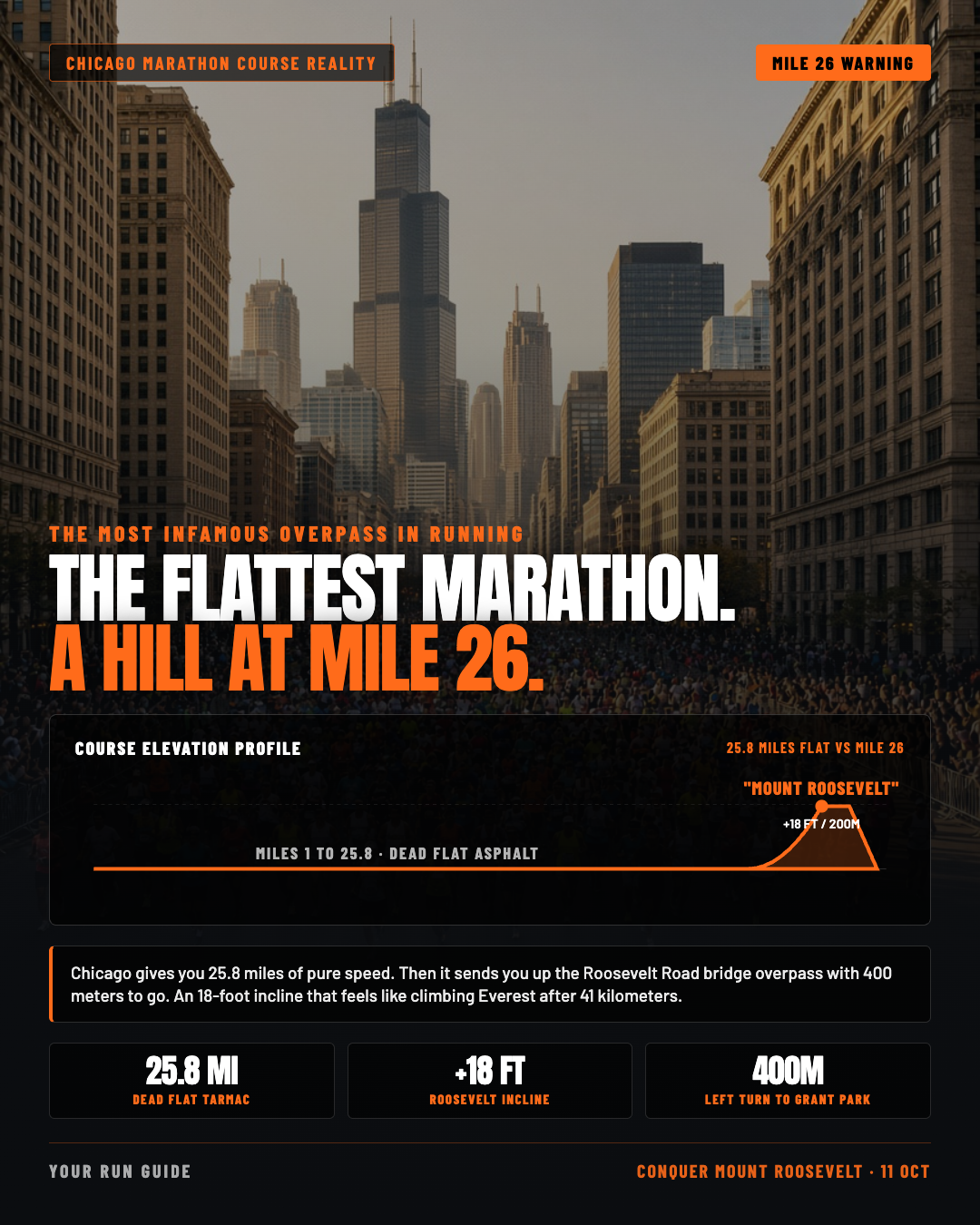
Because the course has no sustained climbs, runners never experience the sudden spikes in blood lactate that derail pacing plans on hilly routes. Your metabolic burn rate stays completely level from start to finish.
2. Long, Straight Tangents Through 29 Distinct Neighborhoods
Excessive turns scrub momentum. Every tight 90-degree corner forces a runner to decelerate, stabilize through the hips and ankles, and re-accelerate. Over 26.2 miles, twenty extra corners can add 15 to 30 seconds of cumulative muscular fatigue.
Chicago minimizes sharp switchbacks. After navigating the initial loop through the Loop and River North, the course opens up into long, sweeping stretches:
- North on LaSalle Street and Broadway through Lincoln Park.
- South along Damen Avenue and Halsted Street through Pilsen and Chinatown.
- The massive 4-mile straightaway heading north on Michigan Avenue directly back toward Grant Park.
Runners can lock into their target rhythm and run true tangents without breaking stride.
!Kelvin Kiptum's legendary 2:00:35 world record in Chicago
3. The October Sweet Spot: Temperature and Humidity
Held on the second Sunday of October, Chicago consistently catches the sweet spot of midwestern autumn.
The physiological ideal for marathon racing is between 7°C and 12°C (45°F to 54°F) with moderate humidity. At this temperature, the body dissipates heat efficiently through convection and evaporation without diverting excessive blood flow from active leg muscles to the skin surface for cooling.
While Chicago has seen rare outliers (such as the heat-shortened 2007 edition), October race mornings typically start near 8°C to 10°C with crisp air off Lake Michigan, allowing athletes to push threshold paces without cardiac drift.
4. Unbroken Wall of Noise and Motivation
Unlike marathons that pass through quiet residential outskirts or industrial waterfronts, Chicago's loop runs through 29 densely populated neighborhoods. Over 1.7 million spectators line the course.
From the vibrant drumming in Pilsen to the deafening cheer squads in Boystown and the dragon dancers in Chinatown, runners rarely spend more than a few minutes without auditory stimulation. In physiological testing, cheering crowds have been shown to lower perceived exertion (RPE), effectively tricking the brain into delaying central governor fatigue.
!Emily Sisson setting the American marathon record in Chicago
The Chicago World Record Hall of Fame
Chicago has hosted five ratified world records over the past 25 years:
| Year | Athlete | Country | Time | Significance | |---|---|---|---|---| | 1999 | Khalid Khannouchi | MAR | 2:05:42 | First sub-2:06 marathon in history | | 2001 | Catherine Ndereba | KEN | 2:18:47 | First woman under 2:19 | | 2002 | Paula Radcliffe | GBR | 2:17:18 | Smashed women's record by 89 seconds | | 2023 | Kelvin Kiptum | KEN | 2:00:35 | First official sub-2:01 in history | | 2024 | Ruth Chepngetich | KEN | 2:09:56 | First woman to break the 2:10 barrier |
How to Race Chicago for Your Own PR
If you have secured a bib for Chicago, follow these tactical rules:
Avoid the GPS Tunnel Trap During the first three miles through downtown, high-rise buildings cause severe GPS drift on Garmin and Apple watches. Your watch will report wild paces (often showing 15 seconds per kilometre faster or slower than reality). Ignore your wrist pace and use the on-course mile clocks and your lap button to track true splits.
Save Your Quads for Michigan Avenue Because Chicago is flat, your running muscles work through the exact same range of motion with every footstrike. Unlike hilly courses where uphill climbing uses glutes and downhill uses quads, flat marathons can cause localized muscle stiffness. Incorporate periodic cadence shifts (taking 5 to 10 quicker steps every few miles) to relieve muscle fatigue.
Conquer Mount Roosevelt When you turn onto Roosevelt Road with 400 metres to go, do not let the short hill intimidate you. Shorten your stride, pump your arms, and crest the bridge. The final left turn onto Columbus Drive brings you into the roaring finish straight.
To plan your target pace and splits for Chicago, check our marathon pace calculator or build a structured build-up using our 16-week marathon training plan.
Find races: Browse marathons and road races in Chicago on Your Run Guide to compare local events, qualification races, and upcoming Midwestern tune-ups.