How to Improve Your VO2 Max (The Pyramid Method)
Stop running in the garbage zone. Learn how to use the polarized training pyramid to build your aerobic base and increase your VO2 max.
· 5 min read · Training
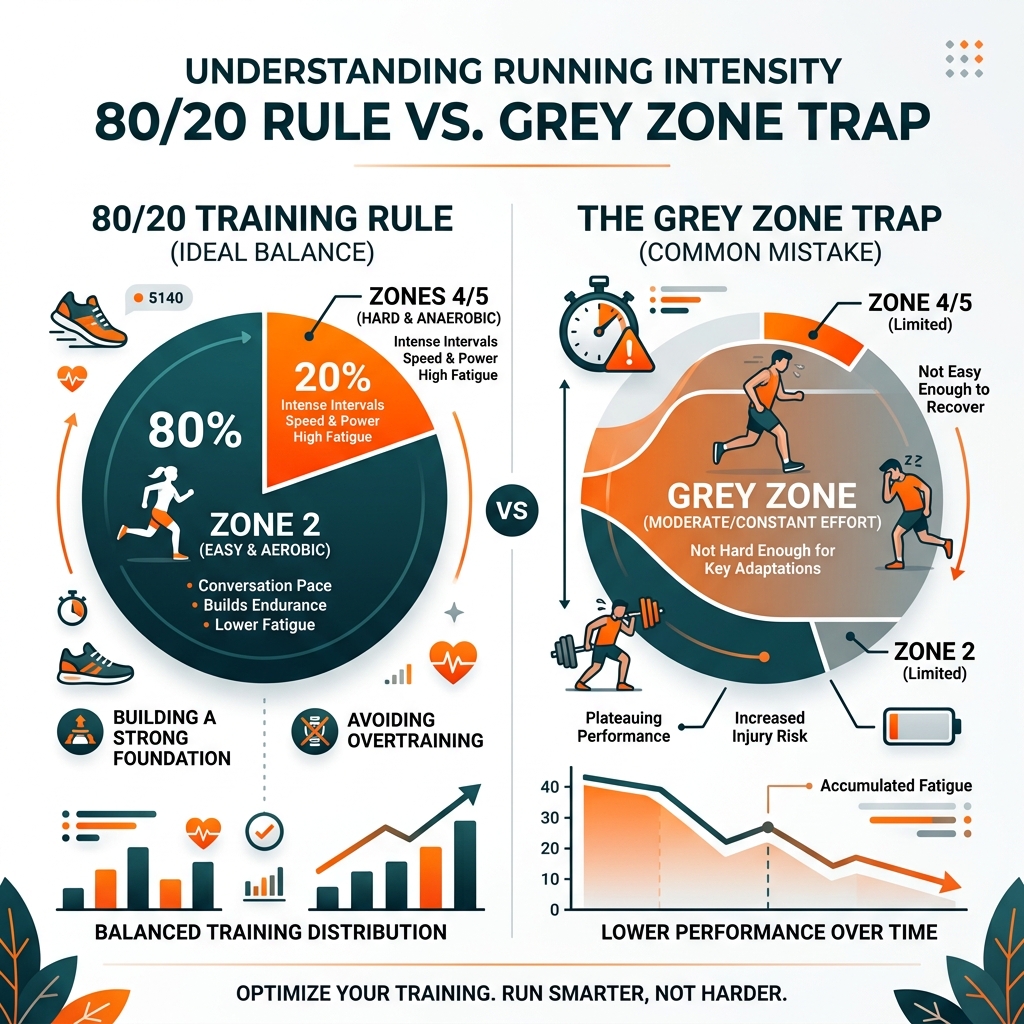
Most runners spend their entire week stuck in the "garbage zone." They head out the door, settle into a pace that feels somewhat hard but not exhausting, and log their miles. The problem is this medium-intensity effort is too hard to build your aerobic base and too easy to stimulate real cardiovascular adaptations. If you want to increase your fitness and run faster with less effort, you need to rethink your approach to VO2 max training.
You do not build a massive engine by running the same pace every day. You build it by treating your fitness like a pyramid.

The VO2 Max pyramid concept
Your VO2 max is a measure of how efficiently your body uses oxygen during maximum effort. A high VO2 max allows you to hold faster paces without drowning in lactic acid.
Think of your cardiovascular fitness as a pyramid. The height of the pyramid represents your peak VO2 max. You cannot build a tall peak if you have a narrow base. The wider your base, the higher you can push the peak.
This concept is the foundation of the 80/20 running rule. Elite athletes and smart coaches know that polarized training - keeping the easy days truly easy and the hard days extremely hard - yields the best results.
Building the base with Zone 2 running
The base of your pyramid is your aerobic capacity. You build this through high-volume, low-intensity running.
When you spend eighty percent of your training time in Zone 2, your body undergoes specific physiological changes. You increase your capillary density, meaning more tiny blood vessels deliver oxygen directly to your muscles. You also improve mitochondrial efficiency, teaching your cells to process that oxygen better.
This is not the time to push the pace. Zone 2 should feel almost embarrassingly slow. You should be able to hold a full conversation without gasping for air. If you finish an easy run feeling exhausted, you went too fast.
Use our running pace calculator to find your true easy pace. It is likely a minute or two per kilometer slower than your current default speed. Trust the process. Aerobic base training running is what gives you the structural integrity to handle intense speedwork later.

Building the peak with Zone 5 intervals
Once you have a wide aerobic base, you can start building the peak. This is where you dedicate the remaining twenty percent of your training to high-intensity interval training for runners.
To improve your VO2 max directly, you need to stress your heart's stroke volume - the amount of blood it pumps per beat. This requires running at 90 to 100 percent of your maximum heart rate.
The most effective way to achieve this is through long intervals. A standard protocol is the "4x4" workout. You run four intervals of four minutes at an all-out, lung-burning effort, separated by four minutes of active recovery.
Hill repeats are another excellent tool for this. Charging up a steep incline forces your heart rate to spike immediately while reducing the impact load on your joints compared to sprinting on flat pavement.
Putting it into practice
The theory is simple, but the execution requires discipline. Stop doing medium-hard runs every time you lace up your shoes.
A typical week for a runner looking to boost their VO2 max might look like this: - Three days of easy, conversational Zone 2 running (the base). - One day of hard intervals or hill repeats (the peak). - One rest day or cross-training session.
If you struggle to balance these intensities, a personalised running plan can take the guesswork out of your schedule.
Commit to the pyramid approach for six weeks. Build the base, sharpen the peak, and then go find a parkrun or a local 5K to test your new engine. You will find that holding your old race pace suddenly requires far less effort.