Pacing Strategies by Distance: How to Avoid Blowing Up in the Second Half
Starting too fast is the most predictable mistake in running. Here's what the research says about pacing for 5K, 10K, half marathon, and marathon - and how to stay in control when your legs are telling you to go.
· 8 min read · Training
You trained for months. You felt great at the start line. You went out at a pace that felt comfortable - maybe even a little conservative. And then somewhere around the 30-kilometre mark of the marathon, or mile 8 of the half, your legs turned to concrete and the race became survival.
This is not a fitness problem. It's a pacing problem. And you're in excellent company.
Large-scale analysis of millions of race records consistently shows that the vast majority of recreational runners execute positive splits - running the second half slower than the first. In marathons, studies have found that even a slight excess of pace in the opening miles dramatically increases the probability of hitting the wall. Physiologists define the wall as the sudden, catastrophic depletion of muscle glycogen that typically occurs between 28 and 32 kilometres.
Starting too fast is the single biggest predictor of a poor finish. This applies to 5Ks as much as it applies to full marathons.
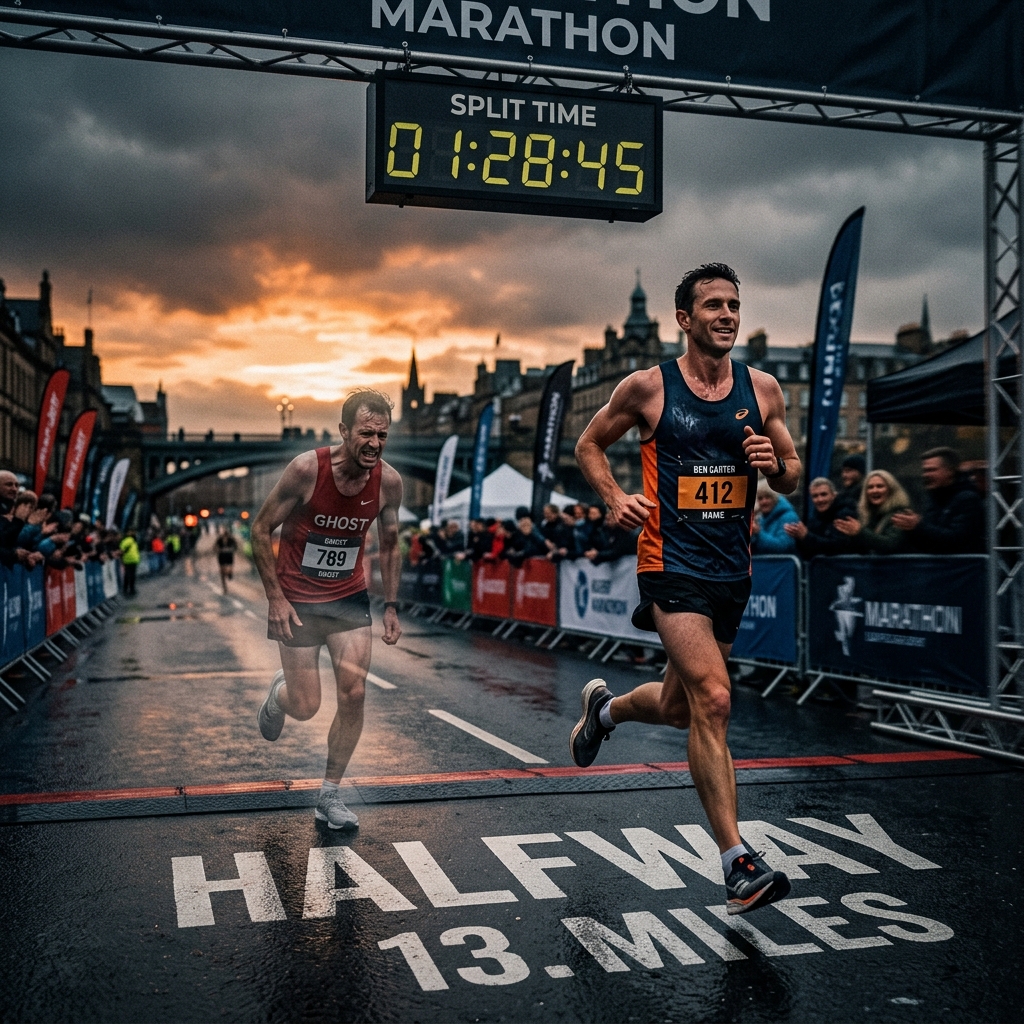
!Race halfway point with one runner holding pace and another fading
Why your body lies to you at the start
The beginning of a race feels deceptively easy. Your glycogen stores are full, adrenaline is flowing, and months of anticipation push you forward faster than your training pace.
The problem is that running even 5 to 10% too fast in the first third of a race compounds exponentially. Your glycogen burns faster. Lactate accumulates earlier. Perceived effort is artificially suppressed by adrenaline, which fades around kilometre 5 to 8 - exactly when you need objective judgement the most.
The wall is a glycogen story. When your muscles run out of their preferred fuel, your body tries to compensate by burning more fat. But fat oxidation at running intensity is simply slower and less efficient. The result is a dramatic pace drop that no amount of mental toughness can fully override. Interestingly, research has consistently found that men hit the wall at a higher rate than women in marathons. Women tend to execute much better pacing strategies, pacing themselves more conservatively in the first half, while men are statistically more likely to start too fast and pay the price later.
Pacing by distance: what the research recommends
5K
The 5K is short enough that a massive energy crash isn't the primary risk. The bigger danger is blowing your anaerobic threshold in the first kilometre and spending the rest of the race fighting to recover.
Research on 5K pacing suggests even or very slightly negative splits produce the fastest times. Start the first kilometre at goal pace or just slightly slower - not easy pace, but not all-out. Kilometres 2 and 3 lock in the rhythm. Use whatever you have left for 4 and 5.
The mistake most runners make is treating kilometre one like a sprint for position. Unless you're competing at an elite level, you have 20 to 30 minutes. There's no prize for first kilometre leader.
10K
The 10K sits in an interesting zone - long enough that glycogen management starts to matter, short enough that aggressive early pacing can sometimes work.
For most recreational runners, even splits or a slight negative split are optimal. Elite runners at 10K often vary by just 10 to 20 seconds per kilometre across the whole race.
A practical approach: start 5 to 10 seconds per kilometre slower than goal pace for the first two kilometres. Lock in at goal pace for kilometres 3 through 7. Then run the final 3 kilometres to whatever you have left. At kilometre 8, you should feel genuinely uncomfortable but still in control. If you felt controlled at kilometre 4, you went out too easy. If you were already hurting at kilometre 4, you went out too fast.
Use the running pace calculator to convert your goal time into per-kilometre splits before race day. For example, if you are targeting a 50-minute 10K (5:00/km average), plan your first two kilometres at 5:05 to 5:10/km.
Half marathon
The half marathon is where pacing discipline separates good races from great ones. It's long enough for glycogen to become a real factor in the final 7 kilometres, but short enough that an early surge feels like nothing in the moment.
Research and coaching consensus point to the same approach: run the first 5 kilometres at 5 to 8 seconds per kilometre slower than goal pace. Lock in at goal pace for kilometres 5 through 14. Save any acceleration for the final 7 kilometres.
At kilometre 5, the internal monologue you want is: "This feels slightly too easy." If it feels spot-on, you're already running too fast for a sustainable race.
Weather matters. If race day is 5°C warmer than your long run conditions, add 10 to 20 seconds per kilometre. Heart rate will tell you more than GPS pace in those conditions.
Marathon
Marathon pacing is the most studied and the most brutal when it goes wrong.
Research comparing positive splits against even and negative splits consistently finds that runners who execute even or slightly negative splits finish faster on average - even when hard starters covered the first half at the same time as conservative runners. The second half unravels all of that apparent advantage.
The guideline that holds up best: run the first 10 kilometres at 10 to 15 seconds per kilometre slower than goal race pace. Hold goal pace from kilometres 10 through 30. If you still have energy at kilometre 30, then pick it up.
Most runners do the opposite. They arrive at kilometre 30 hoping to pick it up, but there's nothing left.
Research has also shown that a "controlled fade" - a very slight positive split of 0.5 to 3% - is often associated with faster recreational marathon times. The margin for hitting a perfect even split across 42 kilometres is narrow. Better to finish strong from conservative early pacing than to blow up trying to go negative.
The practical tools that make pacing work
Know your splits before the start. Write your 5 km targets on your hand or use a pace band. Having the numbers removes guesswork when your brain isn't working optimally mid-race.
Use heart rate as a guardrail. GPS pace can be disrupted by hills and signal issues. Heart rate reflects actual effort. Establish your race effort zones during training and use heart rate to confirm you're not redlining in the early kilometres.
Bank the fuel, not the time. For half marathons and marathons, take your first gel 20 to 30 minutes into the race - before you feel like you need it. Blood glucose management is part of pacing management. If energy crashes, pace follows. Use a personalised running plan that includes practice fueling on long runs.
Train at race pace. Race pace miles feel different from easy miles. Your training needs to include tempo runs, marathon-pace long run segments, and goal-pace intervals so your body isn't surprised on race day.
What to do when the wheels start to come off
If you went out too fast in the first 5 to 8 kilometres, drop the pace immediately. Do not wait. Every kilometre you continue at too-hard an effort compounds the damage exponentially. Back off 10 to 15 seconds per kilometre and reset.
If you genuinely hit the wall, slow to a walk for 60 to 90 seconds, take in carbohydrate immediately - a gel, a banana from the course - and restart at 30 to 60 seconds per kilometre slower than your target. The wall is not the end of the race. It's a fuel crisis that can be partially managed.
The runners who finish strong aren't always the most talented. They're the most honest about what their current fitness can sustain, and they trust their plan even when every early-race instinct is pushing them forward faster.