Mid-Run Fueling: Gels, Chews, Real Food, and How to Train Your Gut
The gel you grabbed at the expo might be ruining your race. Here's what the sports nutrition research actually says about fueling while running - and why your gut needs training as much as your legs do.
· 8 min read · Nutrition
Nobody talks about the runner who bonked at kilometre 30 because their legs gave out. They talk about the runner who was sprinting for the port-a-potty at kilometre 15 because they grabbed a gel they'd never tried before. Race day nutrition disasters are almost always preventable, and they almost always trace back to one of two problems: not enough fuel, or the wrong fuel at the wrong time.
Sports nutrition research has become considerably more sophisticated on mid-run fueling in recent years. The core principles aren't complicated, but they do require actual training - not just of your legs, but of your digestive system.
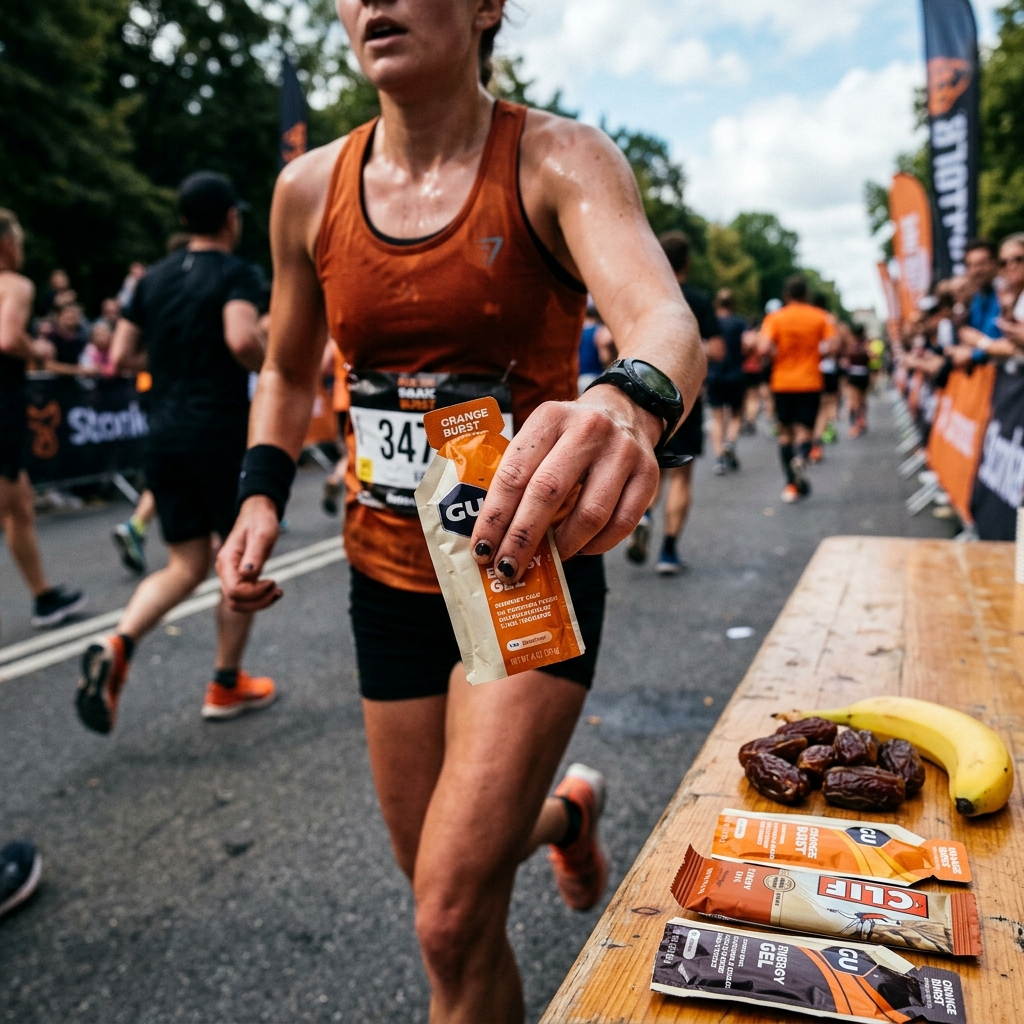
!Runner grabbing a gel mid-race with energy food laid out on a table
Why mid-run fueling matters (and when it doesn't)
For a typical 65 to 75 kg runner, the body stores approximately 1,800 to 2,000 calories of glycogen - the carbohydrate fuel your muscles prefer - split between your liver and muscles. At an easy run pace, that is roughly enough to cover 25 to 30 kilometres without additional fuel.
This is why fueling strategy doesn't matter much for runs under 60 to 75 minutes. Your glycogen stores can handle a 10K without help. Eating gels for a parkrun is unnecessary and can actually cause gastrointestinal distress without the benefit of prolonged exercise to flush the sugar through.
The picture changes entirely once you're running beyond 75 to 90 minutes. At that point, your glycogen stores start to deplete and blood glucose levels begin to drop. Both of these things reduce running performance. Fueling consistently during the run keeps blood glucose stable and spares the glycogen reserves you're going to need later.
Current sports nutrition guidelines, based on research from institutions including the University of Birmingham and published in peer-reviewed journals, recommend:
- Under 60 minutes: no carbohydrate intake needed
- 60 to 90 minutes: 30 to 40g of carbohydrate per hour
- 90 minutes to 2.5 hours: 40 to 60g of carbohydrate per hour
- Over 2.5 hours: 60 to 90g of carbohydrate per hour, using multiple carbohydrate types
The 60g/hour ceiling - and how to break through it
Here's the biology that most runners don't know.
Glucose - the primary carbohydrate in most gels and sports drinks - is absorbed in the small intestine via a transporter called SGLT1. That transporter has a maximum capacity of around 60 grams of glucose per hour. Feed it more than 60g from glucose alone and the excess sits in your gut, draws in water, and causes the bloating, cramping, and GI distress that every long-distance runner has experienced at least once.
The way to break through 60g/hour without causing gut problems is to use a second type of carbohydrate: fructose. Fructose uses a completely different intestinal transporter (GLUT5), so it doesn't compete with glucose. Combining glucose (or maltodextrin, which breaks down to glucose) and fructose in approximately a 2:1 ratio allows the body to absorb 80 to 90g of carbohydrate per hour with meaningfully lower GI distress.
Most modern endurance-specific gels and drinks are now formulated with this dual-transporter approach. Check the label: if you see both maltodextrin and fructose (or glucose and fructose), that's the dual-source formulation. If it only lists maltodextrin or glucose, you're limited to the 60g ceiling.
For half marathon runners, this rarely matters - you're unlikely to exceed 60g/hour over a 1.5 to 2.5 hour race unless you're fueling very aggressively. For marathoners pushing 3+ hours, it becomes relevant in the final stages when cumulative carbohydrate consumption starts to add up.
Gels, chews, and real food compared
There is no universally superior option. Each has practical trade-offs.
Gels are the most convenient. They're compact, require no chewing, deliver carbohydrate quickly, and can be practiced easily on training runs. The main issue is that some runners find the texture and high sugar concentration nauseating at high intensities - the same intensity that also reduces blood flow to your gut, making digestion harder. Always take standard gels with water, not sports drink, to prevent an overly concentrated sugar solution in your stomach.
Chews (such as Clif Bloks or Sport Beans) are a middle ground. They require chewing, which slows absorption slightly and can feel more natural to runners who find gels unpleasant. They work well for runners who prefer to spread fueling across several chews over a few minutes rather than downing a full gel at once. The downside is that at very high intensities, chewing while breathing hard is impractical.
Real food - bananas, medjool dates, cooked white rice balls, boiled potatoes with salt - is what many ultra runners and some marathoners use, particularly in later stages of a long race. Studies comparing real food to gels have found comparable performance outcomes when matched for carbohydrate content. The practical advantages of real food include satiety (which matters more in ultras than marathons), palatability for runners who have gel fatigue late in a race, and the psychological comfort of eating something recognisable. The disadvantages are bulk, mess, and the need for preparation.
Timing: when to start, how often, how much
The number one rule: start fueling before you need it.
By the time you feel the energy dip, blood glucose has already begun to fall and glycogen depletion is underway. At that point, you're playing catch-up, which is physiologically harder than staying ahead of it.
For a half marathon: - Take your first gel or chews at 20 to 30 minutes into the race - Take a second at 55 to 70 minutes (depending on your finish time target) - Most runners need 2 to 3 gels total for a half marathon
For a marathon: - First gel at 20 to 30 minutes in - Continue every 30 to 45 minutes thereafter - Most runners need 4 to 6 gels total, aiming for 45 to 60g of carbohydrate per hour - Consider a caffeinated gel in the final third of the race for the cognitive and fatigue-perception benefits - but only if you've practiced this in training
Caffeinated gels (typically 25 to 75mg of caffeine) do have evidence behind them. Caffeine reduces perceived exertion and can blunt the mental fog of late-race fatigue. The key is timing - taking caffeine too early or in excess can cause jitters and GI distress.
The gut training protocol: how to actually prepare your digestive system
This is the part most runners skip, and it's the part that causes the most race day disasters.
Your gut is trainable. Research from sports dietitians, including work published in the International Journal of Sports Nutrition and Exercise Metabolism, has shown that consistent practice of fueling at exercise intensity causes adaptations in the intestinal transporters themselves - meaning they become more efficient at absorbing carbohydrate during exercise.
The practical protocol involves five steps:
First, start 6 to 10 weeks before your target race. Do not begin gut training the week before - by then it is too late to adapt.
Second, fuel every long run at your target race-level intake. If your race plan calls for 60g per hour, practice 60g per hour on your Sunday long runs. You cannot do long runs fasted and then expect your gut to handle gels on race day.
Third, use exactly what you will use on race day. This means the same brand, flavour, and format. Your gut adapts to specific carbohydrate sources. Switching gel brands in the final weeks is a major risk. Never, under any circumstances, use a product on race day that you haven't practiced with in training.
Fourth, practice at race intensity. The gut is much more tolerant of fueling at an easy pace. The real challenge is absorbing carbohydrate while running at threshold or above, when blood flow to the intestines is reduced. Your tempo runs and long run surges should include fueling practice.
Finally, log what works. After every long run with fueling, note what you took, when, and how your gut responded. GI tolerance is highly individual - what wrecks one runner's stomach might be perfect for another.
What to do if you have GI issues
Gastrointestinal distress during running is extremely common - studies suggest up to 50% of marathon runners experience some symptoms. The causes are a combination of the mechanical jarring of running, reduced blood flow to the gut during intense exercise, and nutritional factors.
If you're regularly having stomach problems on long runs, start by isolating variables. Try one change at a time: switch to an isotonic gel (designed to be taken without water), reduce your intake per hour, increase the water you take with each gel, or trial real food instead. Be aware that glucose-only products can cause more distress at high intake rates than dual-source gels, as they hit the SGLT1 ceiling faster.
Also look at pre-run nutrition. High-fibre, high-fat, or high-protein meals too close to a long run can cause problems independent of what you take during the run. Keep pre-run meals simple, low-fibre, and carbohydrate-dominant in the two to three hours before.
Finally, don't forget electrolytes. Carbohydrate absorption requires sodium. Top nutrition strategies always pair carbohydrate intake with adequate sodium, particularly in warmer weather. Ensure your gels contain sodium, or use a separate electrolyte drink.
A well-designed running plan should schedule your long runs and fueling practice as a combined system - not treat nutrition as an afterthought. And if your gut is severely limiting your training, a sports dietitian consultation is worth the investment before your next big race.
The runners who nail fueling don't have magic stomachs. They trained their guts the same way they trained their legs - with consistency, patience, and the same specificity they applied to every other aspect of race preparation.