Masai Russell Runs 12.14: America's Fastest Hurdler Is Two Hundredths from History
Masai Russell clocked a 12.14 at the 2026 Xiamen Diamond League, setting a new American Record and moving to second on the all-time women's 100m hurdles list. Here's a breakdown of the run and what makes her world record chase so compelling.
· 5 min read · Athletics News
Two hundredths of a second.
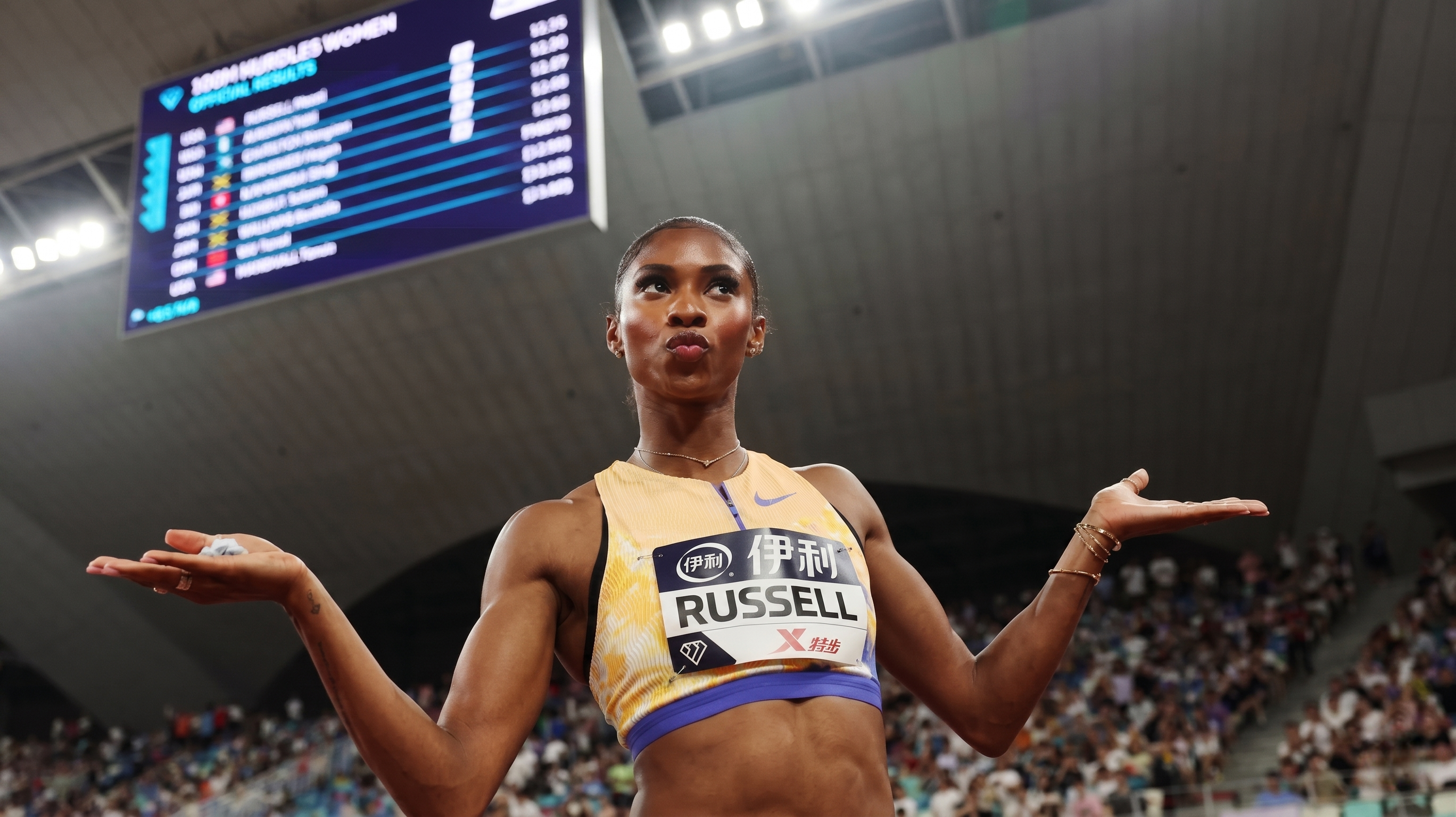
That's all that stands between Masai Russell and the fastest 100m hurdles ever run by a woman. Yesterday in Xiamen, China, the Olympic champion clocked 12.14 seconds at the Wanda Diamond League - a new American Record, a new Diamond League record, and the second-fastest time in the history of the event.
The world record, held by Nigeria's Tobi Amusan at 12.12, is well within sight.
!Masai Russell winning the 100m hurdles at the 2026 Xiamen Diamond League
What happened in Xiamen
Russell went to the front early and never gave anyone a look in. She crossed the line in 12.14 seconds (wind: +0.5 m/s - well within the legal limit), beating the reigning world record holder Tobi Amusan into second place by 0.14 seconds. Devynne Charlton of the Bahamas took third in 12.37, a national record.
To put the winning margin in context: Russell didn't just edge Amusan. She beat the world record holder by almost a tenth of a second. In hurdles, that's a dominant performance.
The wind reading matters too. A +0.5 m/s tailwind is close to neutral - far from the maximum legal +2.0 m/s. On a calmer day, Russell still would have run a remarkable time.
The numbers behind the run
Here's where things get interesting. The women's 100m hurdles world record progression has barely moved in the last four decades:
| Time | Athlete | Year | |------|---------|------| | 12.12 | Tobi Amusan (NGR) | 2022 - Current WR | | 12.20 | Kendra Harrison (USA) | 2016 | | 12.21 | Yordanka Donkova (BUL) | 1988 |
For nearly 30 years, the record sat at 12.21. Kendra Harrison finally broke it in 2016 with 12.20. Then Amusan came along in Eugene at the 2022 World Championships and took it all the way down to 12.12. That's an 0.08-second improvement - the biggest single jump in the event's record books in over 40 years.
Now Russell is sitting at 12.14, just 0.02 seconds off that mark.
Her own progression in the last 12 months has been rapid. In May 2025 at the Grand Slam Track meet in Miami, she ran 12.17 to break Kendra Harrison's long-standing American record of 12.20. Less than a year later, she's improved that by another three hundredths. In sprint terms, that's a significant jump.
Who is Masai Russell?
Russell was born in Washington D.C. in 2000 and grew up in Potomac, Maryland. She went to the University of Kentucky where she became the NCAA record holder in the 100m hurdles under coach Lonnie Greene. By the time she reached the 2024 U.S. Olympic Trials, she was already running 12.25 - at the time the fourth-fastest time ever.
Paris was her Olympic debut. She won gold in 12.33, edging France's Cyréna Samba-Mayela on home soil. It was the first time an American woman had taken Olympic gold in the 100m hurdles since 2016.
She's 25 years old. She is already the second-fastest hurdler in history. And she's improving.
The world record is genuinely close
After the race in Xiamen, Russell was clear about what she's thinking.
"I've been saying all year I'm going to break the world record," she said. "I don't know when it's going to come, but I keep getting closer and closer."
That quote matters more than it might seem. In 2025, Russell spoke publicly about overcoming self-doubt following her Olympic win. The pressure of expectations - going from surprise champion to defending favourite - took a mental toll. She's credited a shift in mindset, greater consistency in training, and a renewed love for the event as the reasons she's running like this now.
She also beat Amusan head to head yesterday. The world record holder finished 0.14 seconds back. On a day when Amusan was running a legal 12.28, Russell was running 12.14. That's not a gap - that's a statement.
The championship season is still ahead. If Russell is this sharp in May, what does September look like?
What everyday runners can take from an elite hurdlers mindset
You're probably not going to run 12.14 in the near future. Neither am I. But the mental pattern Russell has described - fighting self-doubt after achieving something big, then recalibrating - is one almost every runner goes through.
A lot of runners hit a PB and then freeze. The expectation to match or beat it the next time out becomes a weight. Some spend years chasing a time they ran on their best day, instead of training toward a new ceiling.
Russell's approach is different. She got the gold, acknowledged the mental noise that followed, worked on it, and came back running faster than she ever has. That cycle - achieve, recalibrate, improve - is what genuine athletic progression looks like at any level.
Your version might be chasing a sub-30 parkrun or a sub-4-hour marathon. The process is the same.
*Want to find your next race or build a training plan around your own goals? Check out upcoming running events near you or generate a personalised training plan at yourrunguide.com.*