What Actually Happens to Your Body at Mile 20 (And How to Never Hit the Wall Again)
The wall is not a myth and it is not a mental failure. Around mile 20, your body runs out of the fuel it has been preferring all race. Here is the physiology behind it and the three things that prevent it from happening.
· 9 min read · Training
You have probably seen it. A runner who looked composed at the halfway mark suddenly goes rigid, slows to a shuffle, and gets passed by everyone around them. Their face changes. Their form collapses. They are staring at the road about six inches in front of their feet.
That is not a mental breakdown. That is glycogen depletion, and it has a very specific biology. Understanding what is actually happening at mile 20 is the first step to making sure it never happens to you.
!Marathon runner stopped at mile 20 marker, hands on knees, grimacing while other runners pass

The fuel your body is running on
Your muscles and liver store carbohydrate as glycogen. At race pace, your working muscles are burning a mixture of carbohydrate (glycogen) and fat, but the ratio shifts strongly toward carbohydrate at any effort above easy jogging. Marathon race pace, for most recreational runners, sits in a zone where carbohydrate is the dominant and increasingly preferred fuel source.
The total glycogen storage capacity of an average trained runner is roughly 400 to 500 grams, which represents about 1,600 to 2,000 kilocalories of energy. That sounds like a lot. At marathon pace it is not.
A runner completing a marathon in four hours burns roughly 2,400 to 2,800 total calories. Even if you could run entirely on carbohydrate - which you cannot - your glycogen stores would fall short. In practice, the faster you run, the more heavily you rely on carbohydrate, which is why faster runners tend to hit the wall harder and earlier than slower ones when pacing or fueling goes wrong.
Around miles 18 to 22 - sometimes earlier in runners who went out too fast or skipped fueling - muscle glycogen falls critically low. Your body begins shifting more aggressively to fat as a fuel source. Fat burning is slower, less efficient, and cannot sustain the effort your pace requires. The result is an abrupt, involuntary slowdown that feels like someone switched off the engine.
This is the wall. It is biology.
Why the first half matters more than the second
The most underappreciated thing about the wall is how much it is determined by what you do in the first half of the race, not the second.
Every kilometre you run faster than your aerobic threshold in the early miles is a kilometre where you are burning carbohydrate at a rate higher than your body's steady-state capacity. The faster you run those early miles, the deeper you reach into your glycogen bank account.
There is no way to "refill" glycogen stores mid-race at the rate needed to compensate for an aggressive first half. Even with perfect fueling - taking a gel every 30 to 45 minutes - you can only absorb roughly 60 to 90 grams of carbohydrate per hour from the gut. That is enough to top up and maintain reserves when pacing is even, but not enough to repair the damage of going out 30 seconds per kilometre too fast for 10 miles.
The conclusion is uncomfortable but simple: if you hit the wall, the root cause was almost certainly something you did before mile 10, not what happened at mile 20.
What the crash feels like from the inside
Runners who have hit the wall describe it in remarkably consistent terms, even when they do not know the physiology behind it.
The first sign is usually a heaviness in the quads that is different from normal fatigue. Then the pace drops, not gradually but in a step. Then a kind of mental fog arrives - the ability to do simple arithmetic, remember the next mile marker, or maintain race strategy becomes difficult. Some runners feel light-headed. Many describe a powerful urge to walk or stop.
The heaviness in the legs is the muscles signaling that their preferred fuel is critically low. The mental fog has a physiological basis too: the brain also runs primarily on glucose, and when blood glucose is pulled down by glycogen-depleted muscles competing for fuel, cognitive function suffers.
The irony is that hitting the wall feels like weakness or lack of fitness. It is actually a consequence of running faster than your fuel system could sustain. Many of the people who hit the wall hardest are the fittest runners in the field who went out at an unsustainable effort.
Three things that prevent the wall
!Cinematic close up of a runner grabbing a bright energy gel pack from a race volunteer
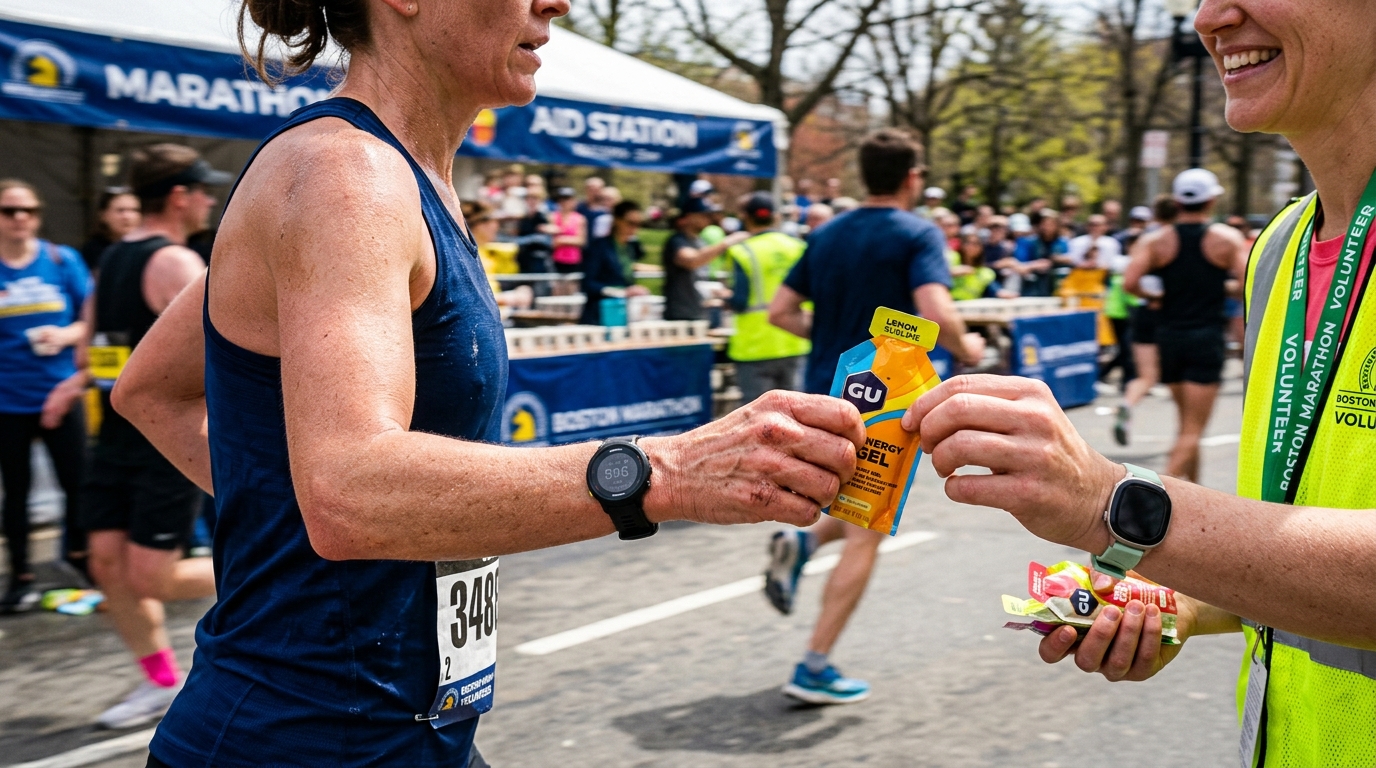
The wall is common but it is not inevitable. Three elements, executed correctly, almost eliminate it as a risk.
Even pacing from the gun. If your goal pace is 5:30 per kilometre, the first 5 kilometres should be around 5:30 to 5:45, not 5:00. The excitement of the start and the freshness of tapered legs will make that feel absurdly slow. Do it anyway. Every 10 seconds per kilometre you run above target pace in the opening miles buys you a smaller and smaller margin of glycogen going into the back half.
Carbohydrate during the race, not just before it. Pre-race carb loading fills glycogen stores to capacity. It does not expand them. To get through a marathon without hitting the wall, you need to take on carbohydrate while running. Start taking gels or chews from around the 30-minute mark - before you need them, not after you feel depleted. A gel every 30 to 45 minutes, washed down with water, keeps blood glucose stable and spares some muscle glycogen. Most runners who hit the wall either started their fueling too late or skipped aid station stops when they felt fine.
Training your gut. The gut is trainable. If you rarely take gels during training runs, your gut will not efficiently absorb carbohydrate mid-race - it may reject it entirely with nausea or GI distress. Practice your race-day fueling on your long runs. Use the same gels in the same quantities you plan to use on race day. A gut that is trained for mid-run fueling is one of the most underrated performance factors in marathon training.
The difference between the wall and ordinary fatigue
Not every difficult final five miles is the wall. Ordinary marathon fatigue - tired legs, accumulated effort, slowing pace - is normal and expected. The wall is a different experience in quality, not just quantity.
The way to tell the difference: ordinary fatigue is gradual and manageable. The wall has a collapse quality. The involuntary nature of the slowdown is the signal. If your legs feel tired but you can still choose to hold pace with effort, that is fatigue. If your pace drops and you cannot stop it from dropping no matter how much you want to maintain it, that is more likely glycogen-related.
There is also a middle zone where runners are partially depleted - enough to slow significantly but not to fully bonk. Most recreational runners who "hit the wall" are in this range rather than in the full crash. The prevention strategies work for both.
Training habits that reduce wall risk
Beyond race-day pacing and fueling, some training habits make you more wall-resistant over the course of a full training cycle.
Running your long runs at genuinely easy pace - not marathon pace, not halfway between easy and marathon - trains your body to access fat as a fuel source more efficiently. This is sometimes called fat adaptation. It does not mean running races on fat alone; it means expanding the aerobic base so that at marathon pace, you are burning a slightly higher proportion of fat, preserving glycogen for the closing miles.
Some coaches prescribe occasional long runs where runners take no fuel at all (only water) for the first 90 minutes, training the metabolic flexibility to use fat at moderate effort. This is not suitable for every runner and should be introduced slowly, but it is a genuine training tool for marathoners who have repeatedly hit the wall.
Find races: Browse marathons and running events on Your Run Guide and build a fueling-smart training plan before your next start line.