Julien Alfred Runs 21.51: Third-Fastest 200m in History at Monaco Diamond League 2026
At the 2026 Monaco Diamond League, Julien Alfred clocked 21.51 seconds in the women's 200m - a new national record, a meeting record, and a time that places her third on the women's all-time list, behind only Flo-Jo and Shericka Jackson.
· 7 min read · Athletics News
Julien Alfred just ran one of the fastest 200 metres in history - and she did it starting from one of the slowest reactions in the field.
On Friday night at Stade Louis II in Monaco, the Saint Lucian sprinter clocked 21.51 seconds in the women's 200m at the 2026 Meeting Herculis EBS Diamond League. It's a new personal best. A new Saint Lucia national record. A new Monaco meeting record. And the world lead for 2026 by a massive margin.
It also puts her third on the all-time list for any woman who has ever run the distance. Only Florence Griffith-Joyner and Shericka Jackson have run faster.
!Julien Alfred powering through the Monaco 200m in 21.51 seconds
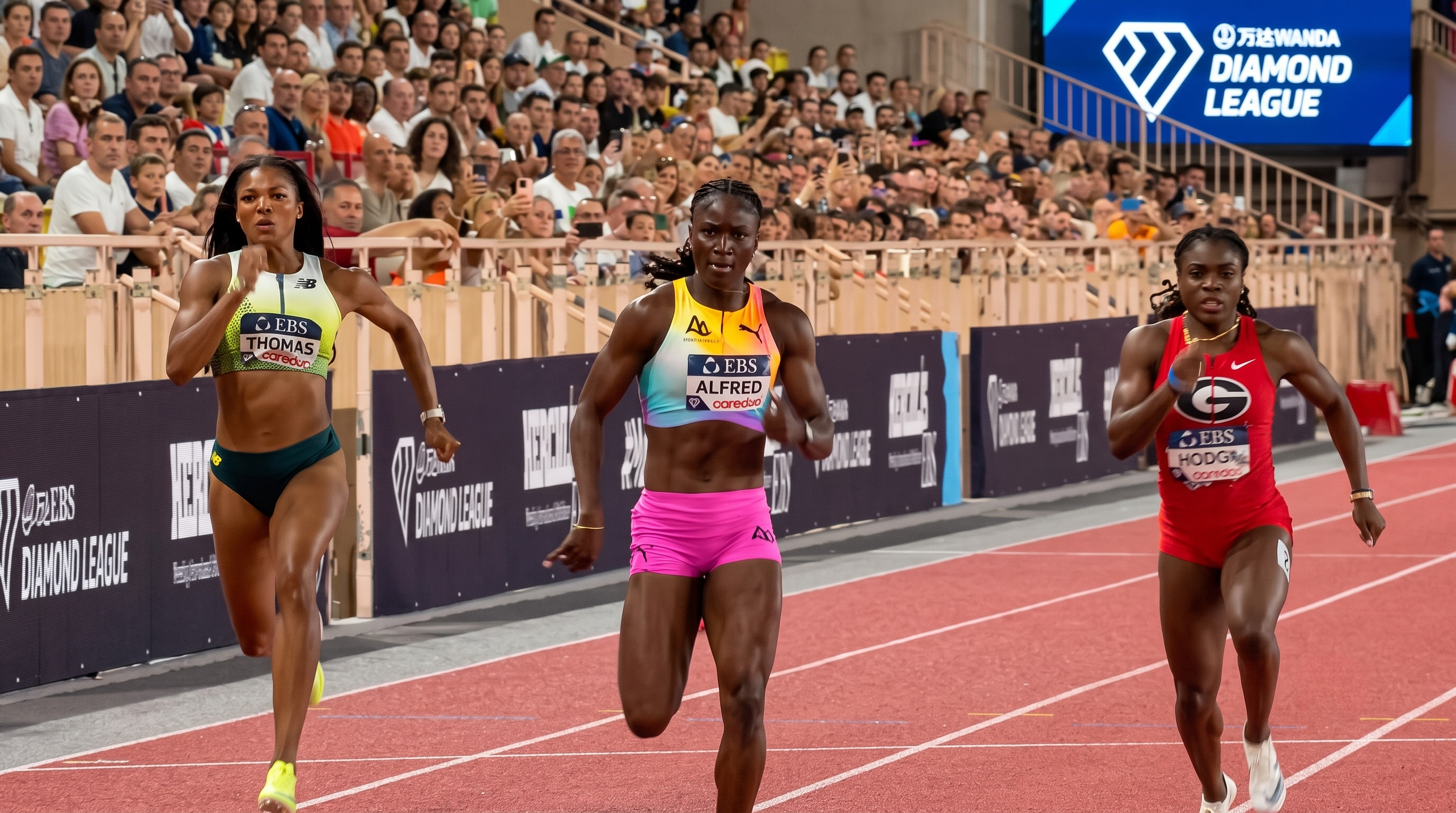
How Julien Alfred won the Monaco 200m in 2026
The women's 200m field in Monaco was exactly what you'd expect from a Diamond League meet - competitive and stacked. Reigning Olympic 200m champion Gabby Thomas was there. Adaejah Hodge, the 19-year-old British Virgin Islands sprinter who has been one of the stories of the 2026 season, was in the race too.
Alfred came out of the blocks with one of the slower reaction times on the track. That's not new for her - she's never been a blazing starter. What she is, however, is a closer. By the time the field hit the straight, she had moved through and by the finish line it wasn't particularly close.
Final results:
| Place | Athlete | Country | Time | |-------|---------|---------|------| | 1st | Julien Alfred | Saint Lucia | 21.51 | | 2nd | Adaejah Hodge | British Virgin Islands | 21.76 | | 3rd | Gabby Thomas | USA | 21.84 |
Alfred crossed the line and looked at the clock. Her reaction said everything - she hadn't expected that time either. "I didn't realise how fast it was till I crossed the line," she said afterwards. "There are no limits right now."
Where 21.51 sits in history
The all-time women's 200m list needs a closer look, because Shericka Jackson occupies three of the top four spots on her own. When looking at unique athletes:
- Florence Griffith-Joyner holds the world record of 21.34 (Seoul, 1988), untouched for 38 years.
- Shericka Jackson is the second-fastest ever with her 21.41 (Budapest, 2023).
- Julien Alfred joins them as the third-fastest unique performer ever with her new 21.51 in Monaco.
The full all-time performance list (all marks, all athletes) looks like this:
| Rank | Time | Athlete | Country | Year | |------|------|---------|---------|------| | 1 | 21.34 | Florence Griffith-Joyner | USA | 1988 | | 2 | 21.41 | Shericka Jackson | JAM | 2023 | | 3 | 21.45 | Shericka Jackson | JAM | 2022 | | 4 | 21.48 | Shericka Jackson | JAM | 2023 | | 5 | 21.51 | Julien Alfred | LCA | 2026 | | 6 | 21.53 | Elaine Thompson-Herah | JAM | 2021 |
Alfred's 21.51 sits 0.17 seconds off Flo-Jo's 38-year-old world record, and 0.10 seconds off Jackson's best. Those aren't abstract gaps - they're real targets within range of an athlete who is clearly still improving.
For context: Elaine Thompson-Herah's 21.53 at the 2020 Tokyo Olympics was considered one of the all-time great 200m performances. Alfred just ran faster than that in a regular season Diamond League meet.
Who is Julien Alfred?
If you've only started paying attention to sprinting recently, here's the short version of what makes Alfred's story extraordinary.
She was born on June 10, 2001, in Castries, Saint Lucia. Growing up, her athletic talent was noticed when she was racing barefoot against boys at school. She lost her father in 2013, briefly stepped away from the sport, and came back. At 14, she moved to Jamaica to train at St. Catherine High School, surrounded by a sprinting culture that shaped some of the world's fastest athletes.
She moved to the United States for university, ran for the University of Texas Longhorns, and won multiple NCAA titles including the 60m, 100m, and 200m. She won The Bowerman Award in 2023 - the top honour in US collegiate athletics.
Then, at the 2024 Paris Olympics, she put Saint Lucia on the global sprinting map for good. She ran 10.72 seconds to win the women's 100m gold - defeating Sha'Carri Richardson in the process - and became the first Olympic medalist of any kind in Saint Lucia's history. She also took silver in the 200m at those same Games.
In early 2024, she had already won the World Athletics Indoor 60m title in Glasgow - again, a first for Saint Lucia at the senior global level.
This Monaco run is not a fluke. It's the latest performance in a career trajectory that keeps rewriting what's considered possible for a small island nation on the world stage.
What makes this run technically interesting
Alfred's race in Monaco illustrates something coaches talk about that most recreational runners find counterintuitive: acceleration curves matter more than start speed.
She had one of the slower reaction times in the race. In a pure 100m sprint, that's almost impossible to overcome at elite level. But the 200m operates under different physics. The curve is where races are set up, and the straight is where they're decided.
Alfred is built for the back half. Her stride rate and length in the final 60 metres of a 200m are among the best on the circuit. She doesn't panic when she's behind off the gun. She trusts her mechanics and executes.
That's a lesson that applies well beyond elite sprinting. In road racing, runners who go out too conservatively for the first half of a race often post better finishing times than those who lead early. Negative splitting - running the second half faster than the first - is the most common characteristic of personal best performances at every level. You can see how this works by planning out your target times with our pace calculator or tracking your negative split strategy with the race splits calculator. Alfred runs a kind of extreme version of that principle.
The Monaco night wasn't just about Alfred
The Meeting Herculis is one of the fastest Diamond League stops on the calendar - Monaco's compact stadium, the warm Mediterranean air, and the quality of the field consistently produce top-shelf times.
Friday's meet delivered. Emmanuel Wanyonyi of Kenya set a new men's 1,000m world record in 2:11.83, one of several major performances across the evening. Alfred's 200m was the standout moment, but the meet as a whole was a reminder of what the Diamond League circuit is capable of producing in peak conditions.
Why this matters beyond the headline number
Alfred's performance deserves a proper acknowledgement that goes beyond just ranking her time on a list.
Saint Lucia has a population of around 175,000 people. For context, that's smaller than most mid-sized regional cities. The idea that a sprinter from a country that size is now the third-fastest woman in the history of the 200m is genuinely remarkable. It's worth sitting with that for a moment before moving on to the next result.
It also sets up what could be one of the best women's sprint seasons in recent memory. Shericka Jackson has been dealing with injuries. Alfred is peaking. Hodge - who finished second here in 21.76 at 19 years old - is still getting faster. The field for this event at the 2026 World Athletics Championships is going to be extraordinary.
> Update 18 July 2026: Alfred backed it up in London with another 200m win over Gabby Thomas, running 21.66 for a meeting record. Read the London Diamond League 200m report.
Find races: Browse running events and races worldwide on Your Run Guide, or build your own training plan and start building toward your own fast finish.