IT band syndrome in runners: what actually helps it heal
Outer knee pain from IT band syndrome usually comes from training load and weak hip control, not a tissue that needs more rolling. Here is a shorter, practical rehab plan runners can actually use.
· 6 min read · Injury Prevention
Outer knee pain from IT band syndrome is usually a load problem first and a tissue problem second. If your pain keeps showing up at the same point in every run, the fix is rarely more foam rolling. It is usually a mix of backing off the aggravating load, rebuilding hip strength, and returning to running more carefully.
The short version is this: reduce the pain enough to train, strengthen the hip muscles that control the knee, then restart with flatter routes and shorter steps. That is what tends to get runners better.
The quick answer
If you think you have IT band syndrome running pain, do these three things first:
- Cut back the runs that trigger it, especially longer runs, hills, and downhills.
- Start hip-strength work 3 to 4 times per week.
- Return with short run-walk sessions instead of jumping back to normal mileage.
Most runners start to feel progress within a few weeks if they stick to that consistently. Full recovery often takes 6 to 8 weeks, and longer if you keep cycling between resting completely and then going straight back to normal training.
If you need a structured comeback, the AI run planner can build a return-to-running plan around your current mileage and race date.
What IT band syndrome actually is
The IT band is a thick strip of connective tissue on the outside of the thigh. In runners, the pain usually shows up because the outside of the knee is getting irritated by repeated loading, not because the band itself needs to be stretched out.
!Anatomy of the lateral knee and iliotibial (IT) band showing areas of compression
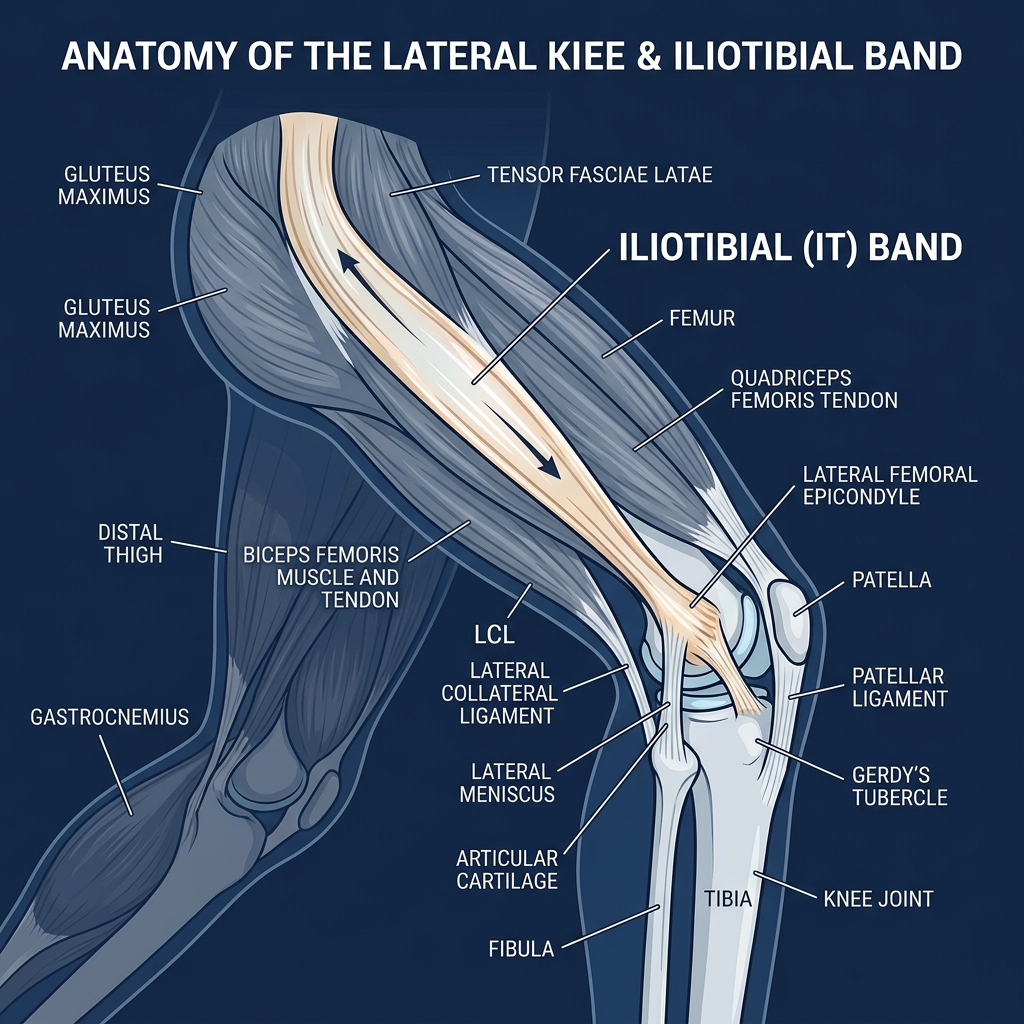
The image above is the key idea: the painful spot is usually around the outside of the knee, where repeated loading irritates the tissue around the IT band.
That is why IT band syndrome often behaves in such a predictable way: the run feels fine at first, then the same outer-knee pain appears at roughly the same distance or time point. That pattern usually points to a training-load issue layered on top of weak hip control or a gait problem.
Foam rolling can still be useful if it makes the area feel better temporarily. The problem is that it does not address the main reason the pain keeps coming back.
Why runners get IT band pain
IT band syndrome in runners usually comes from one or more of these:
- Hip abductor weakness. If the glutes are not controlling the pelvis well, the knee tends to drift inward and the outside of the knee takes more load.
- Overstriding. Landing too far in front of your body increases the time spent in the knee angle where the outside of the knee is most stressed.
- Sudden mileage jumps. IT band pain often shows up when weekly volume or long-run distance goes up faster than the legs can adapt.
- Downhill running. Descents increase braking forces and can flare the outside of the knee quickly.
- Cambered roads. Repeating the same sloped road can load one side differently from the other.
If the pain started during a marathon block, after hill work, or after a big mileage jump, that is usually not a coincidence.
The rehab plan that tends to work
Phase 1: calm it down
The first job is not total rest. It is reducing the specific load that keeps irritating the knee.
- Cut or pause the runs that trigger clear pain escalation.
- Swap some running for cycling, pool running, or swimming if those feel comfortable.
- Use cold therapy or compression if the area feels especially irritated after a run.
- If pain relief is needed, short-term anti-inflammatory medication may help some runners, but it is worth checking with a clinician if you have any medical reason to avoid it.
The goal here is simple: get back to pain-free walking and everyday activity, then move on quickly to strength work.
Phase 2: build hip strength
This is the part most runners skip, and it is usually the reason the pain comes back.
The main target is hip control. Good starting exercises include:
- Clamshells
- Side-lying hip abduction
- Single-leg glute bridges
- Banded monster walks
- Supported single-leg squats once the basics feel easy
Do them 3 to 4 times per week. Keep going after the pain settles. If you stop as soon as the knee feels better, the underlying weakness usually stays there.
If you want a fuller strength routine, strength training for runners covers the key patterns worth keeping in your week.
Phase 3: return to running gradually
Once daily life is comfortable and the strength work is going well, return to running with more restraint than you think you need.
- Start with run-walk intervals.
- Keep the first few runs flat.
- Avoid hard workouts and downhills early.
- Shorten your stride slightly and let cadence come up a little naturally.
A small cadence increase can reduce knee loading for some runners, but the point is not to force an arbitrary number. The point is to stop reaching out in front of your body with every step.
If you are unsure whether a run is safe, use the traffic-light approach from when to run through pain vs. when to stop. Mild pain that stays stable is different from pain that gets sharper as the run goes on.
When to see a physio
Book in with a sports physio if:
- The pain is sharp, severe, or starts affecting walking
- You have swelling, locking, or pain at rest
- The pain has lasted more than a few weeks without real progress
- You have followed a sensible rehab plan for 6 to 8 weeks and still cannot build back up
Outer-knee pain is not always IT band syndrome. A physio can check whether the real issue is something else, such as a meniscus problem or another lateral-knee irritation.
How to stop it coming back
The runners who get past IT band syndrome long term are usually the ones who change their training habits, not just their recovery routine.
- Keep one or two hip-strength sessions in your normal week.
- Build mileage gradually, especially at the start of a new plan.
- Be careful with downhill sessions and sloped roads when fatigue is high.
- Watch for overstriding when your form falls apart late in runs.
If you have had IT band pain before, it is worth treating hip strength the same way you treat long runs or workouts: part of training, not optional rehab homework.
FAQ
Can I run with IT band syndrome? Sometimes, yes. Short easy runs can be reasonable if the pain stays mild and does not worsen as you continue. If you start limping, changing your stride, or feeling sharper pain, stop.
How long does IT band syndrome take to heal? Many runners improve within 6 to 8 weeks when they reduce the aggravating load and stay consistent with strength work. Stubborn cases can take longer, especially after repeated stop-start recovery cycles.
Should I change my shoes? Old shoes can add to the problem, but a shoe change rarely fixes IT band syndrome on its own. Load management and hip strength matter more.