How to Pace a Half Marathon: The Strategy That Stops You from Fading
Most half marathons go wrong in the first five kilometres. The start feels easy, the crowd is fast, and you run yourself into a wall by kilometre 15. Here is the pacing strategy that actually works.
· 8 min read · Training
The half marathon is a brutal distance to pace. Too fast and you are shuffling by kilometre 16. Too conservative and you cross the finish line knowing you left minutes on the course. The gap between a well-executed half marathon and a badly paced one is not fitness - it is decision-making in the first five kilometres.
Almost every half marathon blow-up follows the same script. Start line. Adrenaline. Everyone around you running faster than you planned. The first kilometre feels comfortable at a pace that will cost you later. You find out at kilometre 15, when your legs go and your pace drops and there is nothing you can do.
Here is how to stop that from happening.
!Half marathon start line with calm runner standing composed as others sprint past
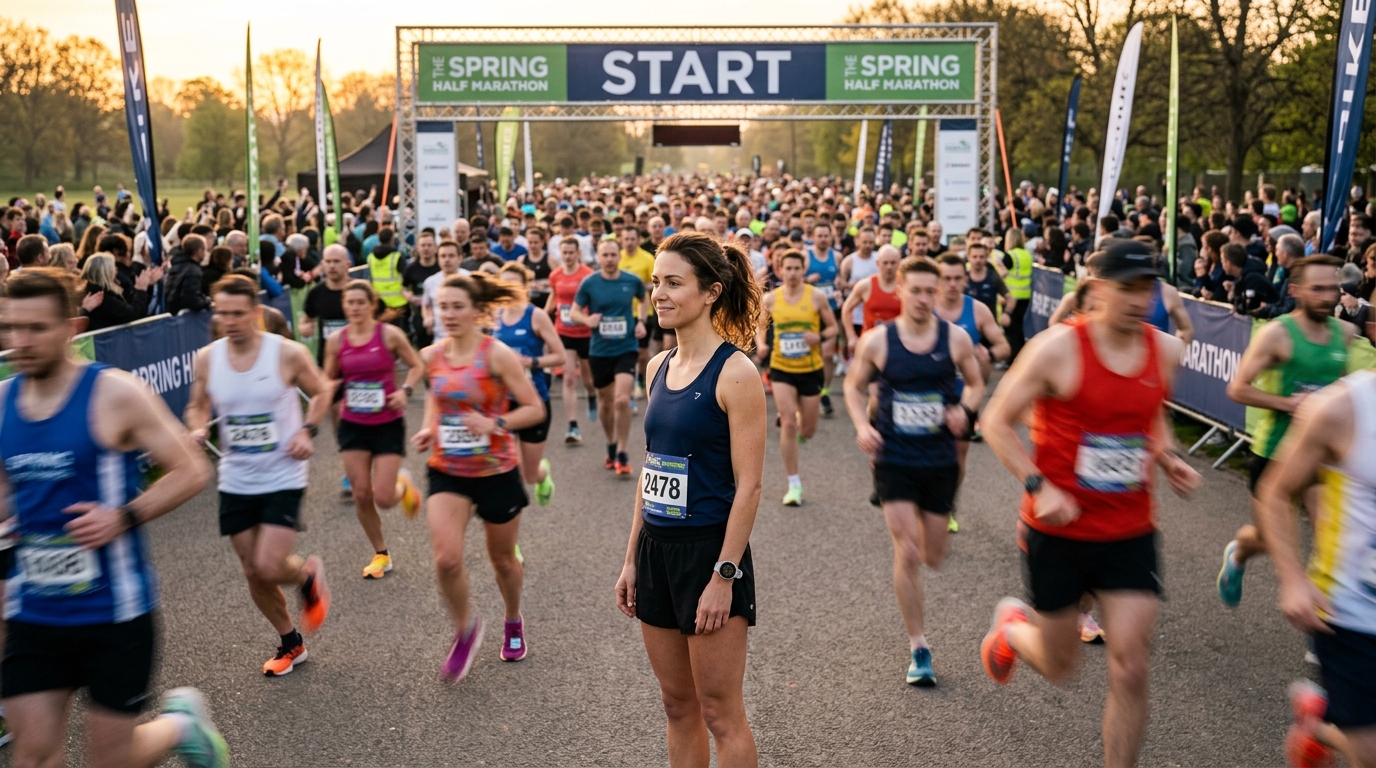
What the first five kilometres are actually for
The opening kilometres of a half marathon have one job: to preserve your ability to run the back half well.
That is it. They are not for banking time. They are not for taking advantage of how fresh your legs feel. They are not for hanging with a pace group that is slightly faster than your target because you feel good today.
The physiology is straightforward. Your aerobic system needs three to five minutes to reach steady state after you push off the line. In that opening window, you are running on whatever residual oxygen is in your muscles and the glycolytic system, which burns carbohydrate fast and accumulates acid. If you run the first kilometre at a pace significantly faster than your aerobic threshold, you start the race in oxygen debt. Repaying that debt takes 10 to 15 minutes of running at a sustainable pace, and most runners never get around to paying it back because they keep the pressure on.
This is why heart rate in the first kilometre of any race looks deceptively low relative to the effort. Your cardiovascular system has not caught up yet. You feel like you are running easy. You are not.
The practical implication: if the first kilometre feels comfortable, you are almost certainly going too fast.
Even pace or slight negative split: which is better?
!Photorealistic close-up of a GPS running watch showing negative split lap times during a race
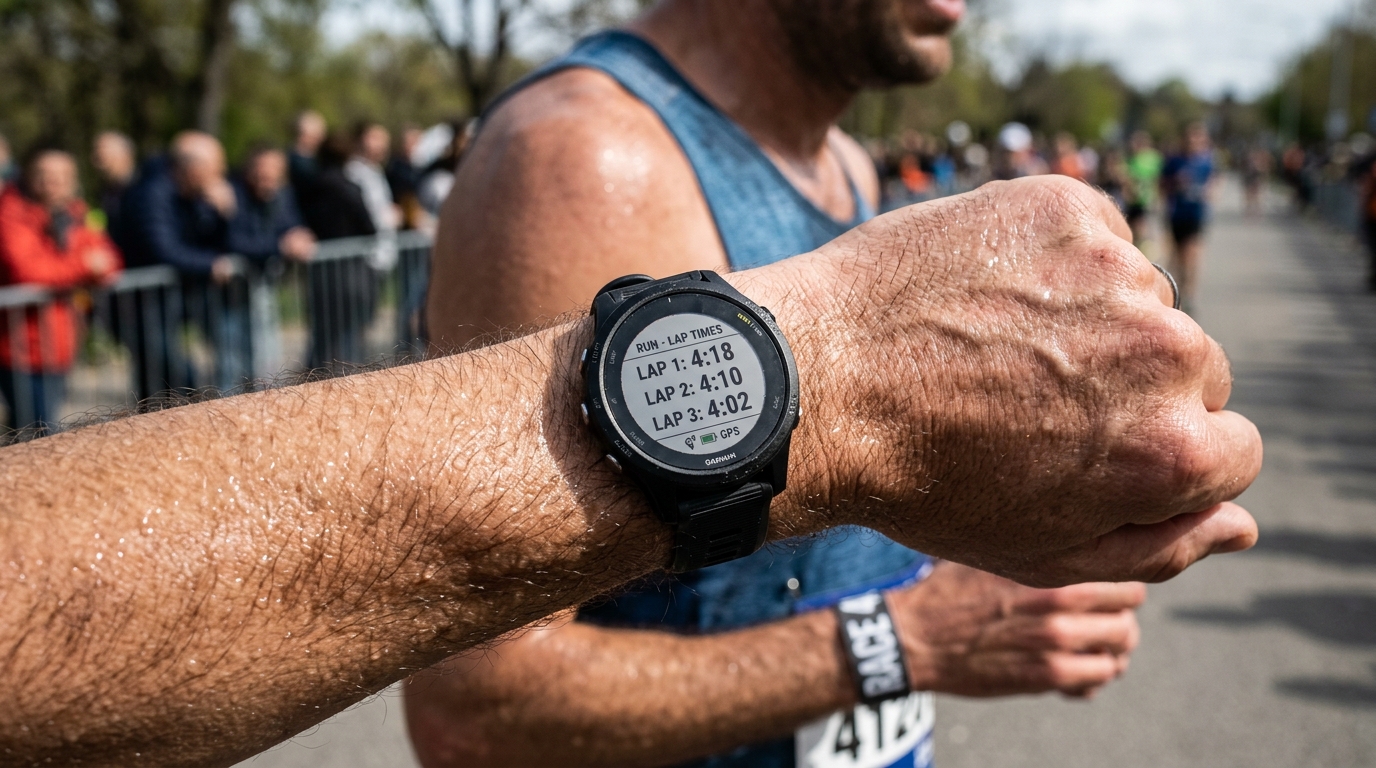
Both beat even-feeling pace, which almost always means a faster first half.
An even split - running the first 10.5 kilometres at exactly the same average pace as the second 10.5 kilometres - is a solid target for most recreational half marathon runners. It requires deliberate restraint early because the first half always feels easier than the second half.
A negative split - running the second half faster than the first - is the gold standard in elite racing and it is achievable for recreational runners who have done their pacing homework. The margin does not need to be large. Running the second half 30 to 60 seconds faster than the first half is a genuinely negative split and it means you finished the race with more in the tank than you started with. That feeling of passing people in the final 5 kilometres, rather than being passed, is worth the discipline of holding back early.
The runners most likely to naturally negative-split are those who feel slightly bored and restrained for the first 5 kilometres of the race. If you feel like you are going at a comfortable training pace, you are probably in the right range.
How to calculate your target pace
Start with your recent race data or a time trial result. A 5K or 10K time from the past six weeks gives you a good predictor.
A simple rule of thumb for recreational runners: your half marathon target time is roughly your 5K time multiplied by 4.6 to 4.8. If you recently ran 5K in 28 minutes, your half marathon target is in the 2:09 to 2:14 range. Multiply that target time by 1,000 and divide by 21.1 to get your per-kilometre pace.
There are also online pace predictors based on the Riegel formula that do this calculation more precisely and account for the exponential increase in difficulty with distance. Use the pace calculator on YourRunGuide to find your splits by kilometre.
Once you have your target pace, add 10 to 15 seconds per kilometre to get your opening 5K pace. That is what you run for the first 5 kilometres. Then ease into race pace for kilometres 5 to 15. If you still feel strong at kilometre 16, you have permission to push.
Managing the pack in the first kilometre
The most dangerous place at the start of a half marathon is the crowd itself.
People are moving fast. The collective pace of a start pack is almost always faster than any individual's race plan. Your instinct is to run with the group in front of you because they are there and you feel fine and they seem to know what they are doing. They do not. They are making the same mistake you are trying to avoid.
Three things that help:
Seed yourself honestly. If your goal pace is 5:45 per kilometre and the 5:30 pack goes out together, do not tuck in with them. Seed one group behind where your ego says you belong.
Use your watch from kilometre 1. Lock the display to pace per kilometre, not total time or distance. Check it every 500 metres for the opening 5 kilometres. Panic if you see a pace faster than your planned opening.
Let people go. This is the hardest one. You will watch runners go past you in the opening kilometre who feel like they must know something. Most of them will be walking by the time you reach kilometre 17. You will overtake them.
Pacing in different conditions
Your training pace and your race pace are not the same number on hot or humid days.
Heat and humidity increase cardiovascular strain at any given pace. Your heart rate rises faster, sweat rate increases, and the body redirects blood to the skin for cooling rather than exclusively to working muscles. A pace that would be comfortable at 15 degrees and low humidity can feel like a tempo effort at 24 degrees and 75% humidity.
On a hot race day, the pace adjustment that accounts for this is roughly 20 to 30 seconds per kilometre slower per 5 degrees above optimal racing temperature (which is roughly 10 to 15 degrees Celsius). Running 5:45 pace in perfect conditions might become 6:05 to 6:15 pace in warm conditions. Runners who ignore this on hot days almost always pay for it in the final 5 kilometres.
Wind is the other common variable. Running into a headwind costs energy in proportion to wind speed. The payback on a loop course (running with a tailwind for the return leg) is not symmetrical - you lose more going into wind than you gain coming back. Adjust expectations accordingly and do not try to make up time on the outbound leg of a headwind course.
What the well-paced half marathon feels like
If you are doing it right, the first 5 kilometres feels slightly uncomfortable in the "this is too slow" direction. Kilometres 5 to 12 feel like genuine race effort - hard but controlled. Kilometres 12 to 18 start to hurt in the normal way that half marathons hurt, but you are not falling apart. The final three kilometres are where you find out whether the early discipline paid off.
A well-paced half marathon ends with you feeling like you could not have run any faster than you did. A badly paced one ends with you knowing you left everything on the road between kilometres 10 and 16 and crawled the rest of the way home.
The difference between those two experiences is almost entirely what happened before kilometre 5.
Find races: Browse half marathons and running events near you on Your Run Guide to find your next race, then use the pace calculator to lock in your strategy before race day.