Why the Marathon is Exactly 26.2 Miles (And the Royal Reason Behind It)
From a Greek legend to the 1908 London Olympics, how a seemingly random distance became the ultimate test of human endurance.
· 7 min read · Uncategorized
The marathon is the ultimate bucket list achievement for millions of runners. It is a grueling test of physical and mental endurance. But if you have ever hit the wall around mile 20, you might have wondered why we run exactly 26.2 miles.
The official distance is 42.195 km (26.2188 miles). For the conversion tables and finish-time chart, see how long is a marathon. This piece is the origin story: why that number is not 40 km or a clean 26 miles.
It is not a round number. It is not a clean metric distance like 40 kilometers. The story of how we landed on 26 miles and 385 yards is a mix of ancient legend, competitive fire, and a very specific request from the British Royal Family.
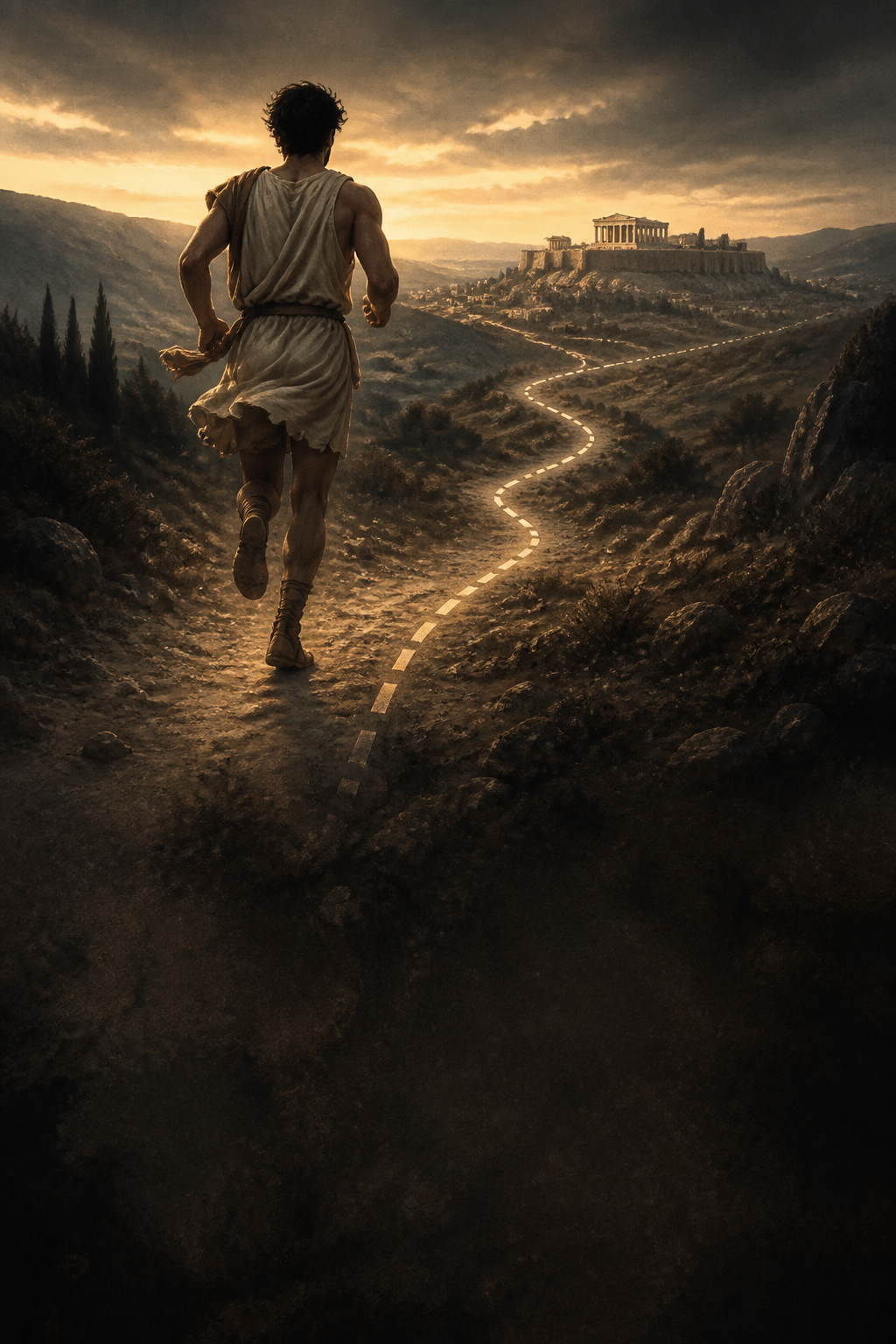
!Pheidippides running toward Athens
The Greek legend that started it all
The story begins in 490 BC with a Greek soldier named Pheidippides. According to legend, he ran from the battlefield of Marathon to Athens to announce a Greek victory over the Persians. He covered roughly 25 miles, delivered the news of the victory, and collapsed dead on the spot.
It is a dramatic story. Whether it is entirely accurate is debated by historians, but the core event - a Greek victory at Marathon followed by a messenger run to Athens - is considered historical. The exact details around Pheidippides were elaborated by later writers, particularly the Roman author Plutarch, writing more than 500 years after the battle.
Whatever its precise origins, the legend of the Marathon run lodged itself into Western consciousness. And when, 2,300 years later, a French historian proposed reviving the Olympic Games, that story became central to what the Games could be.
The 1896 Athens Olympics and the birth of a race
In 1896, the modern Olympic Games were revived in Athens. The French academic Michel Breal had been pushing Pierre de Coubertin to include a long-distance race to honor the legend of Marathon. Breal even promised a silver trophy to the winner.
Organizers created a race from the town of Marathon to the Olympic Panathenaic Stadium in Athens. The distance was roughly 40 kilometers, or about 24.8 miles. It was not precisely measured - they simply mapped a route between the two points.
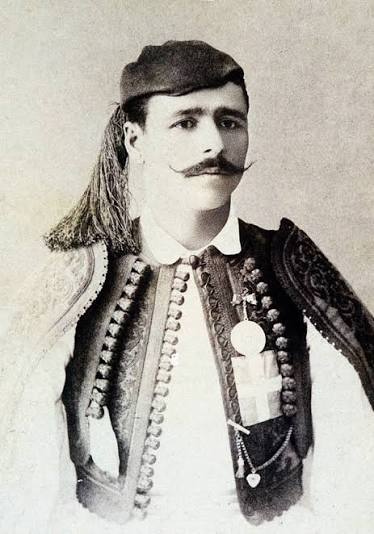
The race was a sensation. Greek runner Spyridon Louis won in 2:58:50, covering the distance in just under three hours while starting his day with a glass of wine. The crowd rushed onto the track and carried him to the finish. The marathon was an instant global symbol.
!Spyridon Louis in traditional Greek dress
For the next few Olympic Games, the marathon remained a loosely defined event: a long race from one significant location to another, somewhere between 24 and 26 miles. Boston introduced its own marathon in 1897 and ran a similar undefined-but-approximate distance. There was no official standard, and no particular urge to create one.
The 1908 London Olympics and the Royal Box
Everything changed in 1908 when the Olympics came to London.
The original plan was to run the marathon from Windsor to the stadium at White City in Shepherd's Bush. The organizers measured a route that came to exactly 26 miles. A clean, workable number. But then came two adjustments that would define every marathon run since.
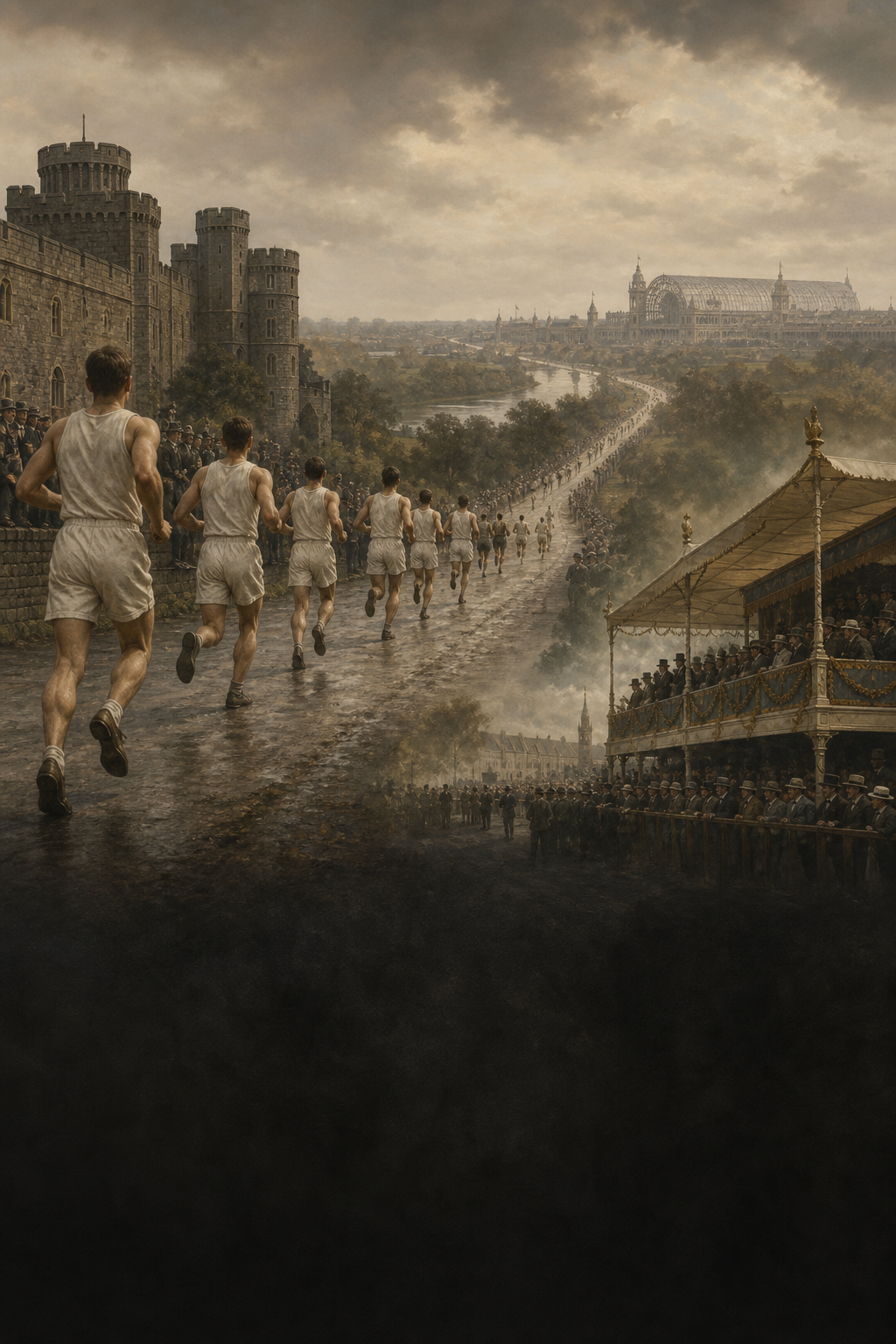
First, the British Royal Family requested that the race start on the lawn below the nursery window at Windsor Castle, so the royal children could watch the start from inside. That moved the starting line and added a little distance.
Second, race officials wanted the finish to land precisely in front of the Royal Box inside the White City stadium, so Queen Alexandra could have a clear view of the drama of the finish.
When surveyors measured the adjusted course from the new start to the finish line in front of the Royal Box, the total distance came to 26 miles and 385 yards. No one particularly intended that number. It was simply what the route measured out to.
!Runners departing Windsor Castle in 1908
The drama of Dorando Pietri
The 1908 race has become one of the most famous sporting events in history, and not because of the distance.
An Italian confectionery worker named Dorando Pietri entered the Olympic stadium in first place, well ahead of the field. But he was completely spent. He turned the wrong way on the track, collapsed, was helped upright by race officials, collapsed again, was helped up again. He went down five times in front of the stands before officials physically supported him across the finish line.
Pietri was disqualified for receiving outside assistance. The gold medal went to American Johnny Hayes, who crossed the line in a composed 2:55:18. But the disqualification did not diminish Pietri in the eyes of the crowd. Queen Alexandra, moved by what she witnessed, presented him with a gilded silver cup the following day as a personal gift. The image of the exhausted man refusing to stop became the defining image of what a marathon can ask of a human being.
That image, and the extraordinary 26-mile-and-385-yards course that produced it, burned the distance into the public imagination.
The standard is finally set
For the next decade, marathons continued to vary. Boston ran different distances across different years. The 1912 Stockholm Olympics used a 40.2-kilometer course. The 1920 Antwerp Olympics ran 42.75 kilometers. Nobody could agree on a number.
Finally, in 1921, the International Amateur Athletic Federation (IAAF) brought order to the chaos. They standardized the marathon at 42.195 kilometers, which converts to 26 miles and 385 yards. The choice honored the 1908 London course - the race that had generated the most attention, the most controversy, and the most public emotion of any marathon in the sport's short history.
The IAAF was essentially saying: if the world already thinks of that distance as what a marathon is, let's make it official.
Why 26.2 still matters
From a physiological standpoint, there is nothing magical about 26.2 miles. The point at which the body fully depletes its glycogen stores and hits the wall varies by runner, training, and race-day conditions - it is usually somewhere between mile 18 and mile 22, not a precise scientific marker.
But 26.2 has earned its difficulty through history. It is the distance that broke Dorando Pietri five times in a stadium. It is what Pheidippides is said to have covered between two worlds. It is what the Royal Family wanted to watch from a particular box on a London summer afternoon in 1908.
The next time you are grinding through those final 385 yards, you can blame a Greek soldier, a Victorian road surveyor, and Queen Alexandra's seating preferences.
!Modern marathon runners on a city course

Ready to run your own?
If the history of the marathon has inspired you to tackle the distance, start by finding the right race. Use our run planner to build a training schedule that fits your timeline, or check the race directory to find marathons near you. Whether you are aiming for a historic course like Boston or a local event in your city, the first step is setting a goal.
Find races: Browse marathons and running events in your area on Your Run Guide to find your next start line.