10 Flexibility Exercises Every Runner Should Be Doing (But Most Skip)
Tight hips, locked ankles, and a stiff thoracic spine don't just feel awful. They quietly erode your form and set the stage for injury. These 10 runner-specific stretches target exactly what the repetitive motion of running shortens over time.
· 8 min read · Training
Whether you are training for a local 5K or a marathon, running makes you fit. Running also makes you tight. That's the deal.
Every kilometre you log involves thousands of identical, single-plane repetitions: hip flexors shortening, calves loading, hamstrings pulling. Over weeks and months, those muscles adapt to the positions you put them in most often: contracted. The runner who logs 50K a week without any mobility work tends to look a certain way, often exhibiting a forward-tilted pelvis, limited hip extension, stiff ankles, arms crossing the midline on longer efforts.
None of that just feels bad. It actively slows you down and raises your injury risk.
The good news is that you don't need to become a yogi or spend an hour on the mat after every run. Ten to fifteen minutes of the right stretches, done consistently three or four times a week, can meaningfully change how you move. These ten exercises are chosen specifically for what running does to the body.
!Runner stretching dynamically on a track at golden hour

Why flexibility matters more than most runners think
Flexibility and mobility aren't the same thing, but both matter for running performance.
Flexibility is how much range of motion a muscle can achieve passively. Mobility is whether you can actively control movement through that range. A runner with flexible hamstrings but no hip extension strength isn't moving well, they are just bendy. The goal is both: enough passive range that your muscles aren't fighting each other mid-stride, combined with the strength to use that range under load.
Research from the British Journal of Sports Medicine points to restricted hip flexor length and limited ankle dorsiflexion as two of the biggest contributors to overuse injury in recreational runners. When the hip flexors can't fully extend, the pelvis tilts forward and the lumbar spine has to compensate. When the ankle can't dorsiflex properly, the knee collapses inward on landing. Both patterns increase stress on structures that eventually give out, such as the IT band, the knee, the plantar fascia.
Addressing those restrictions consistently is one of the highest-leverage things a runner can do outside of actual training.
1. Kneeling hip flexor lunge stretch
The hip flexors (primarily the psoas and iliacus) are chronically shortened in runners. They spend every stride in a shortened position, and if you also sit at a desk for eight hours a day, they're basically never getting a full stretch. This feeds into anterior pelvic tilt, which limits your stride length and stresses the lower back.
!Runner performing a kneeling hip flexor lunge stretch on a running track
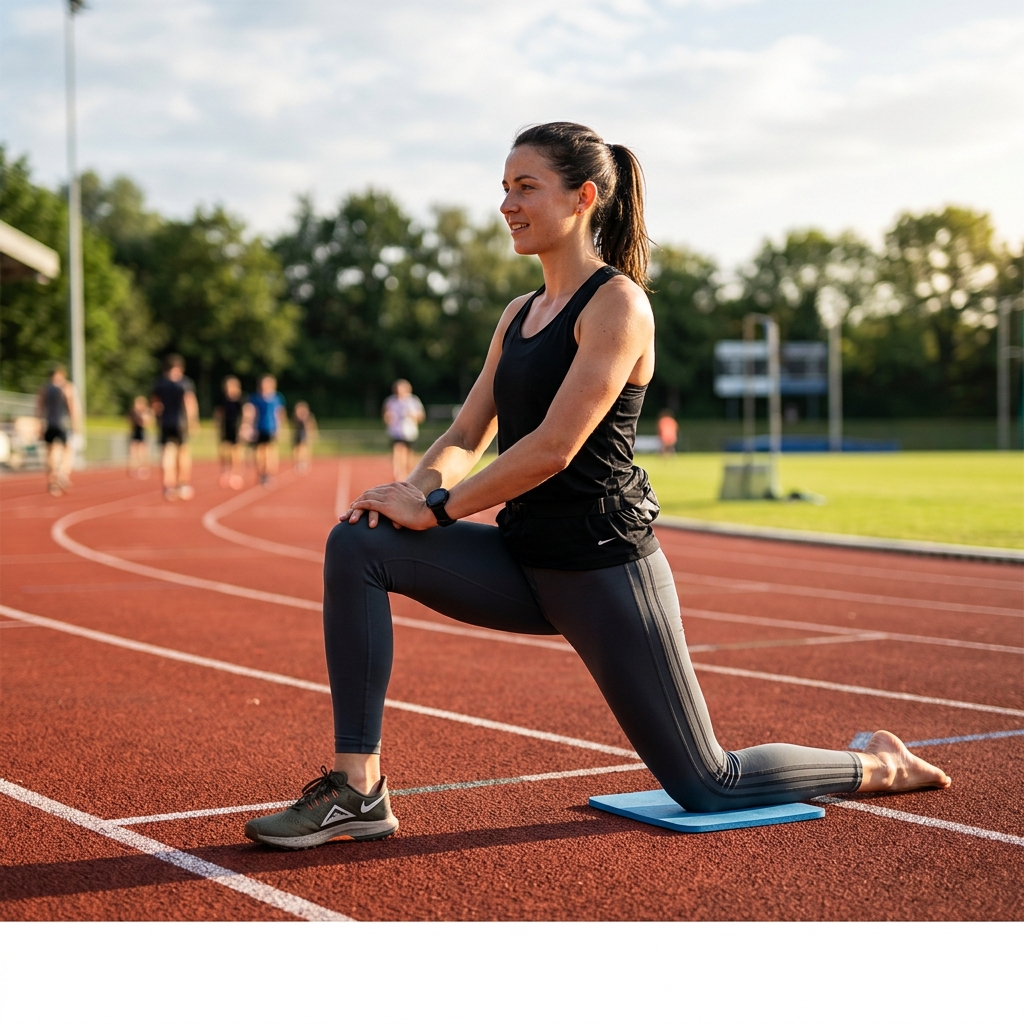
Start in a half-kneeling position with your right knee down and left foot forward. Keep your torso tall and squeeze your right glute gently. Shift your hips forward until you feel a stretch through the front of your right hip. Hold for 30-45 seconds, then switch sides.
To deepen it, raise the arm on the same side as the back knee and reach slightly away to elongate the psoas even further along its path from the lumbar spine to the femur.
Aim to hold this for 30-45 seconds on each side. Do this every day, not just before runs.
2. Pigeon pose for hip external rotation
Runners spend almost all of their time in hip flexion and extension. They almost never train hip external rotation. The piriformis and surrounding deep hip rotators get tight and overloaded, which often presents as vague glute pain, sciatic-like symptoms, or a dragging sensation on long runs.
!Runner performing pigeon pose on a yoga mat in a park
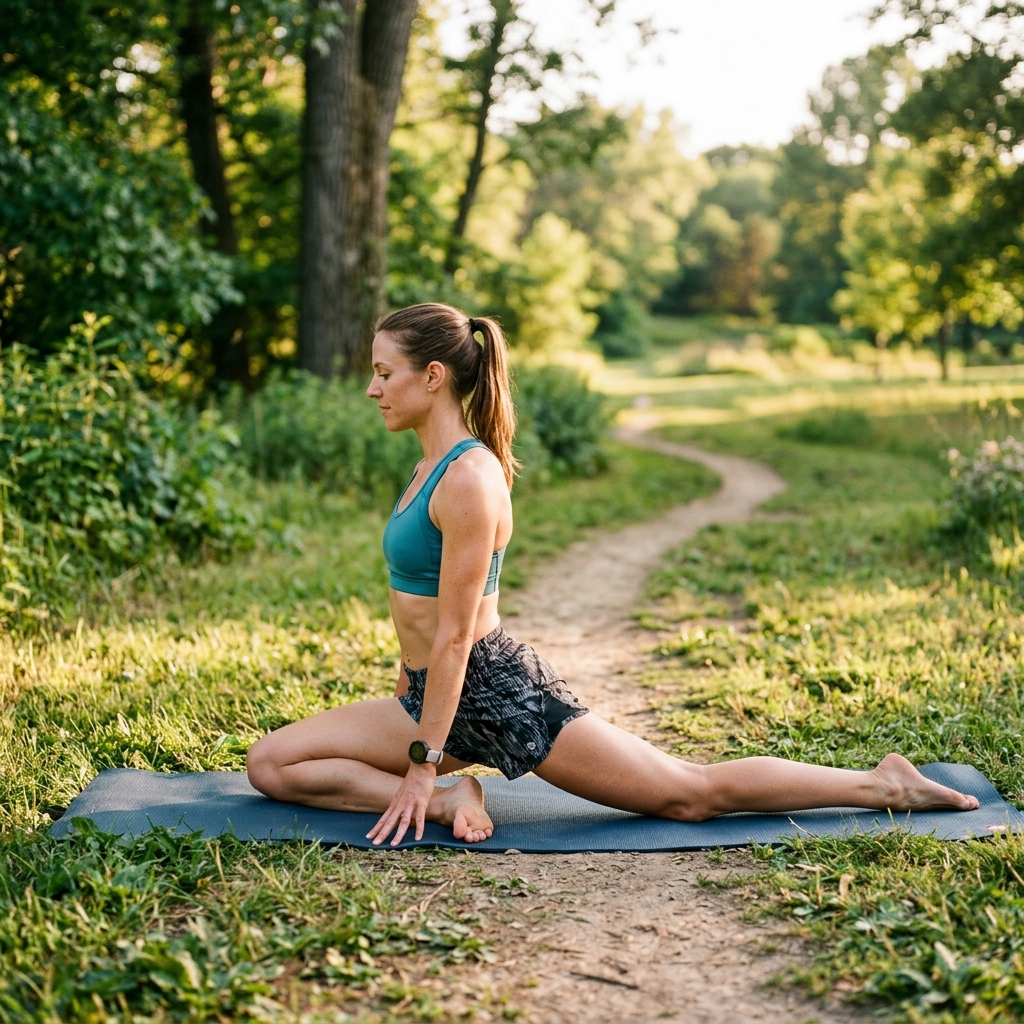
From a downward dog or tabletop position, bring one shin forward so it's roughly parallel to the front of your mat. The angle doesn't need to be perfectly square; work within your range. Extend the back leg straight behind you, then either stay upright or slowly walk your hands forward to lower your chest toward the ground.
The key is keeping the hips level. Avoid flopping to one side, which takes the load off the target area entirely.
You should maintain this position for 60-90 seconds each side. This is a longer hold because the deep hip rotators respond better to sustained rather than short stretches.
3. Standing calf and soleus stretch
Most runners know the standing gastrocnemius stretch: foot back, heel down, leg straight. Fewer do the soleus version, which is actually more important. The soleus sits under the gastrocnemius, attaches to the heel via the Achilles tendon, and takes the majority of the braking force on every foot strike at easy paces.
!Runner doing a standing calf stretch against a wall near a track

Stand facing a wall with both hands on it. Step one foot back. For the gastrocnemius, keep the back leg straight and press the heel flat - you'll feel it high up in the calf. For the soleus (the more important one for runners), bend the back knee slightly while still pressing the heel flat. You'll feel the stretch lower down, closer to the Achilles insertion.
If you've had plantar fasciitis or Achilles issues, the bent-knee version is the one to prioritise. A 2017 paper in the Journal of Orthopaedic and Sports Physical Therapy found that limited soleus flexibility was a significant predictor of Achilles tendinopathy in distance runners.
Spend 30-45 seconds in each position, on each side. For injury-prevention purposes, do both versions every day.
4. Supine hamstring stretch with strap
The seated toe-touch hamstring stretch you learned in PE class is fine. It's just not optimal for runners, because most people compensate by rounding their lower back and barely actually stretching the hamstrings. Using a resistance band or yoga strap with the other leg flat on the ground isolates the target muscle much more effectively.
!Runner performing a lying hamstring stretch with resistance band in a studio
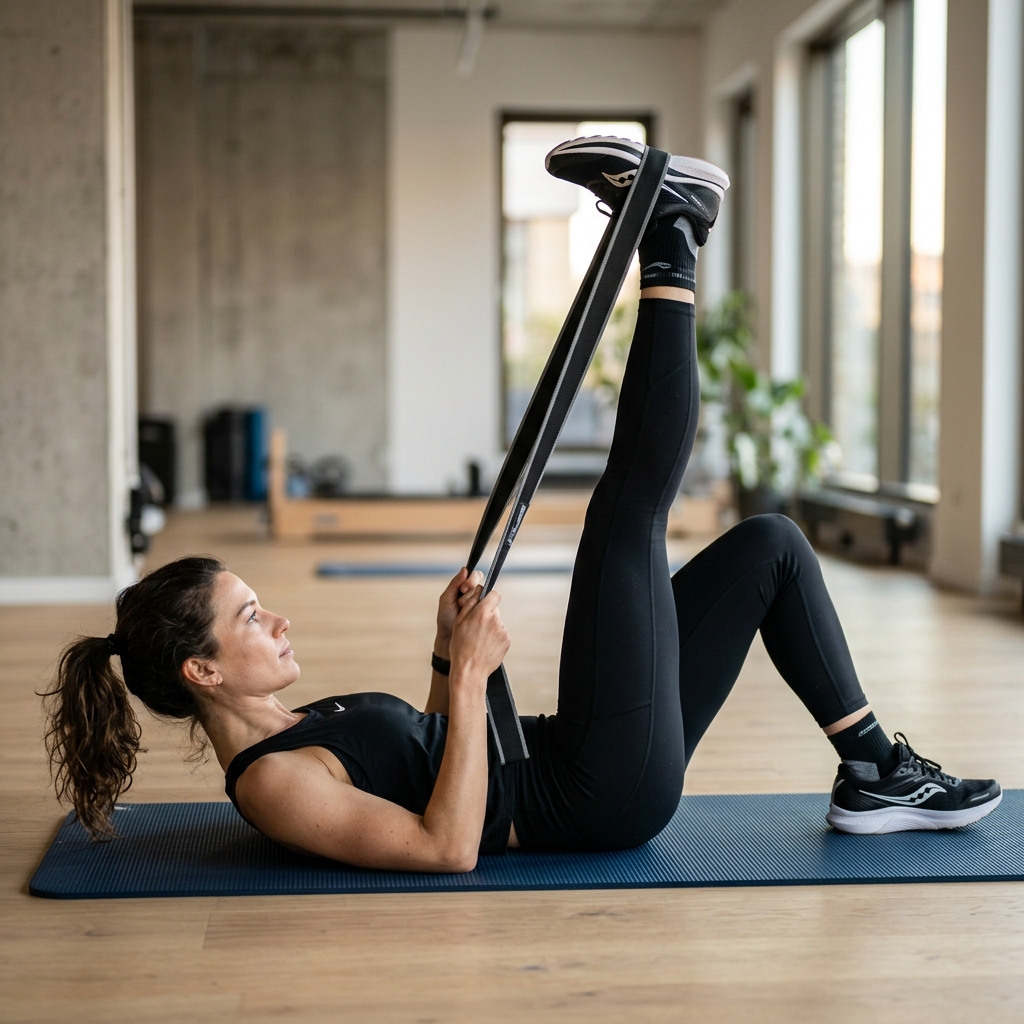
Lie flat on your back. Loop a strap or resistance band around the ball of one foot and extend that leg toward the ceiling. Keep the other leg flat on the floor. Gently pull the raised leg toward you until you feel a stretch through the hamstring, not behind the knee, which signals you're pulling too hard. Keep the knee softly bent rather than forcing it straight.
You can also add a gentle crossover at the end of the hold: pull the straight leg slightly across the midline to bias the stretch toward the outer hamstring and proximal IT band attachment.
Hold this stretch for 45-60 seconds on each side. Avoid pulling so hard that you feel it in the back of the knee.
5. The 90/90 hip stretch
This is one of the most versatile hip mobility exercises in existence, and it's specifically useful for runners because it works hip internal and external rotation simultaneously. This is the range of motion you need to maintain side-to-side stability during each footstrike.
!Runner sitting in the 90/90 hip stretch position in a gym
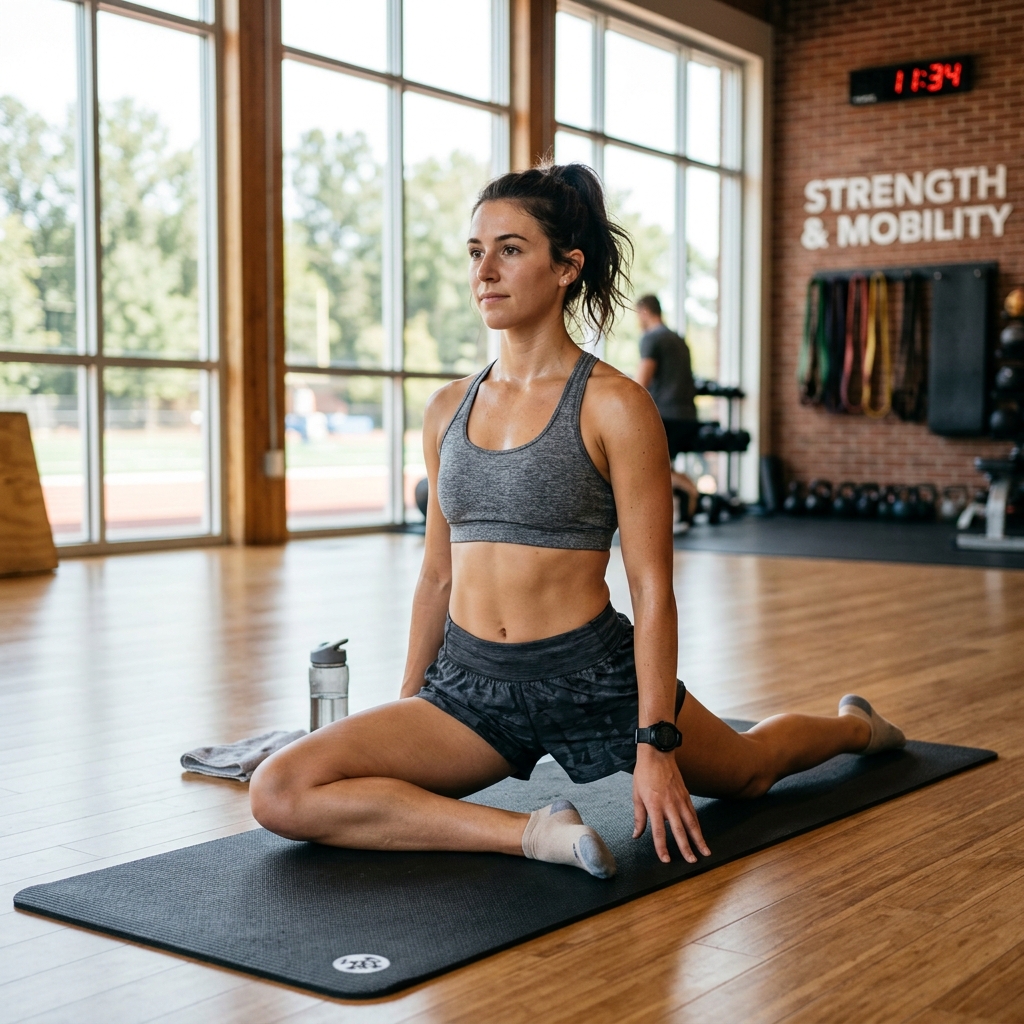
Sit on the floor with both knees bent to 90 degrees, one in front and one out to the side. Your front shin is roughly parallel to the wall in front of you, and your back shin runs parallel to your body. Sit tall with equal weight on both hips. Hold the position for 30-45 seconds, then lean slightly forward over the front shin to deepen the external rotation stretch. Switch and repeat on the other side.
For many runners, this reveals a significant difference between sides. Usually the dominant leg has more restricted internal rotation. Over time, working this stretch consistently can help address the hip mechanics that drive IT band syndrome and runner's knee.
Hold this position for 30-45 seconds in each direction. Progress by adding a gentle forward lean over the front leg.
6. Figure-4 piriformis and glute stretch
This is the lying-down alternative to pigeon pose. It's slightly less intense, easier to get into, and works very well as part of a post-run routine when you're on your back catching your breath anyway.
!Runner performing a figure-4 piriformis stretch lying on a yoga mat
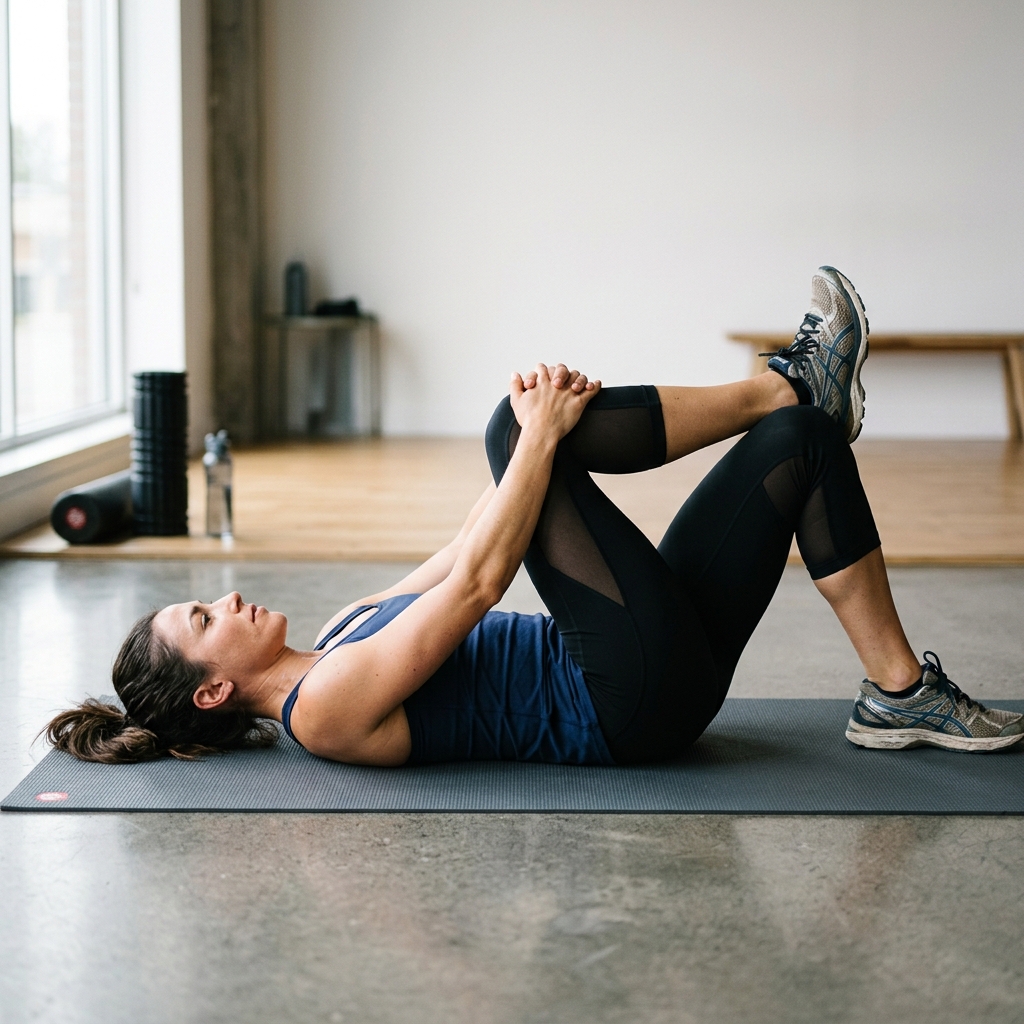
Lie on your back with both knees bent. Cross your right ankle over your left thigh, just above the knee. Flex the right foot to protect the knee joint. Either stay here if you feel enough of a stretch, or lift the left foot off the ground and pull the left thigh toward your chest. The right hand can thread through the gap between the legs to help pull the left thigh closer.
You should feel this in the right glute and deep external rotators. If you feel it in your knee instead, check that your foot is actually flexed, not pointed.
Hold this stretch for 45-60 seconds on each side. Works well paired with the 90/90 stretch.
7. Standing IT band cross-body stretch
The iliotibial band itself doesn't stretch because it's a dense connective tissue structure. But the tensor fasciae latae (TFL) muscle that feeds into it does, and the lateral hip structures around it can release with sustained stretching. Runners dealing with IT band syndrome often find this stretch gives real short-term relief alongside the hip strengthening work that addresses the root cause.
!Runner performing a standing IT band side stretch on a track

Stand upright and cross your right foot behind your left. Keep both feet flat. Lean your upper body to the left while raising your right arm overhead and reaching to the left. You'll feel a stretch running down the outer right hip and thigh. To increase the intensity, push your right hip further out to the side.
Don't hold this one statically for too long. The IT band area responds better to repeated short holds than one long sustained stretch. Aim for 20-30 seconds, release, and repeat two or three times.
Perform 2-3 repetitions on each side, holding each for 20-30 seconds. Repeat throughout the day if you're managing active IT band issues.
8. Thoracic rotation stretch
Runners rarely think about upper body mobility, but thoracic stiffness has a real downstream effect on running form. When the mid-back can't rotate properly, the hips and lower back compensate, and that's where overuse injuries accumulate. This is also one of the main reasons runners develop that hunched, arms-crossing-the-midline pattern in the later stages of a long race: a stiff thoracic spine that limits arm swing.
!Runner performing a thoracic spine rotation stretch on a yoga mat in a studio
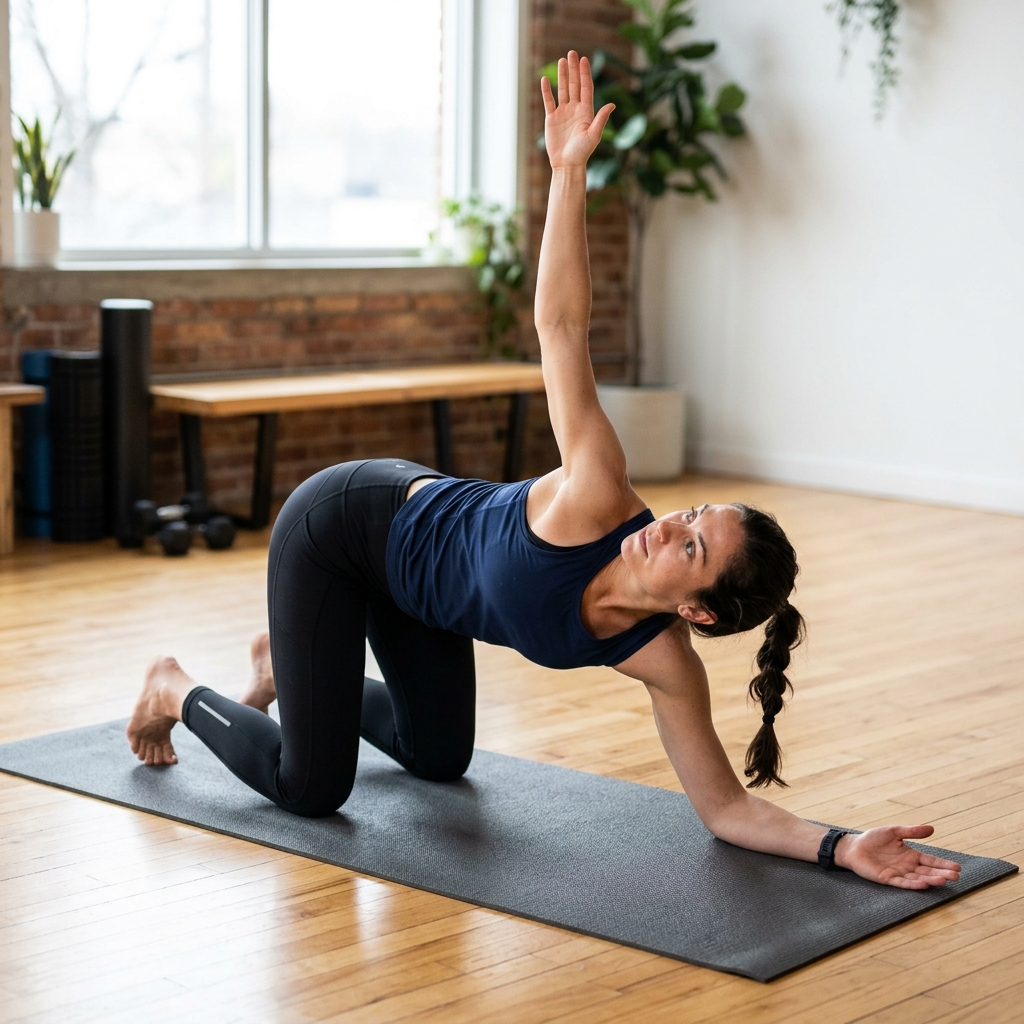
Get into a tabletop position on all fours. Place one hand behind your head. Rotate your elbow toward the opposite knee to start, then reverse and open it up toward the ceiling, following with your gaze. The movement should come from the mid-back, not the lower back. Keep your lower back stable throughout.
Aim for 8-10 repetitions per side as a controlled movement rather than a static hold. This works better as a dynamic drill than a passive stretch.
Complete 8-10 slow, controlled rotations on each side. Works well as a warm-up drill before faster running.
9. Wall ankle dorsiflexion mobilisation
Limited ankle dorsiflexion (how much your ankle can flex upward, bringing your shin forward over your foot) is directly linked to injury patterns in runners. When the ankle can't dorsiflex adequately, the foot overpronates on landing and the knee collapses inward to compensate. The research on this is pretty solid: a study in the Journal of Science and Medicine in Sport found runners with restricted dorsiflexion had significantly higher rates of patellofemoral pain and plantar fasciitis.
!Runner performing a wall ankle dorsiflexion stretch near a track
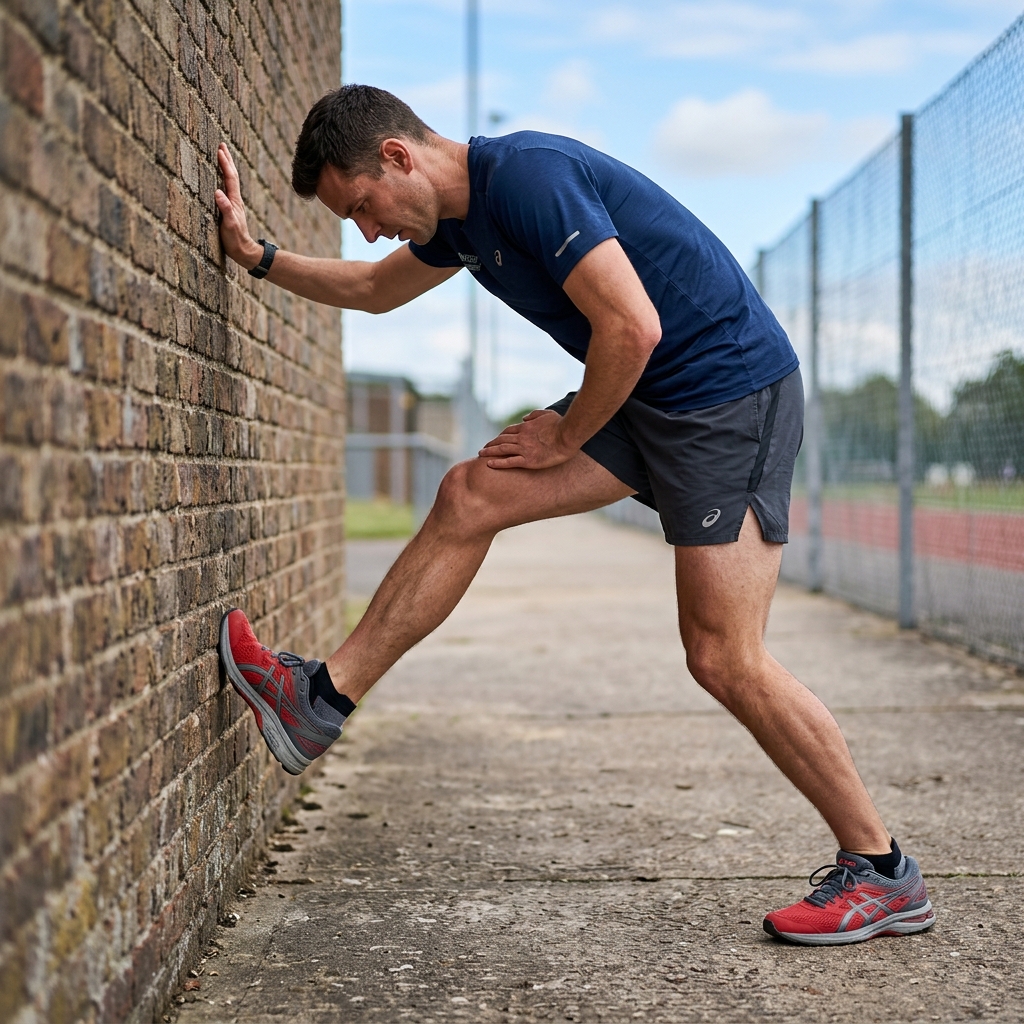
Stand facing a wall with one foot about 5 cm from the base. Drive your knee forward over your toes toward the wall, keeping your heel flat on the ground. If your knee touches the wall without your heel lifting, move your foot back a centimetre or two and repeat. The goal is to find the maximum distance at which your heel stays down while your knee touches the wall.
This is also a useful self-assessment test. Most runners should be able to achieve this with their foot 10-15 cm from the wall. If you're heel-lifting at 5 cm, that's restricted dorsiflexion worth addressing.
Aim for 10-15 slow repetitions on each ankle, holding the end range for 2-3 seconds. Do this before runs rather than after.
10. Standing quad stretch
The quads are the most-used muscle group in running and get far less stretching attention than the hamstrings. The rectus femoris in particular crosses both the hip and the knee, so when it's tight, it limits hip extension on push-off and increases anterior pelvic tilt. Both hurt your running economy.
!Runner performing a standing quad stretch on a running track

Stand on one leg and pull the opposite ankle toward your glute, keeping your knee pointing straight down (not flaring out to the side). Stand tall, squeeze the glute of the standing leg for balance, and keep your pelvis neutral and avoid letting it tip forward, which defeats the purpose.
If balance is an issue, hold a wall or lamp post. The key alignment cue is that the knee of the stretching leg should point straight down, not out to the side, and the hips should stay square and level.
Hold time: 30-45 seconds each side. Pay attention to whether one side is tighter than the other, as quad asymmetry is common and worth tracking.
How to put this into a routine
You don't need to do all ten exercises every day. Here's a practical structure:
- Before a run (5-8 minutes): Ankle dorsiflexion mobilisation + thoracic rotations. Both are dynamic and prepare the joints you'll load most.
- After a run or as a standalone session (10-15 minutes): Hip flexor lunge, pigeon pose, 90/90, figure-4, hamstring strap stretch. These are the sustained holds that improve passive range over time.
- IT band and calf work: Do the calf stretch and IT band stretch daily if you're carrying any tenderness in those areas, not just as part of a post-run routine.
The biggest mistake runners make with flexibility work is doing it inconsistently. A 20-minute session once a week is far less effective than 10 minutes three times a week. Connective tissue and muscle adapt to sustained, repeated loading, not occasional deep sessions.
If you're building flexibility work into a structured training program, our Race Predictor can help set a baseline, and a personalised running plan can help you schedule recovery and mobility sessions around your key run days so they complement rather than compete with your training load. If you're managing a specific injury like IT band syndrome or plantar fasciitis, look at working with a running coach who can assess your movement patterns and prioritise the exercises that will make the biggest difference for your specific mechanics.
The return on ten minutes a day is significant. Your future long-run self will notice.