Ed Whitlock's 2:54 Marathon at Age 73: The Training Secrets of an Aerobic Legend
How a retired mining engineer broke 3 hours in the marathon at age 73 by jogging slow circles in a local cemetery for three hours a day.
· 7 min read · Training
Breaking three hours in the marathon is an elite milestone for recreational runners in their twenties and thirties. Fewer than four percent of all marathon finishers worldwide ever cross the line in under 2:59:59.
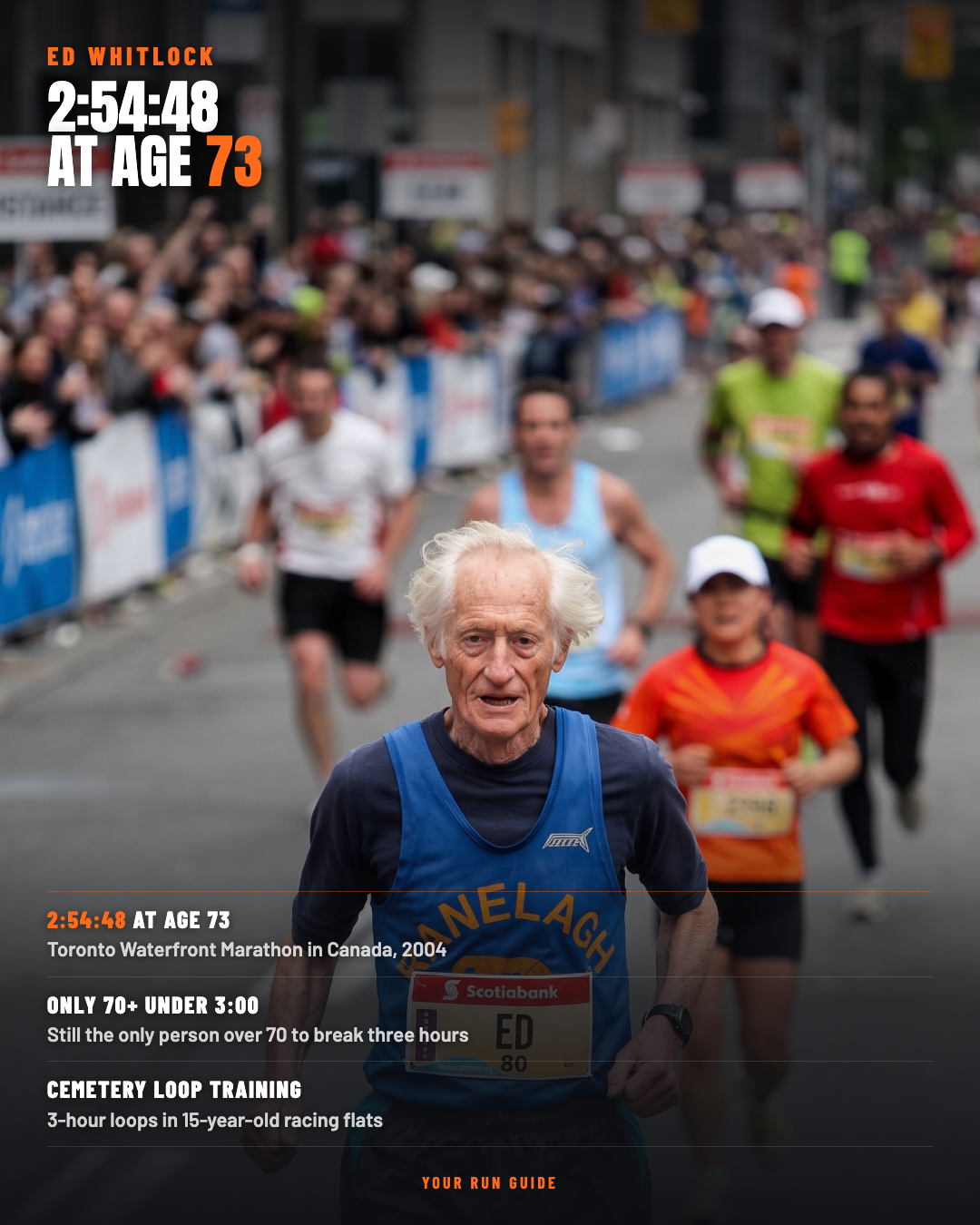
On September 26, 2004, at the Scotiabank Toronto Waterfront Marathon, an unassuming 73-year-old English-born Canadian named Ed Whitlock stepped up to the start line wearing a fifteen-year-old singlet and a pair of worn racing flats he had bought on sale a decade earlier.
He ran 2:54:48.
To this day, Whitlock remains the only human over the age of 70 to run a sub-three-hour marathon. At age 80, he ran 3:15:54. At age 85, he clocked 3:56:33. When age-graded, Whitlock's performances are statistically superior to many open world records, scoring above 95 to 100 percent in age-grading tables.
How did a retired mining engineer from Milton, Ontario, redefine the biological boundaries of human aging?
!Ed Whitlock running a 2:54 marathon at age 73
The Cemetery Loops: Three Hours Every Single Day
Modern coaching manuals preach periodization, tempo intervals, lactate threshold testing, VO2max track workouts, heart rate zones, and dynamic foam rolling.
Whitlock did none of that.
He lived next to Evergreen Cemetery in Milton, Ontario. Every morning, he would lace up his shoes, walk across the road, and shuffle around the cemetery's paved pathways in loops measuring barely 800 metres.
- Volume: Two to three hours of continuous running every day (roughly 15 to 20 miles daily).
- Pace: Embarrassingly slow. While his race pace at age 73 was roughly 4:08 per kilometre (6:39/mile), his daily cemetery shuffle was around 5:30 to 6:00 per kilometre (8:50 to 9:40/mile).
- Speedwork: Zero. No track workouts, no fartleks, no tempo runs.
- Gym work: Zero. No weights, no stretching, no core planks.
- Gear: Outdated shoes, no GPS watch, no heart rate monitor. He simply timed his runs with a cheap digital wristwatch.
When asked why he chose the cemetery, his answer was practical: it was close to home, sheltered from wind by evergreen trees, cleared of snow in winter, and had no traffic. If he felt a niggle, he was never more than a few hundred metres from his front door.
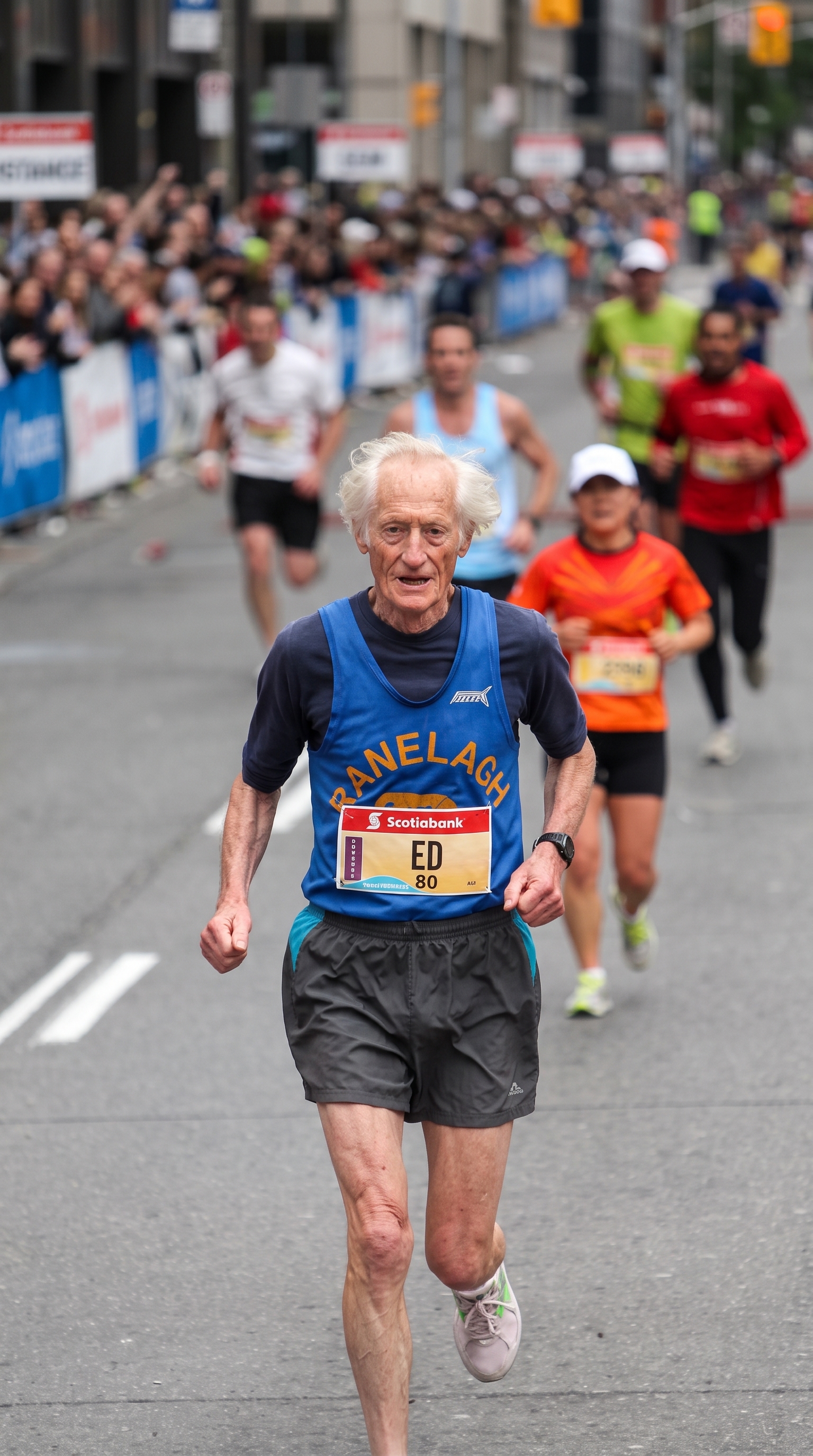
!Ed Whitlock, the pioneer of masters endurance running
The Physiology of Whitlock's Masterclass
Exercise physiologists who studied Whitlock later in life found startling insights into why his simple, monotonous routine was so effective for aging runners:
1. Massive Mitochondrial Density from Pure Zone 2 By running for three hours at a relaxed aerobic effort, Whitlock maintained exceptionally high mitochondrial volume in his slow-twitch muscle fibres. Aging typically causes a natural decline in capillary density and mitochondrial efficiency. Whitlock's prolonged low-intensity volume effectively arrested that decline.
2. Elimination of High-Intensity Injury Triggers As tendons, ligaments, and cartilage age, they lose water content and collagen elasticity. High-intensity track speedwork (such as 400m sprints or hard 5K repeats) produces high peak impact loads that frequently tear calves, hamstrings, and Achilles tendons in runners over 50. By eliminating all fast running in training, Whitlock stayed virtually injury-free for decades.
3. Neuromuscular Efficiency Through Monotony Running the exact same gentle loops day after day trained Whitlock's central nervous system into maximum biomechanical economy. He had virtually zero wasted vertical bounce. His feet stayed low to the pavement, gliding forward with minimal braking force.
4 Core Lessons for Runners Over 40 and 50
You do not need to spend three hours a day circling a cemetery to benefit from Whitlock's principles. If you are training in your masters years, adopt these structural shifts:
Slow Down Your Base Miles The most common mistake masters runners make is running their easy runs too fast. If your marathon goal pace is 5:00/km, running your mid-week miles at 5:20/km does not build more aerobic fitness; it merely accumulates fatigue that your recovering joints cannot repair. Slow your recovery pace down by 60 to 90 seconds per kilometre.
Prioritize Consistency Over Intensity Missing three weeks due to an Achilles flare-up from track intervals does far more damage to your marathon fitness than skipping the intervals altogether. Consistent, uninterrupted aerobic volume across 16 weeks will always produce a faster marathon than sporadic weeks interrupted by calf strains.
Listen to Local Signals Whitlock ran small loops so he could stop the moment a tendon complained. Never push through sharp, localized pain during a workout. If an ankle or knee feels off, cut the run short and rest.
Benchmark by Age-Graded Scores Do not compare your finishing time at age 52 to your personal best from college. Use age-grading calculators to measure your true physiological performance against global benchmarks. A 3:15 marathon at age 55 is often physiologically superior to a 2:55 marathon at age 25.
To structure a safe, durable schedule tailored to your age, explore our masters running plan for over 50 and evaluate your race fitness with our age-grading calculator.
Find races: Browse road marathons and masters-friendly races on Your Run Guide to find fast, flat courses for your next age-group qualifier.