The Eccentric Heel Drop: The Most Important Exercise You Aren't Doing
A breakdown of Achilles tendinopathy and the exact step-by-step protocol to bulletproof your lower legs.
· 5 min read · Injury Prevention
Achilles tendinopathy is one of the most frustrating injuries in running. It starts as a mild stiffness when you step out of bed in the morning, which quickly fades during a run. So, naturally, you ignore it.
Weeks later, the stiffness graduates to a sharp, burning ache that forces you to limp for the first two miles. Finally, it refuses to warm up at all, locking up your training block completely.
Runners immediately reach for the foam roller and massage guns. But stretching a damaged, irritated tendon is like pulling hard on a frayed rope. The clinical answer to Achilles pain isn't resting or rubbing - it’s loading.
Why Rest Ruins Tendons
!Achilles Tendon Anatomy and Pain
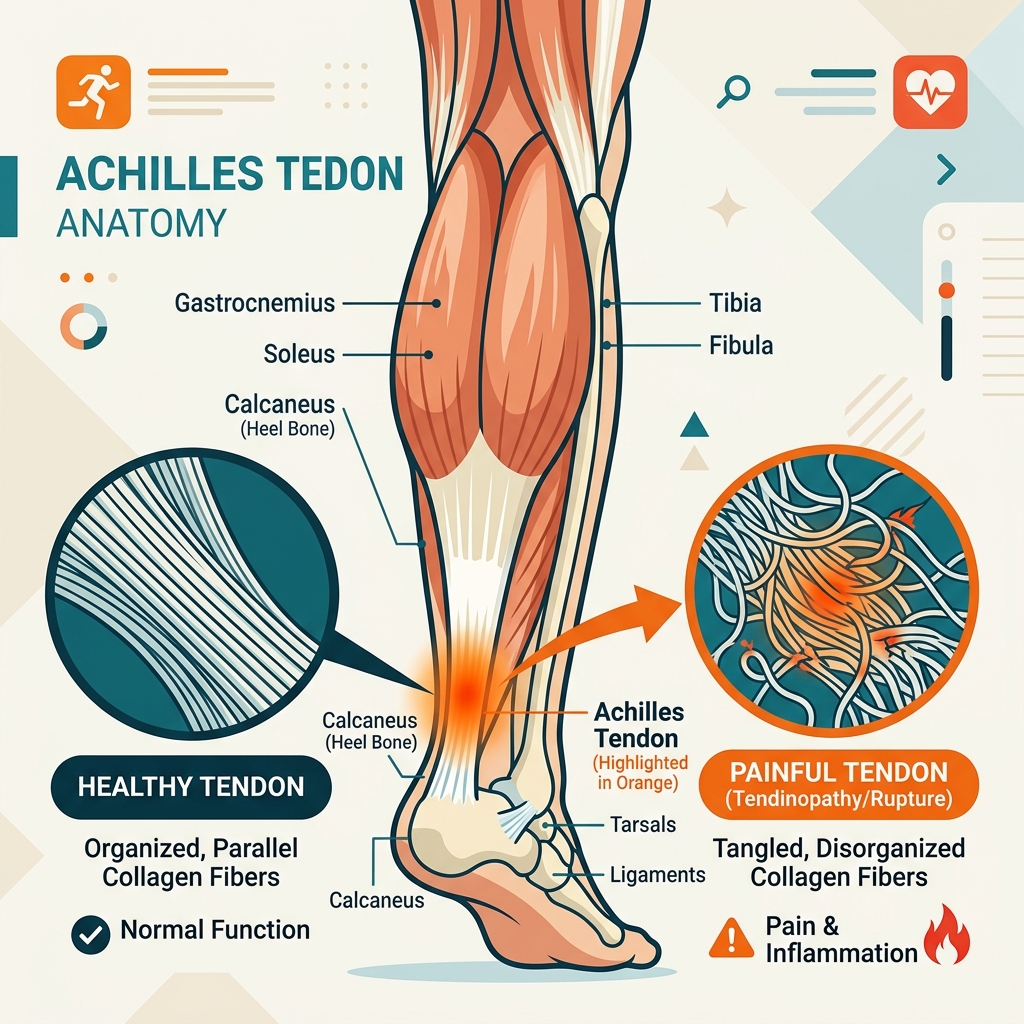
Tendons do not have the same rich blood supply as muscles. When you tear a hamstring, rest and blood flow will eventually heal the tissue. When an Achilles tendon is damaged, the collagen fibers resemble a plate of tangled spaghetti rather than a tightly bound steel cable.
Complete rest causes those fibers to heal weak and chaotic. The moment you sprint again, they immediately flare up.
To heal a tendon, you have to load it under tension to force the collagen fibers to realign correctly. Enter: the eccentric heel drop.
The Alfredson Protocol
In the late 1990s, the Alfredson Protocol became the gold standard for treating Achilles issues. The core mechanism is focusing aggressively on the "eccentric" phase of the movement - which means loading the tendon structure heavily as the muscle gets longer.
!Eccentric Heel Drop Step-by-Step Protocol
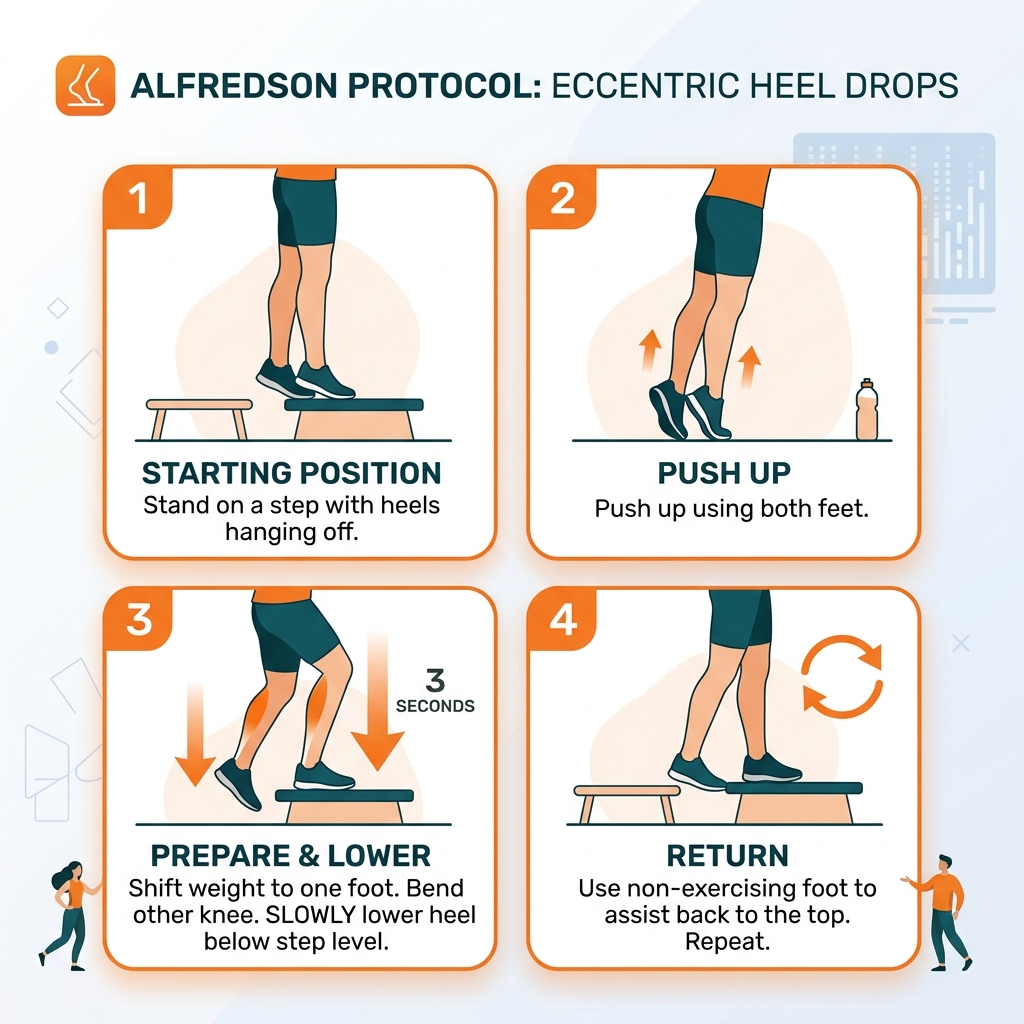
Key Execution Details: - Do not push up with the injured leg. The entire point is to only load the injured tendon on the *downward* phase. Use your healthy leg to press yourself back to the top starting position. - Straight vs. Bent Knee: The calf complex is primarily made of two muscles. Do half of your daily reps with a straight leg to target the larger, higher *gastrocnemius* muscle, and half with a slightly bent knee to shift the load completely onto the deeper, lower *soleus* muscle. Both must be strong to protect the Achilles. - The Protocol is Brutal: The official clinical protocol requires 3 sets of 15 repetitions, twice a day, every single day for 12 weeks. That is massive volume, but it fundamentally restructures the tendon.
Embracing the Discomfort
The eccentric heel drop isn't meant to be painless. A dull, manageable ache during the exercise is not only acceptable - it's expected. You are actively remodeling tissue.
As the body weight drops become painless, you don’t stop doing the routine. You stick a heavy dumbell or a weighted backpack on and keep progressing the load.
Bulletproof calves aren't built on the foam roller. They are built on the stairs.