Adaejah Hodge Runs 10.63: The 5th Fastest Woman in 100m History Is 19 Years Old and a College Freshman
At the 2026 NCAA Outdoor Championships prelims, Georgia's Adaejah Hodge ran 10.63 (+1.9) - shattering Sha'Carri Richardson's collegiate record by 0.12 seconds and entering the all-time top 5 in the women's 100m. Here's what happened and why this run is genuinely historic.
· 6 min read · Athletics News
A 19-year-old college freshman just ran one of the fastest 100-metre dashes in history - and she did it in a preliminary round.
On June 11, 2026, at Hayward Field in Eugene, Oregon, Adaejah Hodge of the University of Georgia blew out of the blocks in her opening heat at the NCAA Outdoor Track and Field Championships and ran 10.63 seconds. Wind reading: +1.9 m/s - well within the legal limit of +2.0. The time is ratified. It counts.
That time makes her the 5th fastest woman to ever run 100 metres.
She is a redshirt freshman. She won't turn 20 until May 2027. And she just smashed a collegiate record that had stood since 2019.
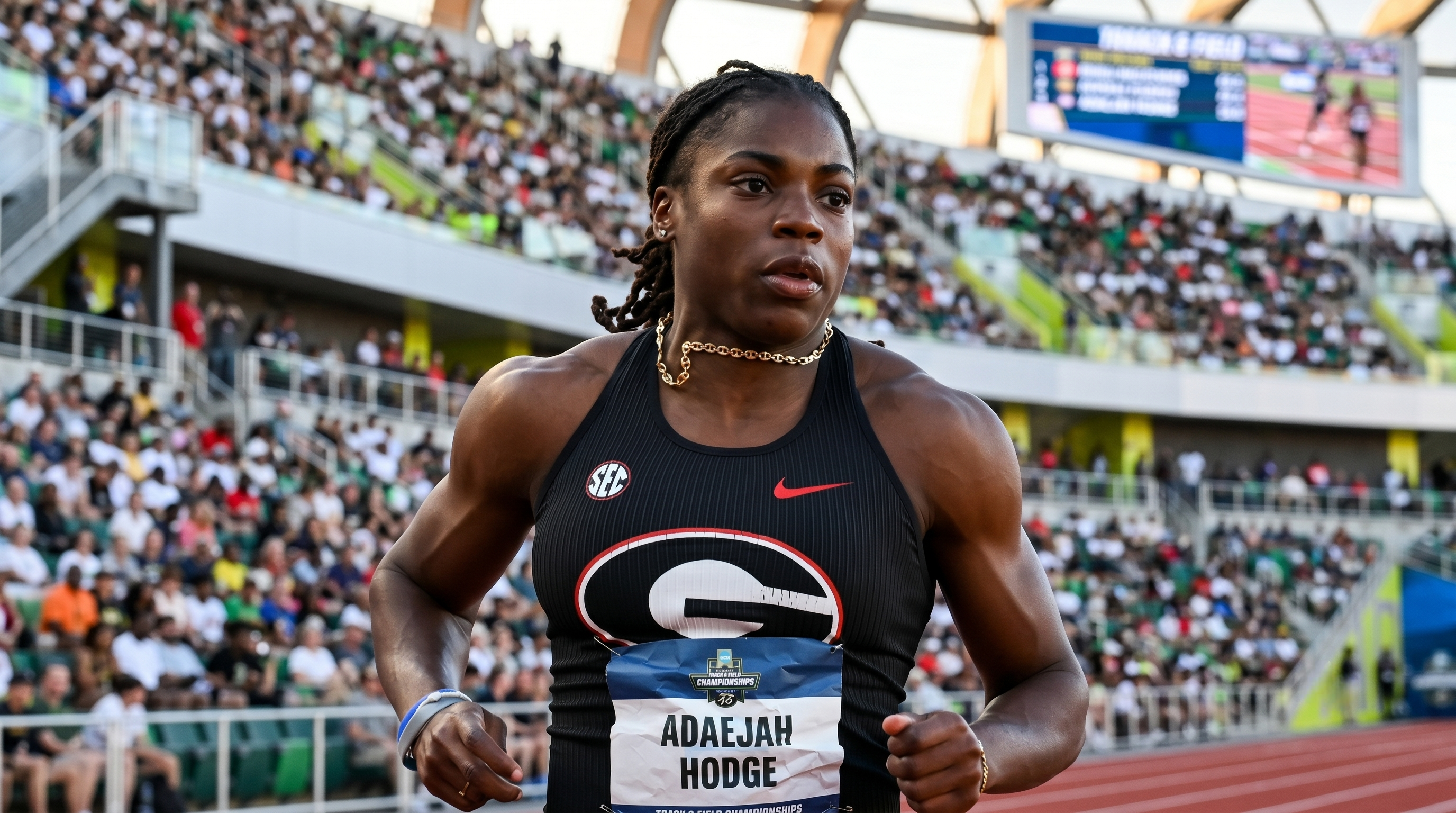
!Adaejah Hodge at the 2026 NCAA Outdoor Championships
What happened at Hayward Field
Hodge drew the opening heat of the women's 100m semifinals. She crossed the finish line in 10.63 seconds - 0.12 seconds faster than Sha'Carri Richardson's previous NCAA collegiate record of 10.75, which Richardson set at the same championship in 2019.
For context: 0.12 seconds doesn't sound like much, but in a 100-metre sprint, that's an enormous gap. At elite level, the difference between first and eighth in a World Championship final is often less than 0.15 seconds.
The run also set a new Under-20 world record and a new meet record at the NCAA Championships.
Where 10.63 sits on the all-time list
Here's the all-time women's 100m performers list, with Hodge now sitting fifth:
| Rank | Time | Athlete | Country | Year | |------|------|---------|---------|------| | 1 | 10.49 | Florence Griffith-Joyner | USA | 1988 | | 2 | 10.54 | Elaine Thompson-Herah | JAM | 2021 | | 3 | 10.60 | Shelly-Ann Fraser-Pryce | JAM | 2021 | | 4 | 10.61 | Melissa Jefferson-Wooden | USA | 2025 | | 5 | 10.63 | Adaejah Hodge | BVI | 2026 |
To understand the weight of this: Florence Griffith-Joyner's world record has stood since 1988. In 38 years, only four women had run faster than 10.63 before Thursday night. Hodge is now one of them.
She also sits ahead of Carmelita Jeter (10.64), Sha'Carri Richardson (10.65), and Shericka Jackson (10.65) on the all-time list. Those are not obscure names. Those are three of the most decorated sprinters of the last 15 years.
Who is Adaejah Hodge?
Born on May 13, 2006 in Tortola, British Virgin Islands, Hodge grew up in Douglasville, Georgia and attended Montverde Academy in Florida - a school known for developing elite young athletes. By the time she arrived at university, she had already represented the British Virgin Islands at the 2023 World Athletics Championships and served as the BVI flag bearer at the 2024 Paris Olympics, where she reached the 200m semifinals at just 18 years old.
She represents the British Virgin Islands internationally, which means this 10.63 doesn't count as an American record. But it counts for everything else.
Her 2026 college season has been remarkable from the start. She won the 200m at the 2026 NCAA Indoor Championships and the 2026 SEC Indoor Championships. She was named the SEC Women's Freshman Runner of the Year. Then she ran 10.77 at the Tom Jones Memorial earlier this season - a new BVI national record at the time. Then on Thursday she dropped to 10.63 in a prelim.
The progression is almost unsettling.
The doping suspension context
This performance comes with some necessary context. Hodge served a doping ban from August 2024 to January 2026 after testing positive for GW501516 - a banned substance - at the 2023 World Athletics U20 Championships. Her results from that championship were disqualified.
She received a reduced sanction for cooperating with anti-doping authorities, and her ban was served in full before the start of the 2026 collegiate season.
She's been competing cleanly and legally since January 2026. Everything she's done this season is above board, verified, and ratified. Including the 10.63.
That history doesn't diminish Thursday's run. It does make her story considerably more complicated than a straightforward feel-good headline. Sports fans and governing bodies have every right to factor that context in. But the time on the clock is real.
The final is still to come
As of writing, the NCAA 100m final is scheduled for Saturday, June 13. Hodge qualified top of the semis by a significant margin.
She ran 10.63 to get into the final. What she does in the actual race - fresher legs, a full crowd, a direct competition - is still an open question.
The world record of 10.49 (Flo-Jo, 1988) has been questioned for decades over disputed wind measurement data from the 1988 U.S. Olympic Trials, though it remains fully ratified. Hodge is now 0.14 seconds off it. She's 19. She has likely years of improvement ahead.
The current legitimate world record holder (excluding Flo-Jo if you apply strict scrutiny) would be Elaine Thompson-Herah's 10.54 from Eugene in 2021 - also run at Hayward Field. Hodge is now 0.09 seconds off that mark.
These aren't abstract numbers. She ran them in a prelim.
What this means for the women's sprint event
Women's sprinting has been through a complicated few years. Sha'Carri Richardson returned from her own suspension to become world champion. Shericka Jackson went sub-10.65 and took the 200m world record. Julien Alfred of Saint Lucia won Olympic gold in Paris. The event has had extraordinary depth.
What Hodge adds to that landscape is something rare: a genuine prodigy still in the earliest stage of her senior career, already capable of performances that only four humans have ever matched.
The next three or four years of women's sprinting just got more interesting.
Why this matters for everyday runners
You're almost certainly not going to run 10.63 in the 100m. Neither am I. But what Hodge's trajectory illustrates is a principle that applies to anyone training for any event: some people improve on a different timeline than expected.
Most training plans assume linear, predictable progress. Most of the time, that's roughly how it works. But occasionally an athlete - at any level - hits a phase where everything clicks. Their mechanics are right, their fitness is peaking, and the performance shoots past whatever was expected.
For recreational runners, that might look like a 5K PB that comes out of nowhere mid-training block, or a half marathon finish time that surprised even your coach. The underlying process is the same: you did the work, the adaptation came, the timing was right.
The lesson isn't to expect miracles. It's to keep showing up consistently, because you genuinely can't predict when your breakthrough performance arrives.
Find races: Browse running events and races worldwide on Your Run Guide, from track nights to road races, or generate your own training plan to start building toward your own breakthrough.