400m World Record: Men's and Women's Fastest Times
Current 400m world records, Michael Johnson to Wayde van Niekerk, and why 43.03 from Rio 2016 remains one of athletics' most enduring marks.
· 8 min read · Rankings & Data
On 14 August 2016, Wayde van Niekerk ran the 400m from lane eight at the Rio Olympics and crossed the line in 43.03 seconds - the fastest 400m world record in history, breaking Michael Johnson's 43.18 from 1999.
Running from the outside lane is usually a disadvantage. Van Niekerk turned it into one of the most iconic performances in Olympic sprinting.
Current 400m world records
| Category | Time | Athlete | Date | Location | | --- | --- | --- | --- | --- | | Men (outdoor) | 43.03 | Wayde van Niekerk | 14 Aug 2016 | Rio de Janeiro | | Women (outdoor) | 47.60 | Marita Koch | 6 Oct 1985 | Canberra | | Men (indoor) | 44.57 | Kerron Clement | 12 Mar 2005 | Fayetteville | | Women (indoor) | 49.17 | Femke Bol | 11 Mar 2024 | Apeldoorn |
Men's 400m world record progression
| Year | Time | Athlete | Country | | --- | --- | --- | --- | | 1968 | 43.86 | Lee Evans | USA | | 1988 | 43.29 | Butch Reynolds | USA | | 1999 | 43.18 | Michael Johnson | USA | | 2016 | 43.03 | Wayde van Niekerk | RSA |
Lee Evans' 43.86 from the 1968 Mexico City Olympics stood for twenty years until Butch Reynolds ran 43.29 in Zurich in 1988. Michael Johnson's 43.18 from Seville in 1999 looked untouchable for seventeen years. Van Niekerk's Rio run took 0.15 seconds off that mark - a significant margin at this distance.
Since 2016, several athletes have run under 44 seconds, including Matthew Hudson-Smith's 43.44 in 2024. Nobody has yet reached 43.03.
Women's 400m record
Marita Koch's 47.60 from the 1985 World Cup in Canberra remains the ratified world record. Sydney McLaughlin-Levrone has dominated the 400m hurdles in recent years and has also run 47.78 flat in 2024 - the fastest time by any woman since Koch's era.
The women's flat 400m is one of the longest-standing records in track and field, similar in longevity to Florence Griffith-Joyner's 200m mark.
Why the 400m is uniquely brutal
The event sits at the intersection of speed and endurance:
- First 100m: near-sprint acceleration out of blocks
- Back straight: holding form while lactate builds
- Final bend and home straight: pure pain management
Van Niekerk's 43.03 averages 10.76 seconds per 100m - a pace most trained sprinters cannot hold for a single straight, let alone a full lap.
For comparison, the 200m world record is 19.19. Doubling that would be 38.38 - the 400m requires slowing substantially to finish.
From elite 400m to your training
Recreational runners rarely race 400m, but the event illustrates why speed endurance matters for 5K racing. Short, hard repeats with full recovery - 200m to 400m efforts - improve your ability to respond to surges in road races.
A 5K training plan with occasional strides builds this capacity without requiring a track. For sprint history, see fastest man in the world: 100m.
Watch the top 10 all-time ranking:

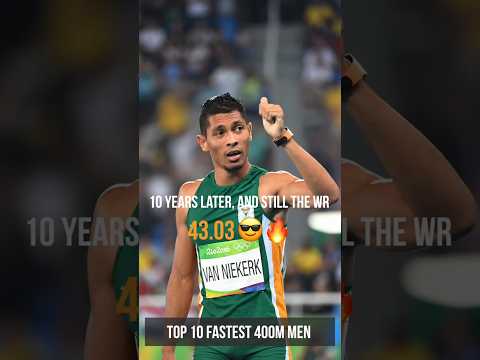
*Subscribe to Your Run Guide on YouTube for more sprint rankings, running stats, and athletics history videos.*
Find races: Browse 5K races worldwide or search by city such as Cape Town, van Niekerk's home country hub.